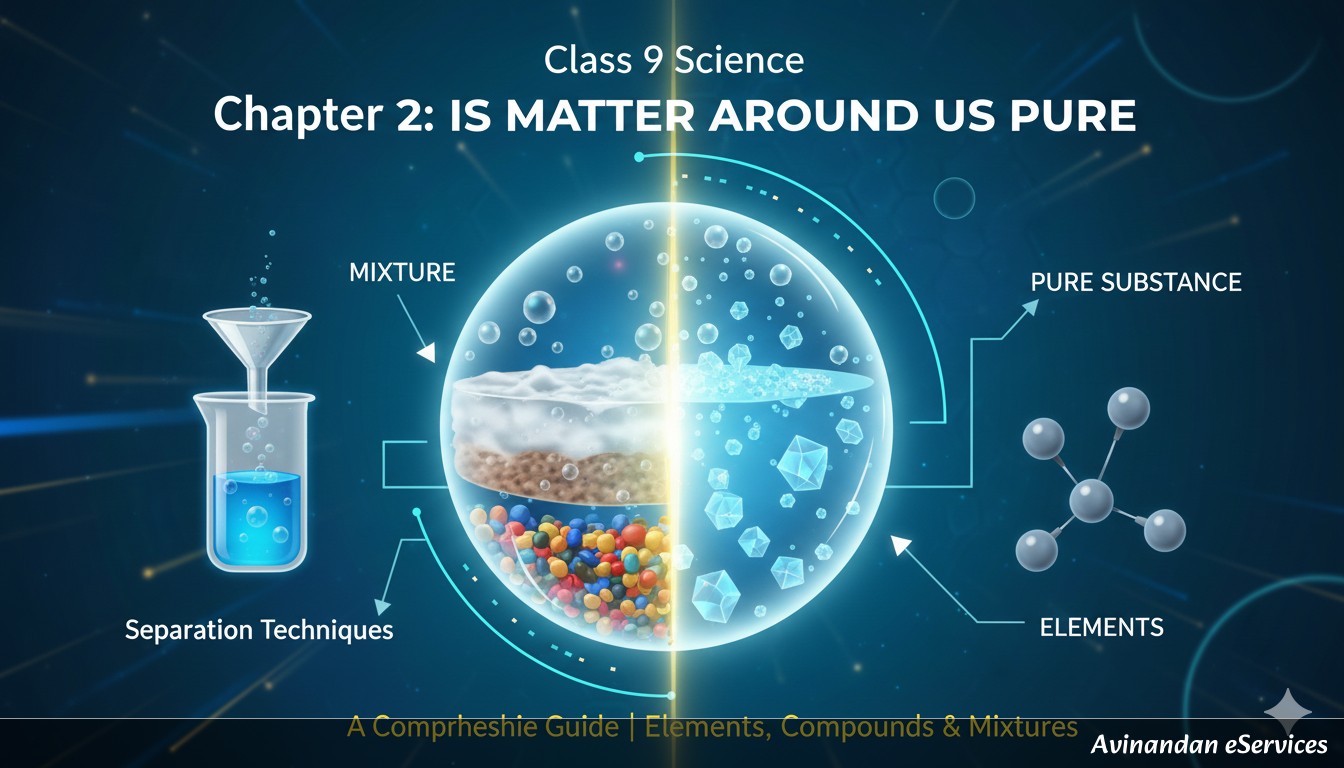
Introduction to Is Matter Around Us Pure
Welcome, students, to this comprehensive guide on Chapter 2 of your Class 9 NCERT Science textbook, 'Is Matter Around Us Pure?'. When we look around, we see a vast variety of substances with different shapes, sizes, and textures. Have you ever wondered if the milk you drink, the salt you use, or the air you breathe is scientifically 'pure'? This chapter delves deep into the scientific classification of matter, helping us understand the fundamental differences between pure substances and mixtures. We will explore the various types of mixtures, their properties, and the fascinating techniques scientists use to separate their components. Understanding these concepts is crucial as it forms the bedrock of chemistry, providing the knowledge needed to identify, classify, and manipulate different kinds of matter in our daily lives and in scientific research.
Understanding Pure Substances and Mixtures
In our everyday language, 'pure' often means something is unadulterated, like 'pure ghee' or 'pure milk'. However, for a scientist, these are actually mixtures. Scientifically, a pure substance consists of only a single type of particle. These particles can be atoms or molecules. For example, sugar is a pure substance because it contains only one kind of particle (sugar molecules). Similarly, common salt (Sodium Chloride, NaCl) is a pure substance.
On the other hand, a mixture consists of two or more pure substances (known as components) physically mixed together in any proportion, where the components do not undergo any chemical change. For example, lemonade is a mixture of sugar, salt, lemon juice, and water.
Types of Mixtures
Mixtures can be broadly classified into two types based on the uniformity of their composition:
- Homogeneous Mixtures: These mixtures have a uniform composition throughout. The particles of the components are evenly distributed, and it's impossible to see the separate components. For example, when you dissolve salt in water, the salt particles spread evenly throughout the water, and you cannot distinguish them. Air is another example of a homogeneous mixture of gases like oxygen, nitrogen, argon, etc.
- Heterogeneous Mixtures: These mixtures do not have a uniform composition. The components are not evenly distributed, and you can often see the different components with the naked eye. The boundaries of separation between the components are visible. For example, a mixture of sand and water is heterogeneous because the sand settles at the bottom, and the composition is not the same throughout. Similarly, a mixture of oil and water is heterogeneous.
| Property | Homogeneous Mixture | Heterogeneous Mixture |
|---|---|---|
| Composition | Uniform throughout | Non-uniform throughout |
| Particle Visibility | Components are not visible to the naked eye | Components can often be seen with the naked eye |
| Boundary of Separation | No visible boundaries of separation | Visible boundaries of separation between components |
| Examples | Saltwater, sugar solution, air, alloys | Sand and water, oil and water, soil, a salad |
What is a Solution?
A solution is a homogeneous mixture of two or more substances. You encounter solutions every day: lemonade, soda water, etc. In a solution, there is a component that dissolves the other component, and a component that gets dissolved. These are known as the solvent and the solute, respectively.
- Solvent: The component of the solution that is present in the larger amount and dissolves the other component is called the solvent. In a sugar-water solution, water is the solvent.
- Solute: The component of the solution that is dissolved in the solvent and is present in a lesser quantity is called the solute. In a sugar-water solution, sugar is the solute.
Solutions are not just liquids. They can be solid (alloys like brass, which is a mixture of zinc and copper) or gaseous (air, which is a mixture of gases).
Properties of a Solution
- It is a homogeneous mixture.
- The particles of a solute in a solution are \textremely small (less than 1 nanometer in diameter) and cannot be seen by the naked eye.
- Because of their very small particle size, they do not scatter a beam of light passing through the solution. Hence, the path of light is not visible in a solution.
- The solute particles cannot be separated from the mixture by the process of filtration.
- The solution is stable; the solute particles do not settle down when left undisturbed.
Concentration of a Solution
The concentration of a solution refers to the amount of solute present in a given amount (mass or volume) of solution, or the amount of solute dissolved in a given mass or volume of the solvent. A solution can be described as dilute, concentrated, or saturated based on the amount of solute.
There are several ways to express the concentration of a solution, but two common methods are:
- Mass by mass percentage of a solution:
(Mass of solute / Mass of solution) × 100 - Mass by volume percentage of a solution:
(Mass of solute / Volume of solution) × 100
Saturated and Unsaturated Solutions
At any particular temperature, a solution that has dissolved as much solute as it is capable of dissolving is said to be a saturated solution. In other words, no more solute can be dissolved in the solution at that temperature. The amount of the solute present in the saturated solution at this temperature is called its solubility.
If the amount of solute contained in a solution is less than the saturation level, it is called an unsaturated solution. More solute can be added to an unsaturated solution without it precipitating out.
Interestingly, if you take a saturated solution at a certain temperature and cool it slowly, the excess solute may crystallize out. You can also increase the solubility of most solids by increasing the temperature of the solvent.
What is a Suspension?
A suspension is a heterogeneous mixture in which the solute particles do not dissolve but remain suspended throughout the bulk of the medium. The particles in a suspension are large enough to be visible to the naked eye. A common example is muddy water, where soil particles are suspended in water.
Properties of a Suspension
- It is a heterogeneous mixture.
- The particles of a suspension can be seen by the naked eye.
- The particles of a suspension scatter a beam of light passing through it and make its path visible.
- The solute particles settle down when a suspension is left undisturbed, that is, a suspension is unstable.
- The components can be separated from the mixture by the process of filtration.
What is a Colloidal Solution?
A colloidal solution, or simply a colloid, is a mixture in which the particles are intermediate in size between those in solutions and suspensions. The particles are uniformly spread throughout the solution. Due to the relatively smaller size of particles, as compared to that of a suspension, the mixture appears to be homogeneous but is actually a heterogeneous mixture. Examples include milk, fog, smoke, and ink.
Colloids have two components:
- Dispersed Phase: The solute-like component or the dispersed particles in a colloid.
- Dispersion Medium: The component in which the dispersed phase is suspended.
Properties of a Colloid
- A colloid is a heterogeneous mixture, though it appears homogeneous.
- The size of particles of a colloid is too small to be individually seen by naked eyes.
- Colloids are big enough to scatter a beam of light passing through it and make its path visible. This phenomenon is called the Tyndall effect. This effect can be observed when a fine beam of light enters a room through a small hole. This happens due to the scattering of light by the particles of dust and smoke in the air.
- They do not settle down when left undisturbed, which means a colloid is quite stable.
- They cannot be separated from the mixture by the process of filtration. However, a special technique known as centrifugation can be used to separate the colloidal particles.
| Property | Solution | Suspension | Colloid |
|---|---|---|---|
| Particle Size | < 1 nm | > 100 nm | 1 - 100 nm |
| Appearance | Transparent | Opaque | Translucent |
| Nature | Homogeneous | Heterogeneous | Heterogeneous (appears homogeneous) |
| Tyndall Effect | Does not show | Shows | Shows |
| Stability | Stable | Unstable (particles settle down) | Stable |
| Filtration | Cannot be separated | Can be separated | Cannot be separated |
Separating the Components of a Mixture
Most natural substances are not chemically pure and are found as mixtures. Different methods of separation are used to get individual components from a mixture. The choice of method depends on the properties of the components of the mixture.
Evaporation
This method is used to separate a volatile component (solvent) from a non-volatile component (solute). For instance, we can separate the coloured component (dye) from ink. By heating a watch glass containing ink, the water (volatile solvent) evaporates, leaving behind the non-volatile dye.
Centrifugation
Sometimes the solid particles in a liquid are very small and pass through a filter paper. For such particles, the filtration technique cannot be used for separation. Such mixtures are separated by centrifugation. The principle is that the denser particles are forced to the bottom and the lighter particles stay at the top when spun rapidly. This is used in diagnostic labs for blood and urine tests, in dairies to separate butter from cream, and in washing machines to squeeze out water from wet clothes.
Separating Funnel
This technique is used to separate a mixture of two immiscible liquids (liquids that do not mix, like oil and water). A separating funnel is a glass apparatus with a stopcock at the bottom. The mixture is poured into the funnel and allowed to stand. The liquids separate into distinct layers based on their densities. The denser liquid forms the lower layer. By opening the stopcock, the lower layer can be carefully run out, and the stopcock is closed as the interface reaches it, leaving the upper liquid in the funnel.
Sublimation
Sublimation is the process where a solid turns directly into a gas upon heating, without passing through the liquid state. This method is used to separate a mixture that contains a sublimable volatile component from a non-sublimable impurity. For example, a mixture of ammonium chloride and common salt can be separated this way. On heating the mixture, ammonium chloride sublimes and its vapours can be collected and cooled to get pure ammonium chloride, while the salt is left behind.
Chromatography
This is a powerful technique used for separating solutes that dissolve in the same solvent. The name comes from 'kroma', the Greek word for colour, as it was first used to separate colours. The principle is that different components of a mixture have different solubilities in the same solvent and are adsorbed at different rates on an adsorbent material (like filter paper or silica gel). A common example is separating the different dyes in a drop of black ink using paper chromatography. It has applications in separating colours in a dye, pigments from natural colours, and drugs from blood.
Distillation and Fractional Distillation
Distillation is used for the separation of components of a mixture containing two miscible liquids that boil without decomposition and have a sufficient difference in their boiling points (generally more than 25 K). The liquid with the lower boiling point vaporizes first, and the vapour is then cooled (condensed) back into a liquid and collected separately. An example is the separation of acetone and water.
Fractional Distillation is used to separate a mixture of two or more miscible liquids for which the difference in boiling points is less than 25 K. The apparatus is similar to that for simple distillation, except that a fractionating column is fitted in between the distillation flask and the condenser. The column provides a large surface area for the vapours to cool and condense repeatedly. This process is used for separating different gases from air and different factions from petroleum products.
Crystallisation
Crystallisation is a process that separates a pure solid in the form of its crystals from a solution. It is a purification technique. For example, to get pure copper sulphate from an impure sample, the impure sample is dissolved in a minimum amount of water and filtered to remove insoluble impurities. The solution is then heated to evaporate water to get a saturated solution. This is allowed to cool slowly, undisturbed. Crystals of pure copper sulphate will form, which can then be separated by filtration. Crystallisation is considered a better technique than simple evaporation because:
- Some solids decompose or get charred on heating to dryness.
- Some impurities may remain dissolved in the solution even after filtration. On evaporation, these contaminate the solid.
Physical and Chemical Changes
The world around us is constantly changing. These changes can be classified as either physical or chemical.
A physical change is a change in the physical properties of a substance, such as its shape, size, colour, and state (solid, liquid, or gas). No new substance is formed in a physical change. Examples include melting of ice, boiling of water, tearing paper, and dissolving sugar in water. These changes are generally reversible.
A chemical change is a change in which one or more new substances with entirely new properties are formed. It involves a chemical reaction. Examples include burning of a candle, rusting of iron, cooking of food, and digestion. These changes are generally irreversible.
| Basis of Difference | Physical Change | Chemical Change |
|---|---|---|
| New Substance | No new substance is formed. | One or more new substances are formed. |
| Reversibility | It is generally reversible. | It is generally irreversible. |
| Nature of Change | It is a temporary change. | It is a permanent change. |
| Energy Change | Very little heat or light energy is usually absorbed or given out. | A lot of heat or light energy is absorbed or given out. |
| Examples | Melting of ice, cutting of trees, dissolving salt in water. | Burning of coal, rusting of iron, formation of curd from milk. |
What are the Types of Pure Substances?
On the basis of their chemical composition, pure substances can be classified into elements and compounds.
Elements
An element is a basic form of matter that cannot be broken down into simpler substances by chemical reactions. Robert Boyle was the first scientist to use the term element in 1661. Antoine Laurent Lavoisier later established an experimentally useful definition. Elements can be normally divided into metals, non-metals and metalloids.
- Metals: They usually have a lustre, are silvery-grey or golden-yellow, conduct heat and electricity, are ductile (can be drawn into wires), malleable (can be hammered into thin sheets), and are sonorous (make a ringing sound when hit). Examples: gold, silver, iron, sodium. Mercury is the only metal that is liquid at room temperature.
- Non-metals: They display a variety of colours, are poor conductors of heat and electricity, and are not lustrous, sonorous or malleable. Examples: hydrogen, oxygen, carbon, bromine, chlorine.
- Metalloids: These are elements that have intermediate properties between those of metals and non-metals. Examples: boron, silicon, germanium.
Compounds
A compound is a substance composed of two or more elements, chemically combined with one another in a fixed proportion by mass. The properties of a compound are entirely different from those of its constituent elements. For example, water (H₂O) is a compound made of hydrogen and oxygen. Hydrogen is a combustible gas and oxygen supports combustion, but their compound, water, is used to \textinguish fires.
| Mixture | Compound |
|---|---|
| Elements or compounds just mix together to form a mixture and no new compound is formed. | Elements react to form new compounds. |
| A mixture has a variable composition. | The composition of each new substance is always fixed. |
| A mixture shows the properties of the constituent substances. | The new substance has totally different properties. |
| The constituents can be separated fairly easily by physical methods. | The constituents can be separated only by chemical or electrochemical reactions. |
Important Questions and Answers
Here are some solved questions from the NCERT textbook to help you test your understanding of the chapter.
Question 1: Classify the following as chemical or physical changes:
- cutting of trees
- melting of butter in a pan
- rusting of almirah
- boiling of water to form steam
- passing of electric current through water and the water breaking down into hydrogen and oxygen gases
- dissolving common salt in water
- making a fruit salad with raw fruits
- burning of paper and wood
Answer:
- Cutting of trees: Physical change (only changes the form of wood, not its chemical nature).
- Melting of butter in a pan: Physical change (change of state from solid to liquid).
- Rusting of almirah: Chemical change (iron reacts with oxygen and moisture to form a new substance, iron oxide).
- Boiling of water to form steam: Physical change (change of state from liquid to gas).
- Passing of electric current through water (electrolysis): Chemical change (water (H₂O) breaks down into new substances, hydrogen (H₂) and oxygen (O₂)).
- Dissolving common salt in water: Physical change (no new substance is formed, and salt can be recovered by evaporation).
- Making a fruit salad with raw fruits: Physical change (fruits are just mixed, their individual chemical properties do not change).
- Burning of paper and wood: Chemical change (wood and paper react with oxygen to produce new substances like carbon dioxide, water vapour, and ash).
Question 2: How will you separate a mixture containing kerosene and petrol (difference in their boiling points is more than 25 °C), which are miscible with each other?
Answer: A mixture of two miscible liquids like kerosene and petrol, with a difference in their boiling points of more than 25 °C, can be separated by the process of simple distillation.
Procedure:
- Take the mixture in a distillation flask fitted with a thermometer.
- Heat the mixture gently using a Bunsen burner.
- Petrol has a lower boiling point than kerosene, so it will vaporise first.
- As the petrol vapours rise, they will pass into the condenser.
- The condenser has a cold water jacket which cools the vapours, causing them to condense back into liquid petrol.
- This liquid petrol is collected in a separate beaker (the distillate).
- Kerosene, having a higher boiling point, will remain behind in the distillation flask.
This method effectively separates the two liquids based on their difference in volatility.
Question 3: Differentiate between homogeneous and heterogeneous mixtures with examples.
Answer:
| Homogeneous Mixture | Heterogeneous Mixture |
|---|---|
| It has a uniform composition throughout its mass. | It has a non-uniform composition throughout its mass. |
| There are no visible boundaries of separation between the components. | There are visible boundaries of separation between the components. |
| The components cannot be seen easily. | The components can generally be seen easily. |
| Examples: Sugar dissolved in water, saltwater, air, alloys. | Examples: Mixture of sand and water, mixture of oil and water, soil. |
Question 4: Which separation techniques will you apply for the separation of the following?
- Sodium chloride from its solution in water.
- Butter from curd.
- Oil from water.
- Tea leaves from tea.
- Iron pins from sand.
- Different pigments from an \textract of flower petals.
Answer:
- Sodium chloride from its solution in water: Evaporation or Crystallisation.
- Butter from curd: Centrifugation.
- Oil from water: Using a separating funnel.
- Tea leaves from tea: Filtration (using a sieve).
- Iron pins from sand: Magnetic separation (using a magnet).
- Different pigments from an \textract of flower petals: Chromatography.
Chapter Summary
Here are the key takeaways from 'Is Matter Around Us Pure?':
- Pure Substance: Consists of a single type of particle (elements or compounds).
- Mixture: Consists of two or more pure substances physically mixed in any ratio.
- Homogeneous Mixture: Has a uniform composition (e.g., solutions).
- Heterogeneous Mixture: Has a non-uniform composition (e.g., suspensions).
- Solution: A homogeneous mixture of a solute (lesser quantity) and a solvent (larger quantity).
- Suspension: A heterogeneous mixture where particles are large, visible, and settle down.
- Colloid: A heterogeneous mixture with particle size between solutions and suspensions. It shows the Tyndall effect.
- Separation Techniques: The choice of method (evaporation, centrifugation, separating funnel, sublimation, chromatography, distillation, crystallisation) depends on the physical and chemical properties of the components.
- Physical Change: A reversible change where no new substance is formed (e.g., melting ice).
- Chemical Change: An irreversible change where new substances are formed (e.g., rusting).
- Elements: Basic forms of matter that cannot be broken down further (Metals, Non-metals, Metalloids).
- Compounds: Formed when two or more elements combine chemically in a fixed proportion.