Introduction to Natural Resources
Welcome, students! In this chapter, we embark on a journey to understand the very things that sustain life on our planet: Natural Resources. Earth is the only known planet where life exists, and this is possible because of the unique combination of resources available here. These resources, the 'gifts' of nature, are essential for meeting the basic needs of all life forms, including humans. This chapter, 'Natural Resources', from the NCERT Class 9 Science syllabus, delves into the composition, importance, and conservation of these precious assets.
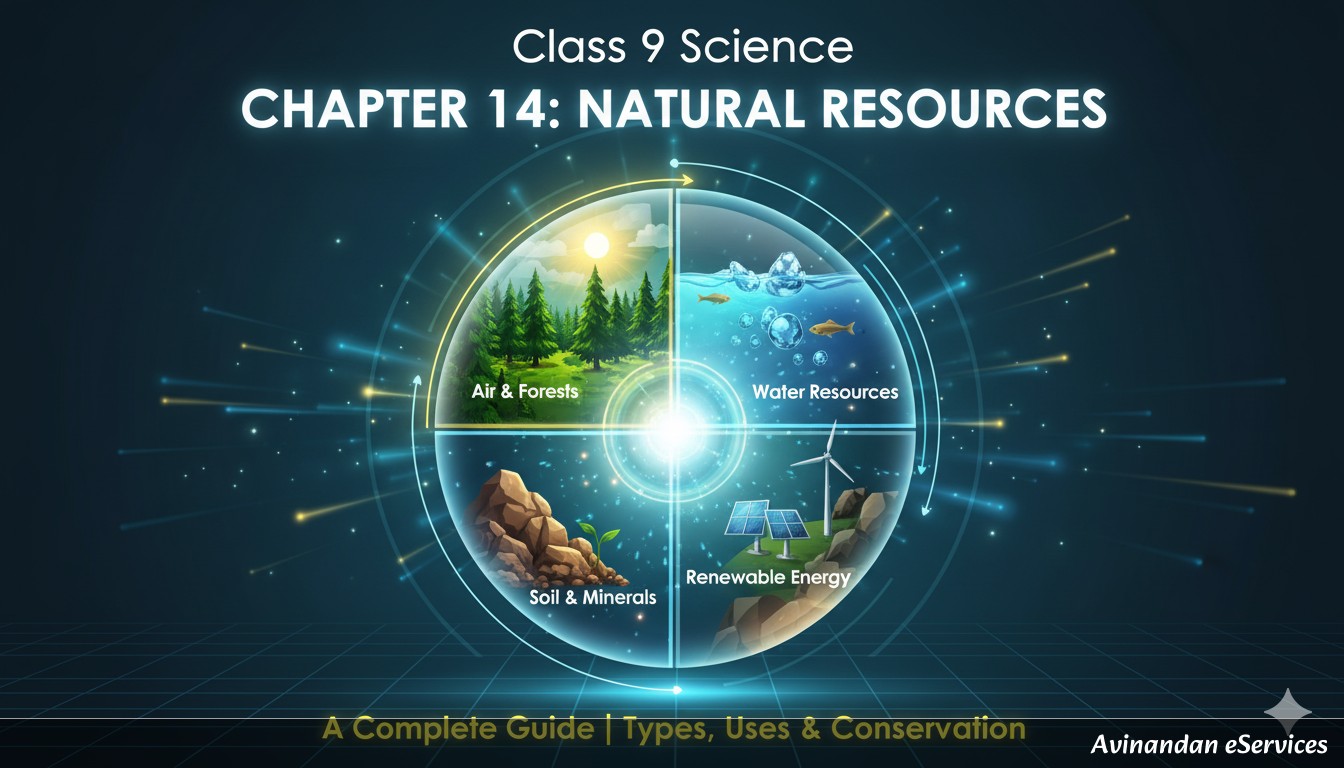
So, what exactly are natural resources? Simply put, they are the stock of nature, such as air, water, soil, minerals, and forests, that are useful to humankind. We can categorize the resources on Earth into three main spheres:
- The Lithosphere: This is the solid, outer part of the Earth, the crust and the upper mantle. It's the land we live on, providing us with soil for agriculture and minerals for industries.
- The Hydrosphere: This sphere comprises all the water on Earth's surface, such as oceans, seas, lakes, rivers, and streams, as well as groundwater and glaciers. Water is indispensable for life.
- The Atmosphere: This is the blanket of gases that surrounds our planet. It protects us from the harsh conditions of outer space and provides the air we breathe.
The interaction between these three spheres creates a narrow zone where life is possible. This life-supporting zone is called the Biosphere. It is the dynamic space where the biotic (living) components, like plants and animals, interact with the abiotic (non-living) components – land, water, and air. This chapter will explore these abiotic components in detail and understand the delicate cycles that maintain their balance.
The Breath of Life: Air
Air is one of the most fundamental natural resources. While we cannot see it, life as we know it would be impossible without it. It is an integral part of the atmosphere and plays multiple roles beyond just providing oxygen for respiration.
Composition of Air
Air is not a single substance but a mixture of several gases. The composition of clean, dry air is fairly constant. Here's a breakdown of its main components:
- Nitrogen (N₂): Approximately 78%. It is crucial for making proteins and other essential molecules in living organisms.
- Oxygen (O₂): Approximately 21%. It is essential for respiration in most living organisms and for combustion.
- Argon (Ar): Approximately 0.93%. It is an inert gas.
- Carbon Dioxide (CO₂): Approximately 0.04%. Although present in a small amount, it is vital for photosynthesis in plants and plays a significant role in regulating Earth's temperature (the greenhouse effect).
- Other gases: Trace amounts of neon, helium, methane, krypton, and hydrogen are also present, along with variable amounts of water vapour and dust particles.
This specific composition is unique to Earth and is a product of life itself. For example, the oxygen-rich atmosphere we have today was largely produced by photosynthetic organisms over billions of years.
The Role of the Atmosphere in Climate Control
The atmosphere acts like a protective blanket for the Earth. Air is a poor conductor of heat, which means it helps in moderating the planet's temperature. It prevents a sudden increase in temperature during the daylight hours and slows down the escape of heat into outer space during the night. This is why the range of temperatures on Earth is relatively stable, unlike on the Moon, which lacks an atmosphere and experiences \textreme temperature swings from about -190°C to 110°C.
The Movement of Air: Winds
Have you ever wondered what causes the cool evening breeze? It's all about the movement of air, which we call wind. This movement is driven by the uneven heating of the Earth's surface by the sun. When air gets heated, it expands, becomes less dense, and rises. This creates an area of low pressure. Cooler, denser air from surrounding high-pressure areas then moves in to fill this space. This movement of air from a region of high pressure to a region of low pressure creates winds.
Two classic examples of this phenomenon are sea breezes and land breezes:
- Sea Breeze: During the day, land heats up faster than water. The air above the land becomes hot and rises, creating a low-pressure area. The air over the cooler sea is at a higher pressure, so it flows from the sea towards the land. This is the refreshing sea breeze felt in coastal areas during the day.
- Land Breeze: At night, the process reverses. Land cools down faster than water. The air above the now warmer sea rises, creating a low-pressure zone. The cooler air from the land flows towards the sea, creating a land breeze.
These convection currents in the air are responsible for various weather patterns and play a crucial role in distributing heat across the globe.
Rain
Water is constantly cycling between the hydrosphere and the atmosphere. Rain is a critical part of this cycle. The process begins when the sun's heat causes water from bodies like oceans, rivers, and lakes to evaporate. Plants also release water vapour into the atmosphere through a process called transpiration.
This warm, moist air rises. As it ascends to higher altitudes, it expands and cools. The cooling causes the water vapour to condense into tiny water droplets. These droplets form around microscopic particles in the air, such as dust, smoke, or salt, which act as nuclei. Millions of these droplets come together to form clouds. When the water droplets in the clouds become too large and heavy, they fall back to the Earth as precipitation, which can be in the form of rain, snow, or hail, depending on the temperature.
Air Pollution
While air is essential, its quality can be severely degraded by human activities. Air pollution is the introduction of harmful substances, or pollutants, into the atmosphere. The primary source of air pollution is the burning of fossil fuels like coal and petroleum in industries, vehicles, and power plants.
Common Air Pollutants and their Effects:
- Suspended Particulate Matter (SPM): These are tiny solid or liquid particles suspended in the air, such as dust, smoke, and soot. They can reduce visibility and cause respiratory problems when inhaled.
- Sulphur Dioxide (SO₂) and Nitrogen Oxides (NOx): Produced from burning fossil fuels containing sulphur and nitrogen. These gases are not only poisonous but also dissolve in rain to form sulphuric acid and nitric acid, leading to acid rain. Acid rain damages buildings, harms forests and aquatic life, and corrodes structures.
- Carbon Monoxide (CO): An incomplete combustion product, it is a highly poisonous gas that can be fatal in high concentrations.
- Smog: In cold weather, water vapour can condense around pollutants like smoke, forming a thick fog-like layer called smog. It drastically reduces visibility and is associated with severe respiratory illnesses.
Lichens are very sensitive to sulphur dioxide levels and are often used as biological indicators of air pollution. Their absence in an area often signals high levels of pollution.
A Wonder Liquid: Water
Water is often called the 'elixir of life', and for good reason. It covers about 71% of the Earth's surface and is vital for the existence of all known forms of life. Despite its abundance, most of this water is saline (in oceans), and only a small fraction is available as fresh water.
Water: A Vital Resource
All life processes and cellular reactions occur in a water medium. Water is a universal solvent, capable of dissolving a wide range of substances, which facilitates the transport of minerals and nutrients within organisms and ecosystems. Its availability is a major factor that determines the diversity of life in any region. The amount of available fresh water sets the limit on the types and number of terrestrial life forms that can survive in a particular area.
Water Pollution
The addition of undesirable substances to water bodies, which makes the water unfit for use, is called water pollution. The sources are numerous and largely linked to human activities.
Sources and Effects of Water Pollution:
- Sewage and Domestic Waste: Untreated sewage from our homes and towns is often discharged into rivers. It contains disease-causing microorganisms like bacteria and viruses, which can lead to diseases like cholera, typhoid, and jaundice.
- Industrial Waste: Industries release a variety of chemical pollutants, including heavy metals like mercury and lead, which are toxic to aquatic life and can accumulate in the food chain, ultimately affecting humans.
- Agricultural Runoff: The overuse of fertilizers and pesticides in farming is a major source of pollution. When it rains, these chemicals are washed into nearby water bodies. The excess nutrients (like nitrates and phosphates) from fertilizers cause an explosive growth of algae, a phenomenon called eutrophication or algal bloom. This algae covers the water surface, blocking sunlight and consuming large amounts of dissolved oxygen when it dies and decomposes, leading to the death of fish and other aquatic animals.
- Thermal Pollution: Water from power plants and industries is often used for cooling and then released back into rivers or lakes at a higher temperature. This sudden change in temperature can be fatal to aquatic organisms that are adapted to a specific temperature range. It also reduces the amount of dissolved oxygen the water can hold.
The Treasure Under Our Feet: Soil
Soil is the uppermost layer of the Earth's crust, a complex mixture of minerals, organic matter, gases, liquids, and countless organisms that together support life. It is a critical resource for agriculture, providing a medium for plants to grow.
Soil Formation (Pedogenesis)
Soil is formed over very long periods through the process of weathering of rocks. Weathering is the breakdown of large rocks into smaller mineral particles. Several factors contribute to this process:
- Physical Weathering: This involves the mechanical breakdown of rocks without changing their chemical composition. Agents include:
- The Sun: Rocks expand when heated during the day and contract when they cool at night. This repeated cycle causes cracks to form and the rock to eventually break apart.
- Water: Water can seep into cracks in rocks. If it freezes, it expands, widening the cracks. Fast-flowing water in rivers also causes rocks to rub against each other and break down into smaller particles.
- Wind: Strong winds can carry sand and small rock particles, which can erode the surface of larger rocks over time.
- Chemical Weathering: This involves the decomposition of rocks through chemical reactions. For example, acidic rainwater can dissolve certain minerals in rocks.
- Biological Weathering: Living organisms also contribute to soil formation. Lichens and mosses can grow on rock surfaces, releasing chemicals that break down the rock. The roots of large trees can grow into cracks and physically split the rocks apart.
Over thousands of years, these fine particles mix with organic matter (humus) from decaying plants and animals to form fertile soil.
Composition of Soil
Soil is a complex matrix. Its quality and type depend on the parent rock it was formed from, the climate, and the organisms living in it. The main components are:
- Mineral Particles: Derived from the parent rock (e.g., sand, silt, clay).
- Humus: Decomposed organic matter that makes the soil fertile and helps it retain water.
- Living Organisms: A vast community of bacteria, fungi, earthworms, and insects that help in decomposition and soil aeration.
- Water and Air: Held in the pore spaces between soil particles.
Soil Pollution
The contamination of soil with harmful substances is known as soil pollution. It can severely impact soil fertility and the health of the ecosystem. The removal of useful components and the addition of other substances, which adversely affect the fertility of the soil and kill the diversity of organisms that live in it, is called soil pollution.
The main culprits are modern agricultural practices that involve the heavy use of chemical fertilizers and pesticides. These non-biodegradable chemicals accumulate in the soil, kill essential microorganisms like earthworms and bacteria, and can leach into the groundwater, contaminating it as well. Industrial waste and improper disposal of garbage also contribute significantly to soil pollution.
Soil Erosion
Soil erosion is the washing or blowing away of the top layer of soil. This topsoil is the most fertile part, rich in humus and nutrients. The roots of plants play a vital role in binding the soil particles together, preventing erosion. When land is cleared of vegetation through deforestation, overgrazing, or improper farming, the soil is left exposed to the forces of wind and water, leading to rapid erosion. This can turn lush green lands into barren deserts over time. Preventing soil erosion is crucial and can be achieved through methods like afforestation (planting trees), contour ploughing, and terrace farming in hilly areas.
Biogeochemical Cycles
The biosphere is a dynamic system. There is a constant interaction between the biotic and abiotic components, resulting in a continuous transfer of matter and energy. These transfers form complex pathways known as biogeochemical cycles. These cycles ensure that the essential elements required for life are recycled and made available for organisms to use.
The Water Cycle (Hydrological Cycle)
The water cycle describes the continuous movement of water on, above, and below the surface of the Earth. It's a grand, planet-scale process driven by the sun's energy.
- Evaporation & Transpiration: Heat from the sun causes water from oceans, lakes, and rivers to turn into vapour and rise into the atmosphere. Plants also release water vapour from their leaves (transpiration).
- Condensation: As the water vapour rises, it cools and condenses to form clouds.
- Precipitation: When the water droplets in clouds become too heavy, they fall back to Earth as rain, snow, sleet, or hail.
- Collection: The water that falls on land collects in rivers, lakes, and oceans (runoff) or seeps into the ground (infiltration) to become groundwater, eventually making its way back to the larger water bodies. This cycle then repeats.
The Nitrogen Cycle
Nitrogen is a vital component of proteins, nucleic acids (DNA, RNA), and vitamins. Although our atmosphere is 78% nitrogen, most organisms cannot use it directly in its gaseous form (N₂). It needs to be 'fixed' or converted into usable forms like nitrates (NO₃⁻) and nitrites (NO₂⁻). The nitrogen cycle is a complex process involving several key steps:
- Nitrogen Fixation: This is the process of converting atmospheric nitrogen (N₂) into ammonia (NH₃). This can happen in three ways:
- Biological Fixation: Certain bacteria, like Rhizobium (found in the root nodules of leguminous plants like peas and beans), and free-living bacteria in the soil can fix nitrogen.
- Atmospheric Fixation: The high energy of lightning can break nitrogen molecules, allowing them to combine with oxygen to form nitrogen oxides, which then dissolve in rain to form nitric acid and fall to the earth.
- Industrial Fixation: This occurs in fertilizer production plants under high pressure and temperature.
- Nitrification: Soil bacteria convert the ammonia from fixation (and decomposition) into nitrites (NO₂⁻) and then into nitrates (NO₃⁻). Plants can absorb these nitrates through their roots.
- Assimilation: Plants use the nitrates to build proteins and other organic compounds. Animals get their nitrogen by eating plants or other animals.
- Ammonification: When plants and animals die, decomposers (bacteria and fungi) break down the organic nitrogen back into ammonia.
- Denitrification: Another group of bacteria (e.g., Pseudomonas) converts nitrates back into gaseous nitrogen (N₂), which is released into the atmosphere, completing the cycle.
The Carbon Cycle
Carbon is the backbone of all organic life. The carbon cycle describes how carbon is exchanged among the biosphere, atmosphere, oceans, and geosphere.
- Carbon exists in the atmosphere primarily as carbon dioxide (CO₂).
- Photosynthesis: Plants take in CO₂ from the atmosphere and use sunlight to convert it into organic compounds (glucose). This is the primary way carbon enters the biotic world.
- Respiration: Animals get carbon by eating plants. Both plants and animals release CO₂ back into the atmosphere through respiration.
- Decomposition: When organisms die, decomposers break them down, releasing carbon back into the soil and atmosphere.
- Combustion: Over millions of years, some dead organic matter has been converted into fossil fuels (coal, oil, natural gas). When we burn these fuels, the stored carbon is rapidly released into the atmosphere as CO₂.
- Ocean Exchange: A large amount of CO₂ is dissolved in the oceans, where it can be used by marine life or form carbonate rocks like limestone.
The Greenhouse Effect
Gases like CO₂ are called 'greenhouse gases'. They trap heat from the sun in the Earth's atmosphere, keeping the planet warm enough for life. This is the natural greenhouse effect. However, human activities, especially the burning of fossil fuels, have drastically increased the concentration of CO₂ in the atmosphere. This enhances the greenhouse effect, leading to a rise in global temperatures, a phenomenon known as global warming.
The Oxygen Cycle
The oxygen cycle is intricately linked with the carbon cycle. Oxygen constitutes about 21% of the atmosphere and is essential for respiration.
- The main source of atmospheric oxygen is photosynthesis, where plants release oxygen as a byproduct of making food.
- Oxygen is consumed from the atmosphere through three main processes: respiration by living organisms, combustion of fuels, and the formation of nitrogen oxides.
- Oxygen is also found in various compounds, including water (H₂O), carbon dioxide (CO₂), and in mineral oxides in the Earth's crust.
The Ozone Layer
While diatomic oxygen (O₂) is vital for breathing, another form of oxygen, ozone (O₃), plays a crucial protective role. Ozone is formed in the stratosphere when high-energy ultraviolet (UV) radiation from the sun splits O₂ molecules, and the resulting free oxygen atoms (O) combine with other O₂ molecules. The ozone layer absorbs most of the harmful UV radiation from the sun, protecting life on Earth from its damaging effects, such as skin cancer and cataracts.
Unfortunately, this protective layer is being depleted by man-made chemicals, particularly chlorofluorocarbons (CFCs), which were once widely used in refrigerants and aerosol sprays. These chemicals rise to the stratosphere and break down ozone molecules, leading to the formation of an 'ozone hole', particularly over Antarctica. International agreements like the Montreal Protocol have been successful in phasing out CFCs to allow the ozone layer to slowly recover.
Important Questions and Answers
Q1: How is soil formed?
Answer: Soil is formed through a slow and gradual process called weathering, which involves the breakdown of rocks over thousands of years. The key factors involved in soil formation are:
- Physical Weathering: Mechanical breakdown of rocks by agents like the sun (causing expansion and contraction), water (freezing in cracks and erosive action of rivers), and wind (abrasion).
- Chemical Weathering: Decomposition of rocks through chemical reactions, such as hydrolysis or dissolution by acidic rainwater.
- Biological Weathering: Breakdown of rocks by living organisms. Lichens and mosses release chemicals that break down rock surfaces, and plant roots can grow into crevices and split rocks apart.
Q2: What are the different states in which water is found during the water cycle?
Answer: During the water cycle, water is found in all three states of matter:
- Liquid State: This is the most common state on Earth's surface. Water is found as a liquid in oceans, rivers, lakes, groundwater, and as raindrops during precipitation.
- Gaseous State: Water exists as a gas, known as water vapour, in the atmosphere. It enters this state through evaporation from water bodies and transpiration from plants. It is invisible.
- Solid State: Water is found in its solid state as ice, snow, glaciers, and ice caps. It also falls as precipitation in the form of snow or hail in colder regions or at high altitudes. The tiny ice crystals also form clouds along with water droplets.
Q3: What is the greenhouse effect?
Answer: The greenhouse effect is a natural process that warms the Earth's surface. Certain gases in the atmosphere, known as greenhouse gases (e.g., carbon dioxide, methane, water vapour), act like the glass of a greenhouse. They allow sunlight (short-wave radiation) to pass through and heat the Earth's surface. The Earth then radiates this heat back as infrared radiation (long-wave radiation). The greenhouse gases trap some of this outgoing heat, preventing it from escaping into space and thus keeping the planet at a warm, life-sustaining temperature. While this is a natural and essential process, human activities, particularly the burning of fossil fuels, have increased the concentration of these gases, enhancing the effect and leading to global warming.
Q4: List any three human activities which would lead to an increase in the carbon dioxide content of air.
Answer: Three major human activities that increase the carbon dioxide (CO₂) content in the air are:
- Combustion of Fossil Fuels: Burning coal, petroleum (petrol, diesel), and natural gas for energy in industries, power plants, and vehicles releases vast amounts of stored carbon into the atmosphere as CO₂. This is the single largest contributor to rising CO₂ levels.
- Deforestation: Forests act as major 'carbon sinks' because trees absorb CO₂ from the atmosphere for photosynthesis. When forests are cut down and burned on a large scale for agriculture, urbanisation, or timber, the stored carbon in the trees is released as CO₂, and the capacity of the Earth to absorb CO₂ is reduced.
- Industrial Processes: Certain industrial activities, such as the manufacturing of cement, involve chemical processes that release CO₂ as a byproduct, independent of energy consumption.
Chapter Summary
Here are the key takeaways from our exploration of Earth's natural resources:
- Life on Earth depends on resources like land (lithosphere), water (hydrosphere), and air (atmosphere). The interaction of these spheres creates the biosphere.
- Air is a mixture of gases, primarily nitrogen, oxygen, and carbon dioxide. The atmosphere regulates temperature and drives weather patterns like winds and rain.
- Air pollution is caused by burning fossil fuels, releasing pollutants like SO₂, NOx, and SPM, which lead to acid rain, smog, and health problems.
- Water is essential for all life. Water pollution from sewage, industrial waste, and agricultural runoff contaminates water sources, causing disease and harming aquatic ecosystems through processes like eutrophication.
- Soil is formed by the weathering of rocks and is crucial for agriculture. Soil pollution (from pesticides/fertilisers) and soil erosion (due to deforestation) degrade this vital resource.
- Biogeochemical cycles (Water, Nitrogen, Carbon, Oxygen) describe the continuous circulation of essential elements between the biotic and abiotic components of the biosphere, ensuring their availability.
- The Nitrogen Cycle involves fixation, nitrification, assimilation, ammonification, and denitrification, with bacteria playing a crucial role.
- The Carbon Cycle involves photosynthesis, respiration, decomposition, and combustion. An excess of CO₂ enhances the greenhouse effect, causing global warming.
- The Ozone layer in the stratosphere protects us from harmful UV radiation but is being depleted by chemicals like CFCs.