A Storm from the Sun?
Arjun: Zara, I was reading an old adventure book, and it mentioned something really weird. It said that a long, long time ago, telegraph machines—those old-timey texting machines—started sparking and even set fire to paper all by themselves! That can’t be real, can it? Was it magic?
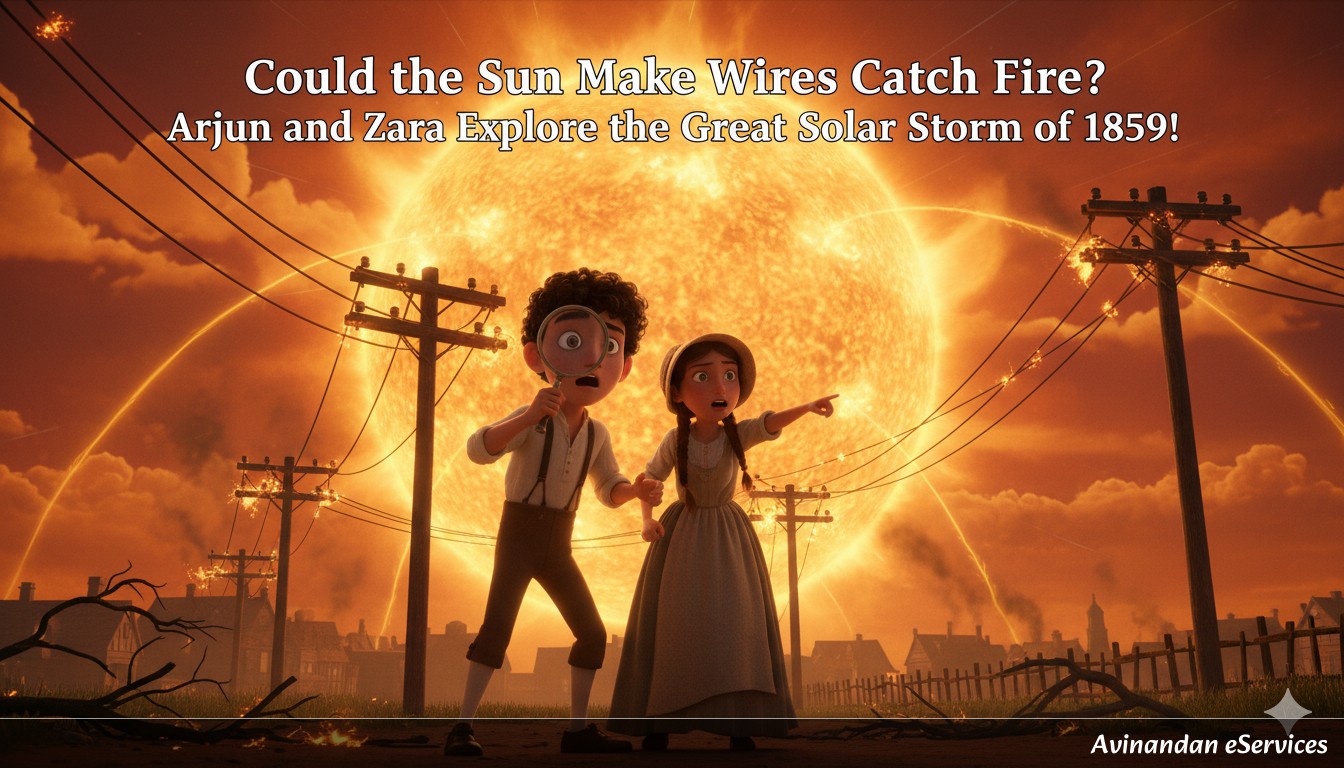
Zara: That’s an awesome question, Arjun! It’s not magic, but it’s something just as amazing: science! What you read about was probably the Carrington Event. It was a real thing that happened in 1859, and it was caused by the biggest solar storm ever recorded.
Arjun: A solar storm? You mean a storm on the Sun? How can a storm that’s 150 million kilometres away make things on Earth catch fire? That sounds like science fiction!
Zara: It does, but it's pure astronomy and physics! The Sun isn't just a calm, glowing ball of light. It's a super active star. Sometimes, the magnetic energy on its surface gets all tangled up and then snaps, creating a massive explosion. This is called a solar flare.
A Solar Sneze Headed for Earth
Arjun: An explosion on the Sun? Whoa! So that’s what a solar storm is?
Zara: That’s part of it! Sometimes, along with a flare, the Sun shoots out a gigantic cloud of super-hot gas and magnetic particles. Think of it like the Sun having a giant sneeze! This cloud is called a Coronal Mass Ejection, or CME for short. The Carrington Event was caused by a huge CME that happened to be aimed directly at Earth.
Arjun: So this giant cloud of sun-sneeze travelled all the way to Earth? How fast was it going?
Zara: Incredibly fast! Most CMEs take a few days to reach us, but this one was so powerful it got here in just under 18 hours. When this massive, magnetised cloud hit Earth, it slammed into our planet’s own magnetic field, the magnetosphere.
Arjun: Our magnetic field? You mean the thing that makes compasses point north?
Zara: Exactly! Our magnetic field usually protects us from the Sun's radiation. But the 1859 storm was so strong that it squeezed and rattled our magnetic shield, creating what’s called a geomagnetic storm. This storm caused all sorts of strange things to happen with electricity here on the ground.
Sparks, Lights, and Telegraphs Without Power
Arjun: Okay, I think I get it. The solar storm messed with Earth's magnetism, which then messed with electricity. So that’s what made the telegraphs go crazy?
Zara: You got it! Telegraph systems worked by sending electrical pulses through very, very long metal wires that stretched across countries. The geomagnetic storm created, or ‘induced’, powerful electrical currents in those long wires. The \textra electricity was way too much for the systems to handle. It overloaded the circuits, making them spark, shock the telegraph operators, and in some cases, the sparks were strong enough to set the telegraph paper on fire!
Arjun: That’s wild! They got zapped by the Sun!
Zara: They did! And here’s the craziest part. Some telegraph operators figured out they could disconnect their batteries and still send messages. They were literally using the electricity generated by the solar storm to power their machines! They were communicating using energy from space.
Arjun: No way! Were there any other effects? Did people see anything?
Zara: Oh, yes! The storm created the most incredible auroras—the Northern and Southern Lights. Usually, you can only see them near the North and South Poles. But during the Carrington Event, the auroras were so bright and widespread that people saw them all over the world. There were reports of red, green, and purple skies in places like Cuba, Hawaii, and even Mumbai! People in the mountains of America woke up in the middle of the night and started making breakfast because the sky was as bright as dawn.
Could It Happen Again?
Arjun: It's amazing that a scientist even saw this happen. How do we know so much about it?
Zara: It's named after a British astronomer, Richard Carrington. He was observing the Sun and actually saw the giant white-light flare that started it all. He was the first person to connect an event on the Sun with effects here on Earth. He was a real science detective!
Arjun: So, the big question is… could a storm like that happen again today? With all our computers, phones, and satellites?
Zara: It absolutely could. In fact, scientists say it’s not a matter of ‘if’, but ‘when’. A Carrington-level storm today would be a much bigger problem than sparking telegraphs. It could damage our satellites, disrupt GPS and communications, and even cause widespread power blackouts by overloading our electrical grids. That's why scientists at places like ISRO and NASA constantly watch the Sun, so we can get a warning and protect our technology if another big one is headed our way.
So, What Did We Learn Today?
Zara: It was a lot to take in, but super interesting, right? Here’s a quick summary:
- The Carrington Event in 1859 was the most powerful solar storm ever recorded.
- It was caused by a Coronal Mass Ejection (CME), a huge cloud of particles and magnetism 'sneezed' from the Sun.
- When the CME hit Earth, it created a massive geomagnetic storm.
- This storm induced powerful electrical currents in long wires on the ground, causing telegraph systems to spark and catch fire.
- It also created spectacular auroras (Northern and Southern Lights) that were seen all across the globe, even near the equator.
Arjun: Wow. So the Sun can do more than just give us light and heat—it can send us giant magnetic space storms too! Science is definitely cooler than magic. Thanks, Zara!