Introduction to Direction Sense Test for RRB Exams
The Direction Sense Test is a fundamental topic in the General Intelligence and Reasoning section of Indian Railway Recruitment Board (RRB) examinations, including RRB NTPC, Group D, and Technician grades. In this test, candidates are evaluated on their ability to trace a path based on sequential movements involving various directions and turns. A clear mental map and understanding of directional geometry are all it takes to score full marks in this high-scoring segment.
Directional problems typically require candidates to track a person or object moving through a series of left and right turns, calculate the shortest distance using geometric theorems, or determine the final direction relative to the starting point. Because these questions are logic-driven and do not require heavy calculations, mastering them provides a massive boost to your overall percentile in computer-based tests (CBT).
Topic Weightage and Importance
For RRB NTPC (CBT 1 and CBT 2) and RRB Group D exams, the Reasoning section carries substantial weightage. The Direction Sense Test consistently accounts for 2 to 3 questions (approx. 2 to 4 marks). While this might seem small, in a highly competitive environment where a fraction of a mark can change your merit rank, securing these questions is crucial.
Furthermore, solving direction problems quickly leaves more time for complex mathematics and data interpretation questions. Questions range from straightforward single-person path tracings to advanced coded directions and shadow-based scenarios, making a comprehensive understanding essential for success.
Key Concepts and Formulas
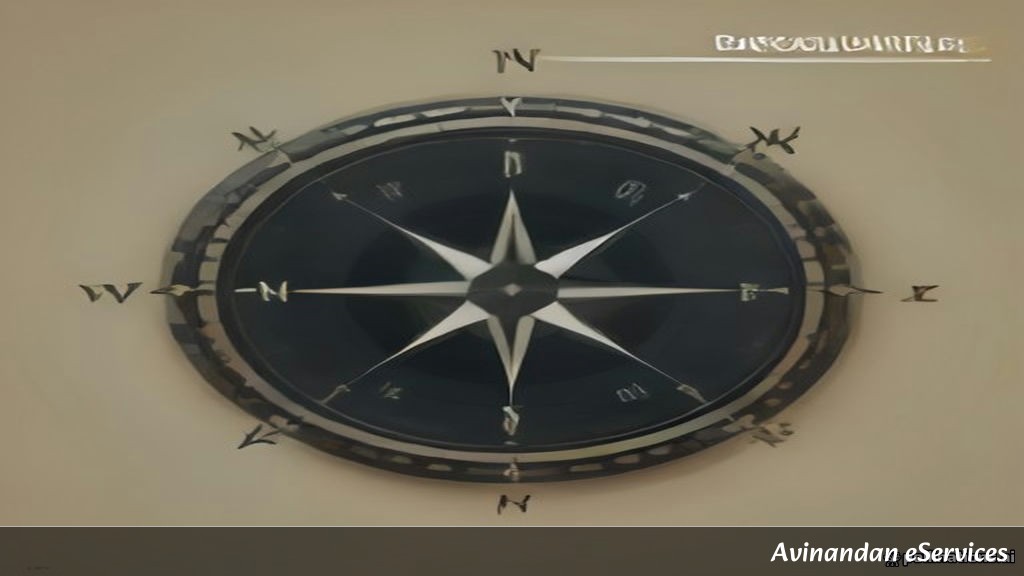
To master the Direction Sense Test, you must memorize the four primary directions and four intermediate cardinal directions, along with rules for turns and distance calculation.
1. The Four Cardinal Directions and Four Intermediate Directions
- Four Cardinal Directions: North (N), South (S), East (E), West (W).
- Four Intermediate (Cardinal) Directions: North-East (NE), North-West (NW), South-East (SE), South-West (SW).
2. Rules of Turns (Clockwise and Anti-Clockwise)
- A right turn is equivalent to a 90-degree clockwise rotation.
- A left turn is equivalent to a 90-degree anti-clockwise rotation.
- Facing North: Right is East, Left is West.
- Facing South: Right is West, Left is East.
- Facing East: Right is South, Left is North.
- Facing West: Right is North, Left is South.
3. Pythagoras Theorem for Shortest Distance
When asked to find the shortest distance between the starting point and the final destination, we often form a right-angled triangle. The formula is given by:
$$\text{Hypotenuse}^2 = \text{Base}^2 + \text{Perpendicular}^2$$
$$\text{Shortest Distance} = \sqrt{(\text{Base})^2 + (\text{Perpendicular})^2}$$
Solved Examples (Step-by-Step)
Example 1: Basic Movement and Final Direction
Question: Rohan walks 10 km towards the North. From there, he turns right and walks 15 km. Then, he turns right again and walks 10 km. Finally, he turns left and walks 20 km. In which direction is he now from his starting point?
Step-by-Step Solution:
- Step 1: Rohan starts from point O and walks 10 km North. He is now at point A (North of O).
- Step 2: He turns right (towards East) and walks 15 km to point B.
- Step 3: He turns right again (towards South) and walks 10 km to point C. (Point C is directly parallel to the East of his starting point O).
- Step 4: He turns left (towards East) and walks 20 km to point D.
- Step 5: To find his final direction from the starting point O: Point D is to the East of point C, and point C is due East of point O. Therefore, Rohan is in the East direction from his starting point.
Example 2: Calculating Shortest Distance
Question: A man leaves his office and walks 5 km towards West. He then turns South and walks 3 km. Again, he turns East and walks 8 km. How far is he from his initial point?
Step-by-Step Solution:
- Step 1: Let the office be the origin $(0,0)$. The man moves 5 km West to point A $(-5, 0)$.
- Step 2: He turns South and walks 3 km to point B $(-5, -3)$.
- Step 3: He turns East and walks 8 km. Since he was at $-5$ on the X-axis, moving 8 km East brings him to $-5 + 8 = +3$ on the X-axis. His final position is point C $(3, -3)$.
- Step 4: Form a right-angled triangle between the origin $(0,0)$, point $(-5, 0)$, and point $(-5, -3)$. The vertical distance is 3 km. The horizontal displacement from origin to final X coordinate is 3 km.
- Step 5: Apply Pythagoras theorem: $\text{Distance} = \sqrt{(3)^2 + (3)^2} = \sqrt{9 + 9} = \sqrt{18} = 3\sqrt{2} \text{ km}$.
Example 3: Shadow-Based Direction Problem
Question: One morning at sunrise, Amit and Rahul are standing facing each other. Rahul's shadow falls exactly to the right of Amit. Which direction is Rahul facing?
Step-by-Step Solution:
- Step 1: At sunrise (morning), the sun is always in the East. Therefore, any shadow falls towards the West.
- Step 2: Rahul's shadow falls to the right of Amit. This means Amit is facing South, because if someone faces South, their right hand points towards the West (where the shadow is).
- Step 3: Since Amit and Rahul are standing face to face, if Amit is facing South, Rahul must be facing the exact opposite direction, which is North.
Common Mistakes to Avoid
- Confusing Left and Right: Always imagine yourself standing in the direction of movement to correctly determine left and right turns.
- Ignoring Scale and Proportions: While sketches do not need to be to exact scale, drawing relative distances incorrectly can distort the right-angled triangle used for Pythagoras theorem calculations.
- Misinterpreting 'from' vs 'towards': Pay close attention to phrases like 'In which direction is A from B?' versus 'In which direction is A moving?'.
- Forgetting Sun Positions in Shadow Problems: Remember that in the morning shadows fall West, and in the evening shadows fall East.
Practice Questions with Solutions
Q1: Priya walks 12 meters north, turns right and walks 20 meters, turns right again and walks 12 meters, and finally turns left and walks 5 meters. How far is she from her starting point and in which direction?
Solution 1: Priya moves 12m North, 20m East, 12m South, and 5m East. Her vertical net displacement is zero. Her horizontal displacement is $20 + 5 = 25$ meters East. Thus, she is 25 meters away in the East direction.
Q2: A clock is placed on a wall such that the hour hand points to the North-East at 4:30 PM. In which direction does the minute hand point?
Solution 2: At 4:30 PM, the minute hand points straight down at 6 o'clock, which corresponds to South. If the hour hand is pointing North-East (4 o'clock position), the orientation is rotated, but standard clock cardinal rules apply unless specified. Standard minute hand at 6 points South.
Q3: Starting from a point, Kabeer walks 15 meters towards South, turns left and walks 25 meters, turns left again and walks 15 meters, then turns right and walks 10 meters. How far is he from his starting point?
Solution 3: Kabeer moves 15m S, 25m E, 15m N, and 10m E. The South and North movements cancel out. Total horizontal distance is $25 + 10 = 35$ meters East.
Q4: One evening before sunset, two friends Sneha and Megha were talking to each other face to face. If Megha's shadow was exactly to the right of Sneha, which direction was Megha facing?
Solution 4: In the evening, the sun is in the West, so shadows fall to the East. Sneha's right points East, meaning Sneha is facing North. Therefore, Megha, standing face-to-face with Sneha, is facing South.
Q5: A postman walks 20 km North, then turns West and walks 10 km, then turns South and walks 10 km, and finally turns East and walks 10 km. Where is he now with respect to his starting position?
Solution 5: Net North-South displacement is $20 - 10 = 10$ km North. Net East-West displacement is $-10 + 10 = 0$. He is 10 km North of his starting point.
Frequently Asked Questions (FAQs)
Q1: Are questions on directions asked in both CBT 1 and CBT 2 of RRB NTPC?
Yes, Direction Sense questions appear in the reasoning sections of both CBT 1 and CBT 2, as well as in RRB Group D and Technician exams.
Q2: Do I need to draw a diagram for every question?
For beginners, drawing a rough sketch is highly recommended to avoid silly mistakes. With practice, you can solve simple direction sequences mentally or using shorthand notations.
Q3: How do I handle degree-based rotation turns (e.g., 135 degrees clockwise)?
Remember that each cardinal-to-intercardinal shift is 45 degrees, and cardinal-to-cardinal is 90 degrees. Add all clockwise turns and subtract anti-clockwise turns to find the net angle of rotation from the initial heading.
Conclusion and Final Tips
The Direction Sense Test is a high-yield, scoring topic for all Indian Railways competitive exams. By mastering the basic cardinal directions, practicing shortcut rules for left/right turns, and applying the Pythagoras theorem accurately, you can secure full marks in this section. Consistent daily practice of diverse problem sets will boost your speed and build unbreakable exam confidence. Keep practicing and stay focused on your goal!