Kabir: Saanvi, I was reading about underwater volcanoes, and I found something crazy. Can animals actually live right next to boiling hot underwater chimneys?
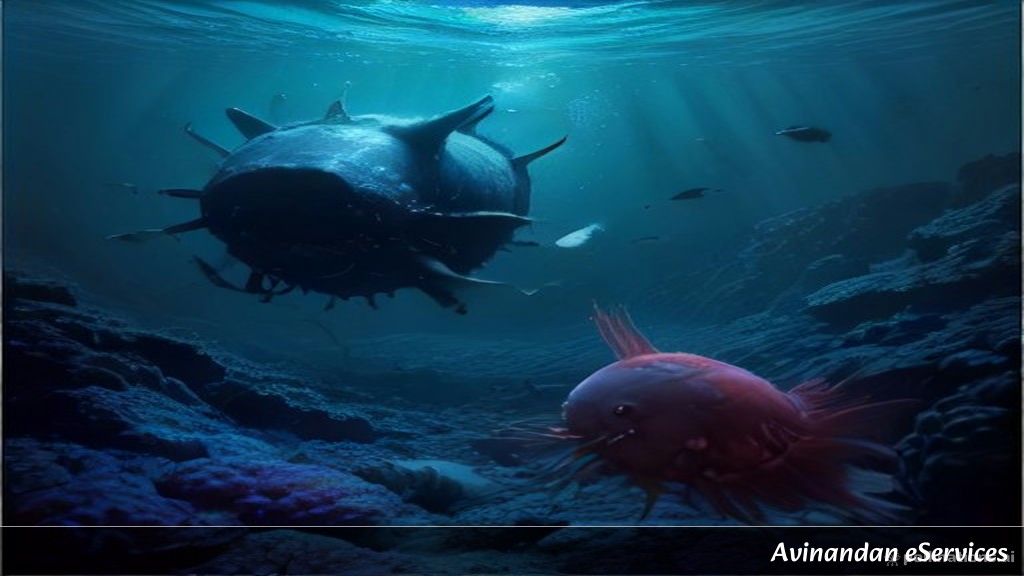
Saanvi: They sure can, Kabir! Specifically, certain amazing deep-sea crabs, like the Yeti Crab, make their homes right on hydrothermal vents where the water temperature can reach a scorching $400^{\circ}\text{Celsius}$!
Kabir: Wow, $400^{\circ}\text{C}$? That is hotter than a regular kitchen oven! How do they not get cooked like a snack?
Saanvi: It is all about location and clever biology. The water coming out of the vents is super-heated, but it mixes quickly with the freezing deep-sea water around it, creating a cozy zone of about $20^{\circ}\text{C}$ to $30^{\circ}\text{C}$ where the crabs hang out.
Kabir: That is lucky for them! But wait, how do they breathe down there with all those poisonous minerals and almost zero sunlight?
Saanvi: Great question, Kabir! These crabs have special hairy arms covered in billions of microscopic bacteria. The bacteria 'eat' the toxic chemicals like hydrogen sulfide coming from the vent through a process called chemosynthesis, and then the crab eats the bacteria!
Kabir: Whoa, so they basically grow their own snack gardens right on their furry arms? That is so cool and weird at the same time!
Saanvi: Exactly! Instead of relying on plants and sunlight, which do not exist down in the pitch-black deep sea, they rely on chemical energy from the Earth's core. Scientists use physics and chemistry formulas to study how heat transfers in these \textreme ocean pressures, using equations like $Q = mc(\Delta T)$ to figure out how the water cools down so fast.
Kabir: Science is just full of surprises. I am so glad I asked you about underwater volcanoes today!
So, What Did We Learn Today?
- Certain deep-sea crabs live right next to hydrothermal vents with \textreme temperatures.
- They survive by staying in the mixing zones where boiling vent water meets freezing ocean water.
- Their furry arms grow special bacteria that turn toxic minerals into food using chemosynthesis.
- This incredible adaptation proves life can thrive without sunlight using energy from Earth's core.
Kabir: Absolutely, Saanvi! Next time I bake a potato, I will think of vent crabs living in underwater ovens!