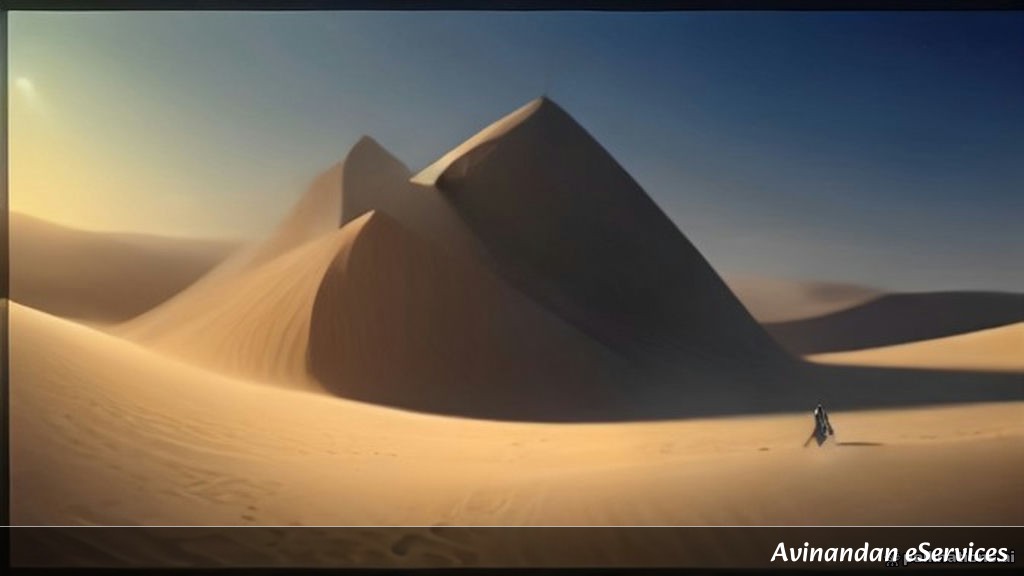
Kabir: Zara, you will not believe what I just saw in a nature documentary! A group of scientists slid down a giant sand dune in the desert, and the whole hill started humming like a massive cello! Wait... can sand actually sing, or was someone hiding a giant speaker under the dune?
Zara: Haha, there is definitely no speaker buried in the sand, Kabir! You just heard one of nature's strangest musical mysteries. Scientists call them singing sands or booming dunes. Believe it or not, in around thirty-five deserts across the world, huge piles of sand can naturally hum, drone, or roar loud enough to be heard kilometers away!
Kabir: Kilometers away?! That is wild! Last winter, when my family visited the dunes near Jaisalmer in Rajasthan, I ran down a huge slope, and all I heard was a soft swishing sound. Why didn't those dunes sing to me?
Zara: Great observation! Most ordinary sand just makes a quiet hiss when you walk on it. To become a singing dune, the sand has to be super picky. First, the grains must be almost the exact same size, usually between $0.1$ and $0.5$ millimeters wide. Second, the sand must be bone-dry. Even a tiny bit of moisture makes the grains stick together instead of sliding freely.
Kabir: Okay, so dry, matching sand grains. Wait—how does sliding down dry sand turn it into a giant musical instrument? Does each grain make a tiny squeak?
Zara: You actually guessed right! When wind blows sand over a steep dune, or when a hiker slides down the slope, it triggers a mini avalanche. Millions of sand grains tumble over the still sand underneath. As these grains rub and bump against one another, each tiny collision creates a minuscule vibration. By itself, one grain makes a sound way too quiet for human ears. But when millions of grains collide in sync at the exact same rhythm, those tiny vibrations add up into a loud, steady musical note!
Kabir: Wait a minute! How do millions of tiny grains know how to bump in sync? Shouldn't they just make random noisy scratching sounds?
Zara: That puzzled scientists for a long time! Physicists discovered that the secret lies in the thickness of the sliding layer and the smooth shape of the grains. Many booming sand grains have a thin, shiny mineral coating called desert glaze. As the top layer of sand slides down, it acts like a bow sliding across a violin string. The sliding layer vibrates at a specific frequency, forcing all the bumping grains inside it to lock into the same beat. Scientists even connect the wave speed $v$, frequency $f$, and wavelength $\lambda$ using the wave formula $v = f \times \lambda$.
Kabir: Whoa, so the sand dune is basically playing itself like a violin! What kind of notes does it play? High squeaky ones or deep rumbling ones?
Zara: Mostly deep, booming bass notes! Singing dunes usually hum at frequencies between $70$ and $105$ Hertz, right around the low notes of a cello, a bassoon, or a propeller airplane. Even cooler, the packed sand deeper inside the dune acts like the wooden body of a guitar. It bounces and amplifies the sound waves, turning the entire sand mountain into a giant loudspeaker! Some dunes can even play two or three different notes at once, creating an eerie desert chord.
Kabir: An eerie desert chord! I bet ancient travelers got totally spooked if they heard a mountain humming in the middle of nowhere!
Zara: Oh, they definitely did! Nearly eight hundred years ago, the explorer Marco Polo crossed the Gobi Desert and wrote about hearing mysterious voices, drums, and instruments coming from the empty sands. People back then thought desert spirits were calling out to trick travelers! Centuries later, in the 1830s, the famous scientist Charles Darwin heard booming sands in Chile and realized it had to be caused by friction between the grains, not ghosts.
Kabir: Haha, sorry desert spirits, it was just physics all along! Why do scientists still study singing sand today? Does it actually help us learn something important?
Zara: Definitely! Studying singing dunes helps scientists understand granular physics—the science of how tiny solid particles like sand, snow, and rocks flow together. That knowledge helps experts predict dangerous snow avalanches and landslides before they happen, and it helps engineers move grains and powders safely in factories. Plus, space scientists think sand dunes on Mars might even hum in the Martian wind, giving us clues about other planets!
Kabir: Singing sand dunes on Mars?! That sounds like the coolest sci-fi concert ever. Let's recap everything we discovered today before I forget!
So, What Did We Learn Today?
Zara: You got it, Kabir! Here are the main takeaways from our musical desert chat:
- Singing sands are real: Around thirty-five deserts worldwide have booming dunes that hum like cellos or airplanes when sand slides down their slopes.
- The sand must be special: To sing, sand grains need to be dry, smooth, and nearly identical in size, around $0.1$ to $0.5$ millimeters wide.
- Synced vibrations make the note: Millions of grains rubbing together during a mini avalanche lock into the same rhythm, vibrating at low frequencies of $70$ to $105$ Hertz while the dune amplifies the sound like a guitar body.
- From myth to modern science: Explorers like Marco Polo thought the sounds were desert spirits, while scientists today use booming dunes to study avalanches, landslides, and even dunes on Mars!
Kabir: Nature really is full of hidden music. Next time I visit a desert, I am definitely bringing a ruler and listening closely to the sand!