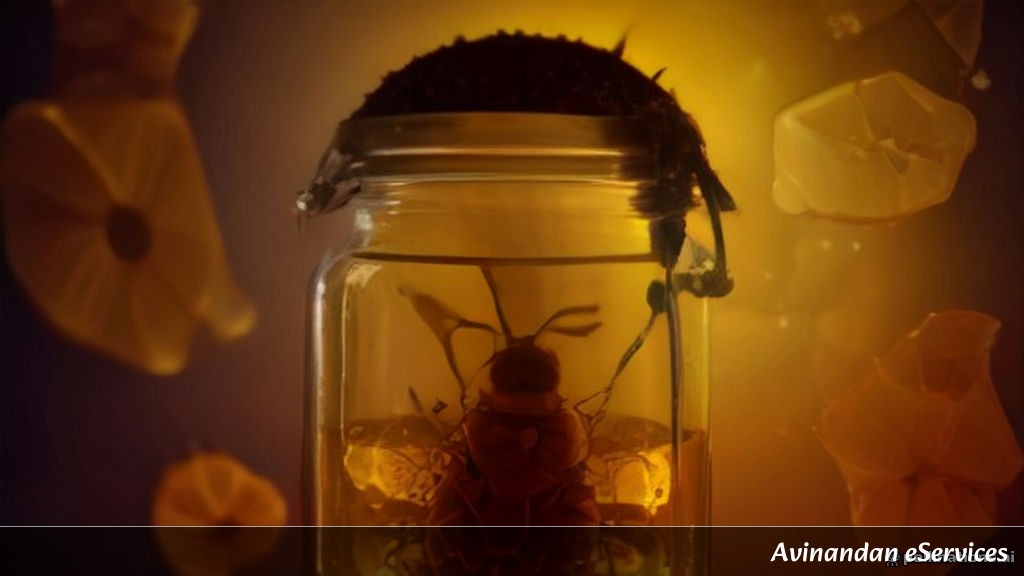
Kabir: Priya, look at this! I spilled a drop of honey from my toast onto the counter, and five minutes later, a whole parade of black ants marched in. That reminds me of a weird photo I saw in a wildlife magazine yesterday—an ant with a giant, glowing golden belly as round as a marble! Was that edited, or is it real?
Priya: Completely real, Kabir! You saw a honeypot ant. Unlike the kitchen ants carrying crumbs back to their nest, honeypot ants have an amazing survival trick. Some ants in the colony literally turn their own bodies into living honey jars!
Kabir: Living honey jars? Why would they do that? Honeybees build neat wax honeycombs. Why don't these ants build jars out of mud instead of turning their friends into balloons?
Priya: Great question! Honeypot ants live in dry deserts in Australia, Mexico, and the southwestern United States. For months, it barely rains and food vanishes. Suddenly, a storm hits, flowers bloom, and sweet nectar appears everywhere! Because ants cannot make beeswax, and dry desert sand crumbles too easily to hold liquid pools, they needed a smart backup plan. During the feast, young worker ants called 'repletes' volunteer to become living storage tanks for the whole colony.
Kabir: Hold on—how does a tiny ant swell up like a marble without popping like an overfilled water balloon?
Priya: It is brilliant insect engineering! Normally, an ant's abdomen is covered by hard armour plates called sclerites, arranged like overlapping roof tiles. Underneath sits a stretchy, folded membrane, like the pleats of an accordion. As a replete drinks more liquid food, its storage pouch expands. The hard plates separate, and the stretchy membrane unfolds smoothly! Over days of feeding, a full replete swells to the size of a small grape and weighs up to eight times its normal body weight, written as $W_{\text{full}} \approx 8 \times W_{\text{normal}}$. Once full, she stays tucked underground for months!
Kabir: Eight times heavier! That would be like me weighing 40 kilograms and suddenly carrying 280 kilograms of mango juice in my tummy! What is actually inside them?
Priya: Not bee honey, though it tastes similar! Worker ants forage at night when the desert cools down. They collect flower nectar, plant sap, and sugary honeydew made by tiny insects called aphids. Nectar is full of water and simple sugars like glucose, which has the chemical formula $C_6H_{12}O_6$. Foragers carry the nectar underground and feed it mouth-to-mouth to the repletes in a process called trophallaxis. Meanwhile, the repletes hang upside down by their claws from the ceilings of cool, deep caves.
Kabir: Hanging upside down like little golden bats! Once the dry season arrives, how do the other ants get the food out? Do they poke a straw in?
Priya: Haha, no straws needed! When another ant gets hungry, it walks up to a hanging replete and taps her antennae—like knocking on a pantry door. The replete squeezes special muscles around her pouch and brings up a shiny drop of sweet liquid onto her mouthparts. Even cooler, the food never rots underground! High sugar concentration pulls water out of germs through osmosis, and Australian honeypot ant honey also contains natural germ-fighting compounds that stop bacteria and fungi.
Kabir: A natural fridge AND a medicine cabinet! Have humans known about these ants for a long time?
Priya: For thousands of years! In Australia, First Nations and Aboriginal peoples have treasured the honeypot ant, Camponotus inflatus, as a nutritious desert sweet. They carefully dig into the earth to find a few repletes, gently enjoying the sweet golden abdomen like pure bush candy—sweet with a tiny tangy kick—while leaving the queen and most of the nest safe so the colony survives and thrives. Indigenous communities in Mexico have also cherished these ants for centuries, long before biologists first described them in scientific journals in the 1800s.
Kabir: Why do scientists still study them today? Can they help us invent new things?
Priya: Definitely! Doctors are studying Australian honeypot ant honey because its natural antimicrobial ingredients can kill stubborn bacteria that regular medicines struggle to stop. Meanwhile, engineers study how a replete's abdomen stretches without tearing to design flexible robots and tough medical liquid pouches. Nature is the smartest inventor!
So, What Did We Learn Today?
Priya: Surviving in tough places takes teamwork and clever biology! Here is a quick recap of our sweet discovery:
- Living Storage Jars: Desert honeypot ants use special worker ants called repletes to store liquid food inside their bodies for dry months.
- Stretchy Science: Hard plates on their abdomens spread apart so a folded membrane can expand until they weigh up to eight times their normal weight ($W_{\text{full}} \approx 8 \times W_{\text{normal}}$).
- Mouth-to-Mouth Sharing: Forager ants feed them sugary nectar ($C_6H_{12}O_6$) using trophallaxis, while repletes hang upside down in cool underground caves.
- Germ-Fighting Candy: Their stored honey resists spoiling and inspires scientists creating new medicines and flexible robotics!
Kabir: Next time I see ants in our kitchen, I will look closer! Though I am glad humans don't have to hang from the ceiling after eating gulab jamun!