Introduction: A Moment in Time
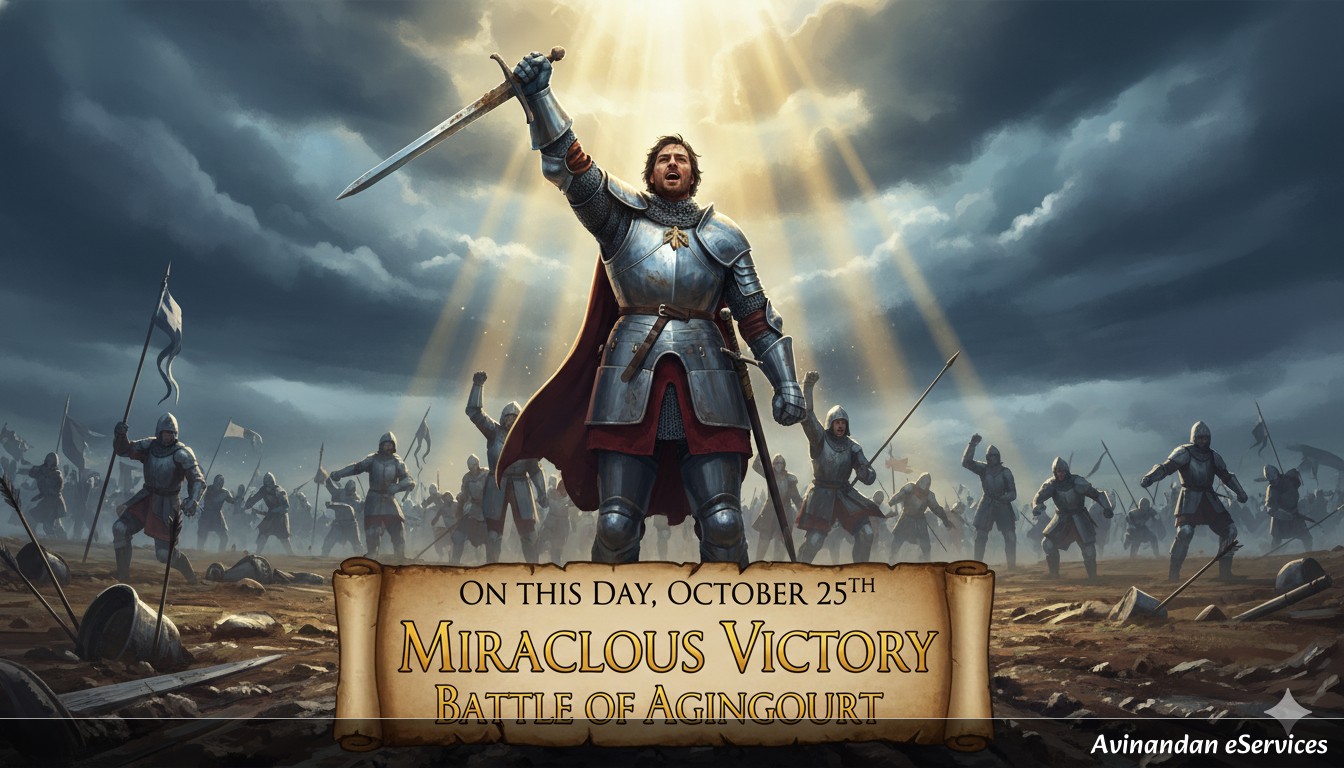
October 25th, 1415. On the feast day of Saints Crispin and Crispinian, a small, weary, and disease-ridden English army stood shivering in the autumn cold on a muddy field in northern France. They were vastly outnumbered by a confident and lavishly equipped French force, filled with the flower of their nobility. The stage was set for what should have been an overwhelming French victory, a final, crushing blow to the English presence on the continent. Yet, against all odds, what transpired on this day would become one of the most celebrated and improbable victories in military history: the Battle of Agincourt. It was a battle that would not only define the reign of a young English king but would also be immortalized in literature, most famously by William Shakespeare in his play Henry V. The story of Agincourt is a tale of desperation, brilliant leadership, groundbreaking military tactics, and the sheer grit of an army that refused to surrender.
The Build-Up: What Led to This Day?
The Battle of Agincourt was a pivotal moment in the long and complex conflict known as the Hundred Years' War, a series of disputes between England and France that spanned from 1337 to 1453. The root of the conflict lay in English claims to the French throne, dating back to Edward III. In 1415, after a period of relative peace, the young and ambitious King Henry V of England revived this claim. France at the time was internally fractured, with the French king, Charles VI, suffering from debilitating mental illness, leading to a power vacuum and a bitter civil war between two factions of the nobility: the Armagnacs and the Burgundians. Henry V, a skilled and ruthless military leader, saw this as the perfect opportunity to press his advantage.
In August 1415, Henry sailed from England with an army of around 12,000 men and laid siege to the strategic port of Harfleur in Normandy. The siege, however, proved more difficult and costly than anticipated. It dragged on for over a month, and though the town eventually fell, the English army was decimated by casualties and, more significantly, by an outbreak of dysentery. With his army weakened and the campaigning season drawing to a close, Henry made a fateful decision. Rather than return directly to England, he chose to march his remaining forces—numbering perhaps as few as 6,000 to 9,000 men—overland to the English-held port of Calais. This was a deliberately provocative act, a demonstration of his right to march through what he considered his French domains. The French, enraged by the fall of Harfleur and Henry's audacity, amassed a large army to intercept and destroy the English intruders. After being shadowed for weeks and finding their path to Calais blocked, the exhausted English army was finally forced to confront the might of France on a field near the village of Agincourt.
The Event Itself
On the morning of October 25th, the two armies faced each other across a recently plowed field, turned into a muddy quagmire by heavy rain. The terrain would prove to be a crucial factor. The battlefield was a narrow corridor of open land, flanked by dense woods, which constricted the French army's ability to deploy its superior numbers and use its cavalry to outflank the English. Henry V, an astute tactician, recognized this advantage. He arranged his small force with his men-at-arms in the center and on the wings, interspersed with large wedges of his most crucial asset: the English and Welsh longbowmen. These archers, who made up nearly 80 percent of his army, were highly skilled soldiers, capable of unleashing a devastating storm of arrows. To protect them from the anticipated charge of the French knights, Henry ordered them to plant long, sharpened stakes in the ground before them.
The French army, a magnificent but unwieldy force estimated to be anywhere from 12,000 to 36,000 strong, was a stark contrast to the disciplined English. Commanded by the Constable of France, Charles d'Albret, it was composed of a huge number of heavily armored knights and men-at-arms, eager for glory. Their confidence bordered on arrogance, and their command structure was muddled and disunified. They planned to smash the English line with a massive frontal assault.
For several hours, the two armies stood in a tense standoff. Finally, recognizing his army's desperate situation, Henry took a gamble and advanced his line to within \textreme longbow range. This goaded the French into action. The first wave of French knights lumbered forward across the sodden ground. The English longbowmen responded, loosing a torrent of arrows that was said to have darkened the sky. The armor-piercing bodkin points of their arrows wreaked havoc on the French horses and found the weaker points in the knights' plate armor. The charge faltered and turned into a chaotic retreat, with panicked horses trampling the advancing French infantry.
The second wave of dismounted French men-at-arms then began their slow, exhausting slog through the deep mud, all while under a relentless hail of arrows. By the time they reached the English lines, they were exhausted and disorganized. The lightly armored English archers, having exhausted their arrows, abandoned their bows and joined the fray with swords, axes, and mallets. What followed was a brutal melee. The French, packed so tightly together and weighed down by their heavy armor in the thick mud, could barely lift their weapons. If they fell, they struggled to get back up and were easy targets. The battle turned into a slaughter. Within a few hours, the French first and second lines had been annihilated, with thousands killed or taken prisoner. A controversial moment came late in the battle when Henry, fearing a regrouping of the French forces and a raid on his baggage train, ordered the execution of a large number of French prisoners—an act that, while perhaps militarily necessary, was seen as a shocking breach of the chivalric code. The English victory was total and overwhelming.
The Aftermath and Legacy
The scale of the French disaster at Agincourt was staggering. It is estimated that the French lost around 6,000 men, including the Constable of France, three dukes, and a host of other high-ranking nobles. English casualties, by contrast, are thought to have been in the mere hundreds. The battle was a devastating blow to the French nobility and military leadership. Henry V and his 'band of brothers' were able to march unhindered to the safety of Calais and returned to England as heroes.
The victory at Agincourt significantly boosted English morale and solidified Henry V's position on the English throne. It paved the way for his subsequent, more successful campaigns to conquer Normandy. The long-term political impact was profound. In 1420, with the French still reeling and divided, Henry was able to force the mentally fragile Charles VI to sign the Treaty of Troyes. This treaty recognized Henry as the heir to the French throne and sealed the deal with his marriage to Charles's daughter, Catherine. It seemed as though Henry had achieved the ultimate English war aim. However, his triumph was short-lived. Henry V died unexpectedly of dysentery in 1422, leaving his infant son, Henry VI, as the heir to both kingdoms. His death marked a turning point, and a French resurgence, famously inspired by Joan of Arc, would eventually lead to the expulsion of the English from France by 1453.
Despite the ultimate failure of the English to secure the French crown, the legacy of Agincourt endures. It stands as a testament to the effectiveness of the longbow, a weapon that allowed disciplined infantry to defeat the elite, heavily armored cavalry that had dominated medieval battlefields. The battle became a cornerstone of English national identity, a symbol of the underdog triumphing against impossible odds. More than any other battle of the Hundred Years' War, Agincourt, thanks in large part to Shakespeare's dramatic retelling, has captured the popular imagination, forever etching October 25th into the annals of history as a day of unbelievable victory.
References
Britannica, T. Editors of Encyclopaedia (2025, October 11). Battle of Agincourt. Encyclopedia Britannica.
Cartwright, M. (2020, March 2). Battle of Agincourt. World History Encyclopedia.
Wikipedia contributors. (2025, October 23). Battle of Agincourt. Wikipedia, The Free Encyclopedia.
The National Archives. (n.d.). The Battle of Agincourt. The National Archives.
Compact Histories. (2025, March 19). The Battle of Agincourt: The Longbow's Deadly Legacy.
BritishBattles.com. (n.d.). The Battle of Agincourt.