Samir: Ouch! Isha, my sweater just gave me a little zap! I really don’t like static electricity. It’s so surprising and annoying.
Isha: I know what you mean, Samir. It’s a bit of a shock, isn't it? But what if I told you that thousands of years ago, people looked for electric shocks on purpose, not from sweaters, but from sea creatures?
Samir: No way! Why would anyone want to get zapped on purpose? That sounds completely crazy. Were they doing it for a silly dare or something?
Isha: Not for a dare, but for medicine! The ancient Romans and Greeks used a special kind of electric fish to treat all sorts of pain, especially for terrible headaches and a painful foot condition called gout.
Samir: Electric fish? You mean like an electric eel from the jungle movies? Did they have those in ancient Rome?
Isha: That’s a great question! They didn't have electric eels, which live in the fresh waters of South America. But they had something just as amazing in their own Mediterranean Sea. It’s a creature called the Torpedo fish, which is also known as an electric ray. It’s a flat, roundish fish that can deliver a very powerful jolt when it’s surprised or trying to defend itself.
Samir: Wow! So how did they even figure out that a fish’s electric shock could be used as medicine? Did a fisherman accidentally step on one and suddenly their headache just vanished?
Isha: That’s probably very close to how it was discovered! Imagine a fisherman trying to pull one out of a net and getting his hands completely numbed by the shock. Someone must have been clever enough to make the connection. We know about it for sure because a Roman physician named Scribonius Largus wrote it all down in his medical texts around the year 46 AD.
Samir: A doctor actually wrote about zapping people with fish? What did he say? Did he have special instructions?
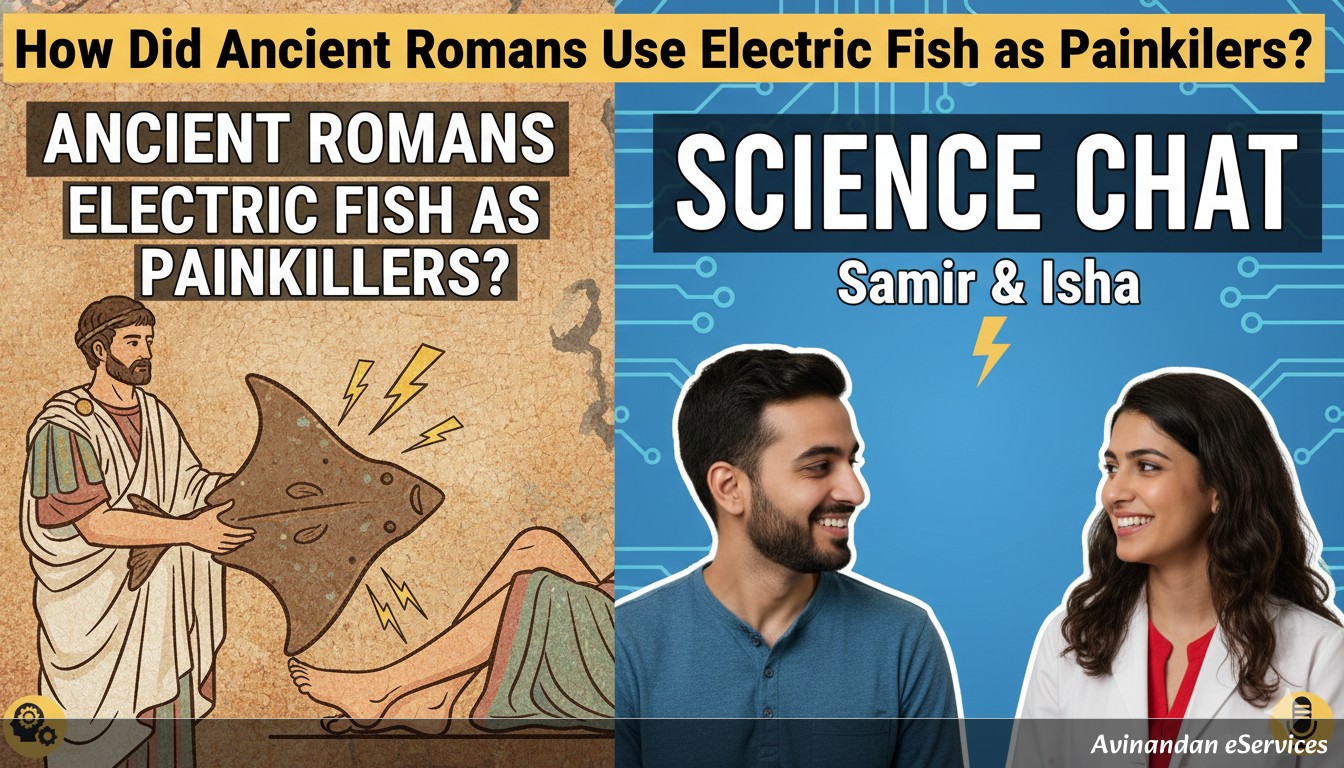
Isha: He did! He gave very specific directions for his patients. He wrote that to cure a constant headache, a live, black torpedo fish should be placed on the person's head and left there until the pain goes away and the whole area feels numb. For foot pain from gout, the patient had to stand on a live electric ray on a wet beach until their whole leg felt numb, sometimes all the way up to the knee!
Samir: Whoa, standing on a live fish on a wet beach? That is so wild! But how does it actually work? How can an electric shock stop you from feeling pain?
Isha: It's all about biology and how our nerves send messages. It’s a process we now call bioelectricity—electricity made by living things. The Torpedo ray has two special kidney-shaped organs, one on either side of its head. These organs are made of millions of modified muscle cells called electrocytes. The best way to think of it is that each electrocyte is like a tiny, natural battery.
Samir: So it’s like the fish is filled with millions of little batteries all lined up?
Isha: Exactly! The electrocytes are stacked in columns, like rolls of coins. When the fish wants to shock something, its brain sends a nerve signal, and all those tiny batteries discharge their electricity at the exact same moment. Together, they can create a shock of up to 220 volts! When that electric current hits a person, it creates a sort of traffic jam in their nerves. The jolt overwhelms the nerve endings, which stops them from sending pain signals to the brain. It’s like creating a 'busy signal' on a phone line—the pain message just can't get through.
Samir: So the electricity numbs the nerves and blocks the pain. That's clever! But was it safe? And did the relief last for a long time?
Isha: It was definitely a temporary fix. Once the numbness wore off, the pain would come back. As for safety, it was probably a bit risky! But for people who were in \textreme pain and had no other options, it was a miracle. And what’s really incredible is that this ancient idea is the great-great-grandfather of a modern medical treatment!
Samir: It is? Like what? Do doctors today still use fish?
Isha: Haha, no, they don't use fish anymore! But I bet you’ve seen a TENS unit. It stands for Transcutaneous Electrical Nerve Stimulation. It’s a small machine with sticky pads that sends gentle electrical pulses through your skin. Doctors and physical therapists use it to help manage pain from injuries. The principle is exactly the same as the Roman method: use a mild electrical current to block pain signals. The Romans just used a much more… slippery and organic version of the machine!
Samir: That is so cool! So the Romans basically had a fish-powered TENS machine! They were using the power of nature to do science and medicine. It's amazing to think that a medical idea from two thousand years ago is still helping people today, just with better, safer technology.
Isha: It really is. It shows how observant ancient people were, even without all the scientific tools we have today. They saw something amazing in nature—a fish that could produce a jolt like lightning—and figured out a practical way to use it to help people. It's one of the world's first examples of electrotherapy.
So, What Did We Learn Today?
- Ancient civilizations like the Romans and Greeks used electric fish as a form of medical treatment for pain.
- The fish they used was the Torpedo ray, also known as the electric ray, which lives in the Mediterranean Sea.
- The live fish was placed directly on the painful area, like the head for headaches or under the feet for gout, to deliver an electric shock.
- This shock numbs the area by overwhelming the nerves and temporarily blocking pain signals from reaching the brain.
- The fish generates powerful electricity using special organs filled with cells called electrocytes, which act like thousands of tiny batteries firing at once.
- This ancient practice is considered one of the earliest forms of electrotherapy and is the ancestor of modern pain-relief devices like TENS units.
Samir: Wow! So the next time I get a static shock from my sweater, I’ll just pretend I’m an ancient Roman trying to cure a headache. It’s incredible to think that nature had its own electric medicine just swimming around in the sea!