The Toughest Animal on Earth is a Microscopic 'Water Bear'!
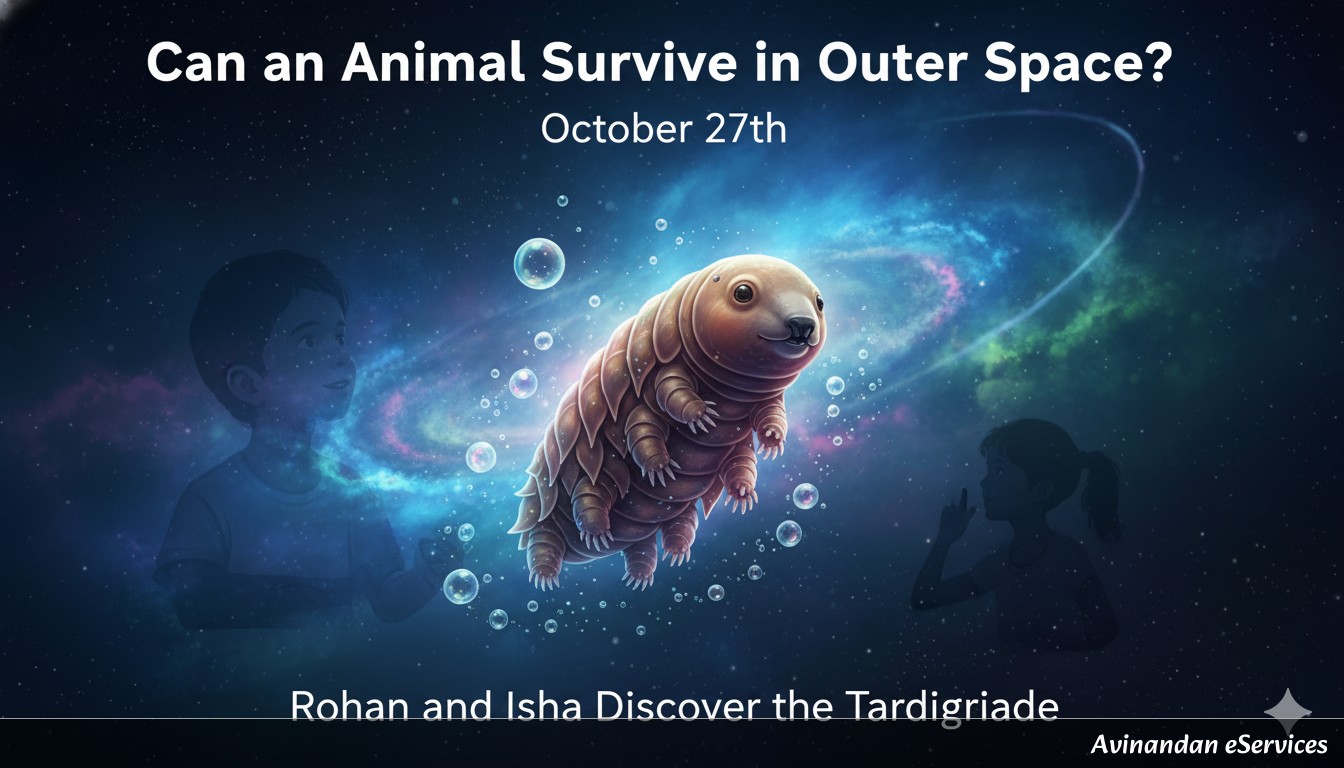
Rohan: Isha, you have to see this! I was reading a science comic online, and it shows this tiny creature called a 'water bear' that has superpowers. It says it can survive being frozen, boiled, and even blasted into outer space! That sounds totally made up. It looks like a tiny, eight-legged gummy bear.
Isha: Oh, I know what you're talking about! That's a tardigrade! And believe it or not, Rohan, it's completely real. They’re also called 'moss piglets,' and while they might not have superpowers like in the comics, they are probably the toughest, most resilient animals on the entire planet.
Rohan: Seriously? But they're so small! How can something microscopic be tougher than a lion or a crocodile? And how could it possibly survive in space? There's no air to breathe, it’s freezing cold, and there's tons of dangerous radiation!
Isha: That's the incredible part. Tardigrades are '\textremophiles,' which is a fancy word for organisms that can live in \textreme environments. They have a special survival trick called cryptobiosis. The word literally means 'hidden life.' When conditions get really bad, they don't just tough it out—they basically press a pause button on life itself.
Putting Life on Pause
Rohan: A pause button? Like on a video game? How does that even work?
Isha: It's amazing. When a tardigrade finds itself without water or in \textreme temperatures, it curls up into a tiny, dry ball called a 'tun.' It pushes almost all the water out of its body—we're talking like 97% of it! Then, it floods its cells with special sugars and proteins. These substances turn into a glass-like material that protects all its important parts, like its DNA and proteins, from being damaged.
Rohan: So it turns itself into a tiny, sugary glass ball? That's so weird! And it can just… wake up later?
Isha: Exactly! It can stay in that 'tun' state for years, even decades. Then, when it comes into contact with water again, it rehydrates, uncurls, and just starts crawling around as if nothing happened, usually within a few hours.
A True Space Explorer
Rohan: Okay, that's cool, but what about space? Did scientists really send them to space?
Isha: They sure did! In 2007, the European Space Agency sent a group of tardigrades into orbit on a satellite. They were exposed directly to the vacuum of outer space and deadly solar radiation for ten days. When they were brought back to Earth and rehydrated, many of them survived and even went on to have healthy babies!
Rohan: That is unbelievable! So what else can they survive? Are there any other 'superpowers'?
Isha: Oh, yes! Scientists have tested them in all sorts of crazy conditions. They can survive freezing temperatures close to absolute zero, which is the coldest temperature possible in the universe. They can also survive being boiled in temperatures over 150 degrees Celsius for a short time. They can even withstand pressures six times greater than at the bottom of the deepest ocean trench!
Why Study a Super-Tough Speck?
Rohan: Wow. So, why is it important to study them? Is it just because they're cool and almost indestructible?
Isha: That's a great question. It's not just a cool fact. Understanding how tardigrades protect themselves could lead to amazing new technologies. Imagine if we could use their tricks to preserve human organs for a much longer time before a transplant. Or what if we could create vaccines that don't need to be kept in a refrigerator because they use the same protective sugars? Scientists are even studying them to see if we can learn how to protect astronauts from radiation on long space missions, like a trip to Mars.
Rohan: So these tiny water bears could help us explore space and save lives here on Earth? That's amazing. They really are superheroes!
So, What Did We Learn Today?
Isha: We learned about one of the most fascinating creatures on our planet! Here’s a quick recap of the tardigrade's incredible story:
- Tardigrades, also known as 'water bears' or 'moss piglets,' are microscopic animals that are famous for their amazing survival skills.
- They are called \textremophiles because they can live in environments where most other life forms can't.
- Their main survival trick is a state of suspended animation called cryptobiosis, where they dry up and turn into a tiny, protected ball called a 'tun.'
- In this state, they can survive the vacuum of space, \textreme hot and cold temperatures, massive pressure, and intense radiation.
- Studying tardigrades could help scientists make breakthroughs in medicine, like preserving organs and creating stable vaccines, and even in protecting astronauts in space.
Rohan: So the toughest animal on Earth isn't a shark or a bear—it’s a tiny little 'space bear' that's too small to even see. Science is so cool!