Introduction: What is the Pradhan Mantri Awas Yojana (PMAY)?
The Pradhan Mantri Awas Yojana (PMAY) is a landmark initiative by the Government of India, launched with the vision of providing "Housing for All". Since its inception in 2015, this flagship mission has been working to address the housing shortage for eligible families in both rural and urban areas across the country. The scheme is broadly divided into two main components: Pradhan Mantri Awas Yojana-Urban (PMAY-U), managed by the Ministry of Housing and Urban Affairs, and Pradhan Mantri Awas Yojana-Gramin (PMAY-G), managed by the Ministry of Rural Development.
The core objective of PMAY is to ensure that every eligible household has a 'pucca' house, which is an all-weather dwelling unit equipped with essential amenities like a toilet, electricity, LPG connection, and tap water. This is achieved through a convergence of various government schemes. Over the last decade, the PMAY scheme has already completed the construction of over 4.21 crore houses for poor families, significantly improving their living standards and providing a sense of dignity and security.
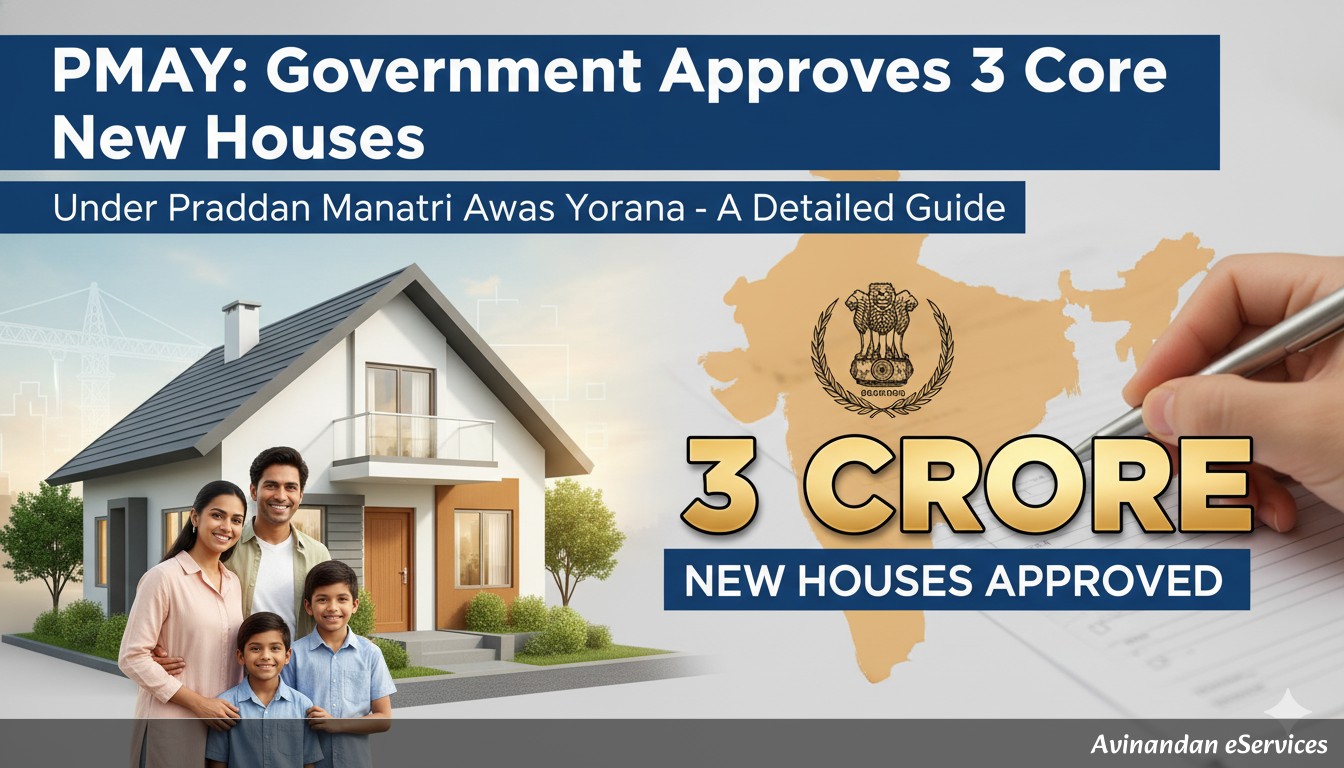
The Latest Announcement: 3 Crore Additional Houses Approved
In a significant move to continue this mission, the Union Cabinet, in its first meeting after the recent elections in June 2024, approved the construction of an additional 3 crore houses for eligible rural and urban families. This major announcement underscores the government's sustained commitment to eradicating housing poverty and enhancing the 'Ease of Living' for its citizens. The plan includes the construction of 2 crore houses under PMAY-Gramin and 1 crore houses under PMAY-Urban.
Key Features and Objectives
The Pradhan Mantri Awas Yojana is built on several key pillars that aim to make housing affordable, accessible, and inclusive.
- Housing for All: The primary objective is to provide a pucca house to every houseless family and those living in kutcha or dilapidated houses.
- Financial Assistance: The government provides direct financial assistance to beneficiaries for the construction of their homes. For PMAY-G, this is ₹1.20 lakh in plain areas and ₹1.30 lakh in hilly or difficult areas. PMAY-U offers assistance through various models, including a credit-linked subsidy scheme (CLSS).
- Women Empowerment: A transformative provision of the scheme mandates that the house should be in the name of the female head of the household or in joint ownership. This has led to a significant increase in homeownership among women, with over 72% of houses under PMAY-G being owned solely or jointly by women.
- Provision of Basic Amenities: Every house constructed under PMAY is provided with essential facilities like a toilet, LPG connection (Ujjwala Yojana), electricity (Saubhagya Scheme), and a functional household tap connection through convergence with other government welfare schemes.
- Quality and Sustainability: The scheme promotes the use of local materials and sustainable, disaster-resilient construction practices. The minimum size of a house has also been increased to 25 sq. mt. to include a dedicated area for hygienic cooking.
- Transparency: Beneficiaries are selected through a transparent process based on the Socio-Economic and Caste Census (SECC) 2011 data and verified by the Gram Sabha to ensure aid reaches the most deserving. Funds are transferred directly to the beneficiary's bank account (Direct Benefit Transfer - DBT) to ensure efficiency.
Pradhan Mantri Awas Yojana-Gramin (PMAY-G)
Who is Eligible? (Eligibility Criteria for PMAY-G)
The selection of beneficiaries for PMAY-G is not based on an open application process but on a carefully curated list to prioritize the most deprived households.
- The primary list of beneficiaries is derived from the Socio-Economic and Caste Census (SECC) of 2011.
- It includes all houseless households and families living in zero, one, or two-room houses with kutcha walls and kutcha roofs.
- The list is then verified by the Gram Sabha to ensure transparency and accuracy.
- There are also automatic exclusion criteria, which bar households that own motorized vehicles, agricultural equipment, or have a Kisan Credit Card with a limit of ₹50,000 or more.
- The scheme gives priority to households with no adult member between 16-59 years, female-headed households with no adult male member, and families with a disabled member and no other able-bodied adult.
How to Avail the Benefits of PMAY-G
Since the process is not application-driven, citizens cannot directly apply for PMAY-G in most cases. The process works as follows:
- The government uses the SECC 2011 and Awaas+ survey data to create a Permanent Wait List (PWL) of eligible beneficiaries.
- This list is made public and verified by the local Gram Sabha.
- Once the list is finalized, beneficiaries are registered, and their details are verified.
- Financial assistance is then transferred in installments directly to the beneficiary's bank account, linked to the stages of house construction which are monitored through geo-tagged photographs.
- Beneficiaries can check their name on the PWL through the official PMAY-G website or at their local Gram Panchayat office.
Pradhan Mantri Awas Yojana-Urban (PMAY-U)
Who is Eligible? (Eligibility Criteria for PMAY-U)
Eligibility for PMAY-U is based on the annual income of the household. A beneficiary family is defined as comprising a husband, wife, and unmarried children. A critical condition is that the beneficiary family must not own a pucca house in their name or in the name of any family member in any part of India.
The income categories are as follows:
- Economically Weaker Section (EWS): Households with an annual income of up to ₹3 lakh.
- Low-Income Group (LIG): Households with an annual income between ₹3,00,001 and ₹6 lakh.
- Middle-Income Group I (MIG-I): Households with an annual income between ₹6,00,001 and ₹12 lakh.
- Middle-Income Group II (MIG-II): Households with an annual income between ₹12,00,001 and ₹18 lakh.
The scheme has four main components or 'verticals' to cater to different needs:
- 'In-situ' Slum Redevelopment (ISSR): Uses land as a resource to provide houses to eligible slum dwellers.
- Credit Linked Subsidy Scheme (CLSS): Provides an interest subsidy on home loans for beneficiaries from EWS, LIG, and MIG categories.
- Affordable Housing in Partnership (AHP): Provides financial assistance to public and private sector entities to build affordable housing projects.
- Beneficiary-led individual house Construction/Enhancement (BLC): Provides central assistance to eligible families to construct a new house or enhance an existing one.
How to Apply / Avail the Benefits of PMAY-U
Unlike PMAY-G, eligible citizens can apply for PMAY-U through a more direct process.
- Online Application: Applicants can visit the official PMAY-U website (pmaymis.gov.in). Under the 'Citizen Assessment' section, they can choose the relevant category and fill out the online application form. An Aadhaar number is mandatory for the application.
- Offline Application: Alternatively, applicants can visit their nearest Common Service Centre (CSC) to get the application form. The form can be filled out and submitted there for a nominal fee.
- Required Documents: Key documents include Aadhaar card, proof of identity (PAN card, Voter ID), address proof, income proof (self-certificate/affidavit, salary slips, IT returns), and an affidavit stating that the beneficiary does not own a pucca house.
- Application Tracking: After submission, applicants receive an Assessment ID which can be used to track the status of their application on the PMAY-U portal.
Official Sources
- Press Information Bureau (PIB) Announcement: https://pib.gov.in/PressReleasePage.aspx?PRID=2023821
- PMAY-Urban Official Website: https://pmaymis.gov.in/
- PMAY-Gramin Official Website: https://pmayg.nic.in/netiayHome/home.aspx