Introduction: A Moment in Time
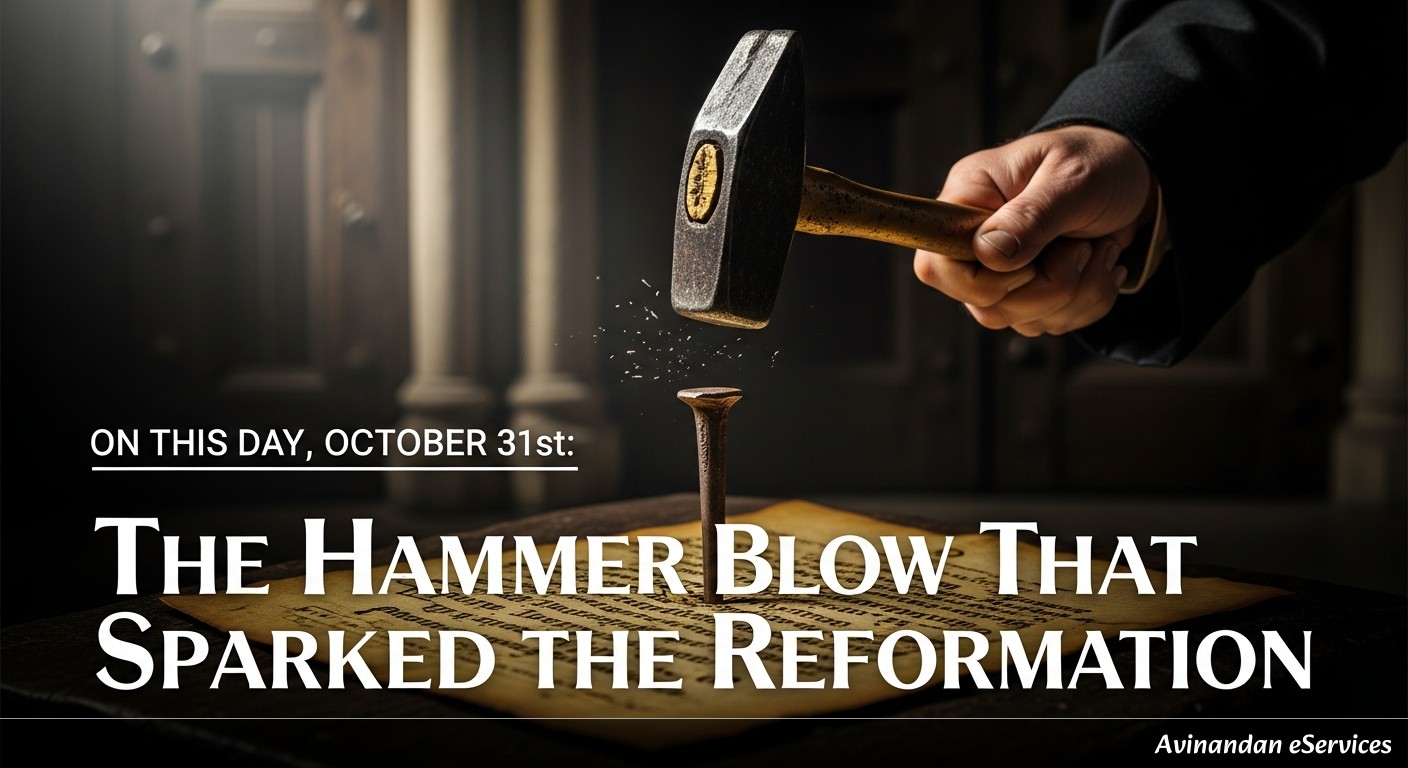
On October 31, 1517, on the eve of All Saints' Day, a momentous act of defiance is said to have taken place in the small German town of Wittenberg. An Augustinian monk and professor of moral theology named Martin Luther allegedly nailed a document to the door of the Castle Church. This document, known as the "Disputation on the Power and Efficacy of Indulgences," would come to be famously known as the Ninety-five Theses. While the historical accuracy of this dramatic act is debated by some scholars, its impact is undeniable. This single act is widely considered the catalyst for the Protestant Reformation, a movement that would permanently shatter the religious unity of Western Christendom and reshape the political, social, and cultural landscape of Europe for centuries to come.
The Build-Up: What Led to This Day?
To understand the significance of Luther's Ninety-five Theses, one must first grasp the religious climate of the early 16th century. The Roman Catholic Church was the dominant spiritual and political force in Western Europe. However, discontent was simmering. The Church was plagued by accusations of corruption and a growing disconnect between its immense wealth and the spiritual needs of its followers. A key point of contention was the practice of selling indulgences.
In Catholic theology at the time, an indulgence was a way to reduce the amount of punishment one had to undergo for sins. While the Church taught that divine forgiveness could not be bought or sold, the practice became increasingly commercialized. In 1517, a Dominican friar named Johann Tetzel was aggressively marketing special indulgences to raise money for the rebuilding of St. Peter's Basilica in Rome. Half of the proceeds were secretly designated to help the Archbishop of Mainz, Albert of Brandenburg, pay off a loan he had taken to secure his appointment. Tetzel's sales pitch was particularly egregious, with slogans like, "As soon as the coin in the coffer rings, the soul from purgatory springs." This crass commercialization of salvation deeply troubled Martin Luther.
Luther, a devout and conscientious theologian, had long struggled with the Church's teachings on sin and salvation. Through his intensive study of the scriptures, he had come to believe that salvation was a gift from God, attainable through faith alone, not by good works or financial contributions. The sale of indulgences, in his view, was not only a corrupt practice but also a dangerous deception that led people away from true repentance and faith in God. Motivated by a desire to spark an academic debate and bring what he saw as a grave theological error to light, Luther penned his Ninety-five Theses.
The Event Itself
The Ninety-five Theses were not a revolutionary manifesto in the modern sense. Written in Latin, the language of scholars, they were a series of propositions for academic debate. Luther's tone was more questioning than accusatory, and he initially believed his views were in line with the Pope's. The theses challenged the Pope's authority to remit temporal punishment for sins and argued that true repentance was an internal matter of the heart, not something that could be achieved through a financial transaction. Thesis 86, for example, provocatively asked, "Why does not the pope, whose wealth is today greater than the wealth of the richest Crassus, build this one basilica of St. Peter with his own money rather than with the money of poor believers?"
On that fateful October 31st, Luther sent a copy of his theses to Albert of Brandenburg. It is traditionally believed that he also posted them on the door of the Castle Church, which served as a public bulletin board for the university. Whether he nailed them to the door or simply circulated them among his colleagues, the impact was explosive. Thanks to the newly invented printing press, the Ninety-five Theses were quickly translated into German and distributed throughout the Holy Roman Empire and beyond. What was intended as a scholarly debate quickly escalated into a public firestorm.
The Aftermath and Legacy
The reaction to the Ninety-five Theses was swift and severe. The established Church authorities saw Luther's arguments as a direct challenge to their power and authority. In 1518, Luther was summoned to Augsburg to defend his positions before a papal legate and was later called to account at a series of debates. The controversy culminated in 1521 at the Diet of Worms, an imperial assembly where Luther was ordered to recant his writings. In a now-famous declaration, Luther refused, stating, "Unless I am convinced by the testimony of the Scriptures or by clear reason... I am bound by the Scriptures I have quoted and my conscience is captive to the Word of God. I cannot and will not recant anything, since it is neither safe nor right to go against conscience." As a result, he was excommunicated by the Pope and declared an outlaw by the Holy Roman Emperor.
Despite the condemnation, Luther's ideas had taken root. The Ninety-five Theses had ignited a widespread movement for religious reform that came to be known as the Protestant Reformation. This movement led to a permanent schism in Western Christianity, with the establishment of various Protestant denominations. The Reformation had far-reaching consequences beyond the realm of religion. It fueled political conflicts, such as the Thirty Years' War, and led to a redrawing of the map of Europe. The Peace of Augsburg in 1555, for instance, established the principle of *Cuius regio, eius religio* ("Whose realm, his religion"), allowing rulers to determine the religion of their own state.
The legacy of the Reformation is complex and multifaceted. It championed the idea of the individual's direct relationship with God, leading to increased literacy as people were encouraged to read the Bible in their own language. It also had a profound impact on the development of modern democracy, individualism, and civil rights. The hammer blow on the church door in Wittenberg, whether literal or symbolic, was a sound that echoed through the centuries, heralding the dawn of a new era in Western civilization.
References
- Britannica, The Editors of Encyclopaedia. "Ninety-five Theses". Encyclopedia Britannica, 23 Sep. 2025.
- Britannica, The Editors of Encyclopaedia. "Diet of Worms". Encyclopedia Britannica, 27 Oct. 2025.
- Christian History Institute. "1517 Luther Posts the 95 Theses". Christian History Magazine.
- Mark, Joshua J. "Martin Luther's 95 Theses". World History Encyclopedia, 01 Dec. 2021.
- Wikipedia contributors. "Ninety-five Theses." Wikipedia, The Free Encyclopedia.
- World History Encyclopedia. "Diet of Worms." World History Encyclopedia, 08 Dec. 2021.