Introduction
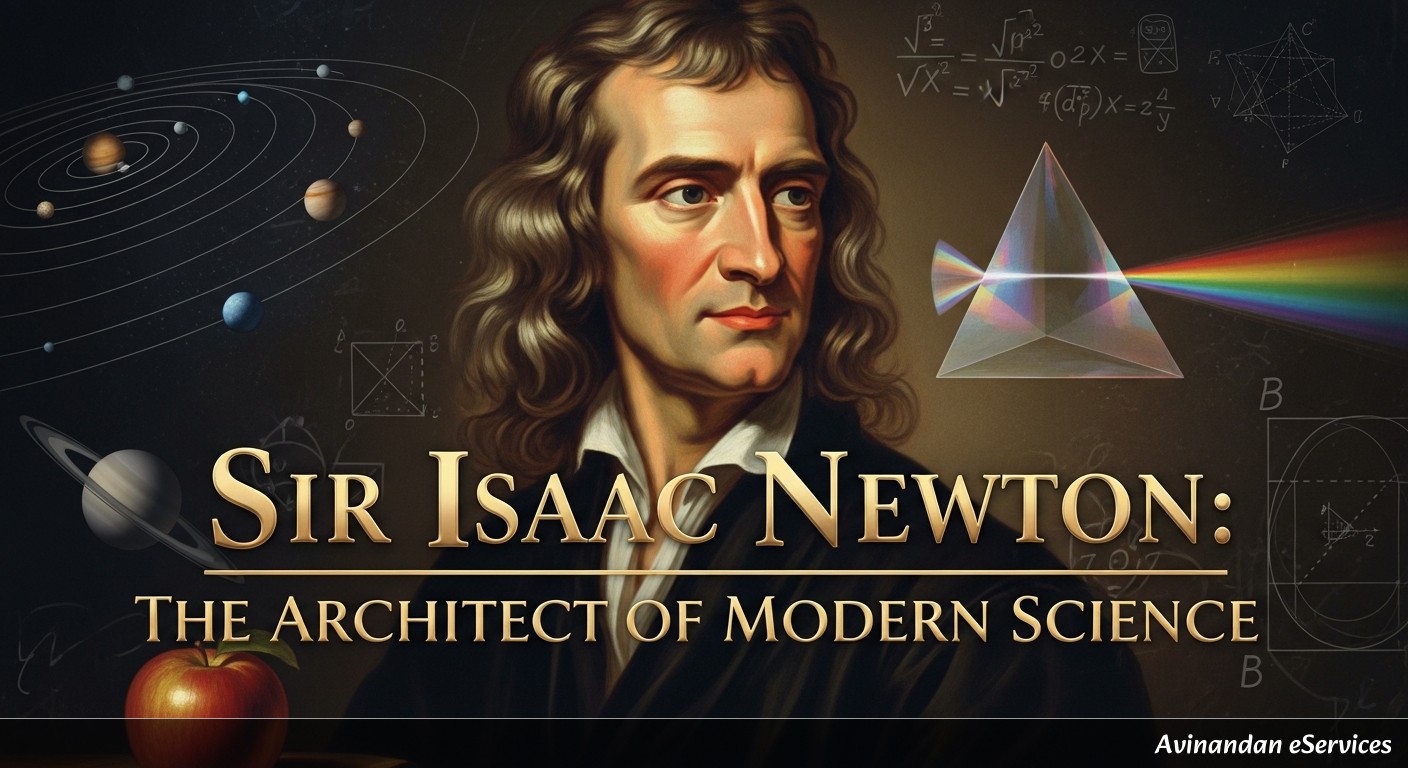
Sir Isaac Newton was an English mathematician, physicist, astronomer, theologian, and author who is widely recognized as one of the most influential scientists of all time and as a key figure in the scientific revolution. His book Philosophiæ Naturalis Principia Mathematica (Mathematical Principles of Natural Philosophy), first published in 1687, laid the groundwork for classical mechanics. Newton's work on optics was groundbreaking, and he shares credit with Gottfried Wilhelm Leibniz for developing infinitesimal calculus. A man of immense intellectual curiosity, Newton's insights into the laws of nature reshaped humanity's understanding of the universe and propelled the scientific advancement of the Enlightenment and beyond. His formulation of the three laws of motion and the law of universal gravitation provided a unified framework for explaining the movements of objects on Earth and celestial bodies in the heavens.
Early Life and Education
Isaac Newton was born prematurely on January 4, 1643 (or Christmas Day 1642, according to the Julian calendar then in use in England), in Woolsthorpe, a small hamlet in Lincolnshire. His father, also named Isaac Newton, a prosperous farmer, had died three months before his birth. Newton was a small and frail baby, not expected to survive. When Newton was three years old, his mother, Hannah Ayscough, remarried and went to live with her new husband, the Reverend Barnabas Smith, leaving the young Isaac in the care of his maternal grandmother. This separation left a lasting imprint on Newton, contributing to a sense of insecurity that would manifest later in his life.
From the age of about twelve to seventeen, Newton was educated at The King's School in Grantham, where he was introduced to the world of chemistry while lodging with a local apothecary. Initially, his school reports described him as 'idle' and 'inattentive'. His mother later pulled him out of school with the intention of making him a farmer, an occupation he detested. Recognizing his intellectual potential, his uncle, a graduate of Trinity College, Cambridge, persuaded his mother to allow him to return to school. In June 1661, Newton was admitted to Trinity College, Cambridge, where he initially enrolled as a subsizar, performing valet duties to pay his way until he was awarded a scholarship in 1664. While the curriculum was heavily based on the works of Aristotle, Newton's interests lay with more modern philosophers like René Descartes and astronomers such as Galileo Galilei and Johannes Kepler. He immersed himself in their works, laying the foundation for his future discoveries.
Major Accomplishments and Career
Newton's time at Cambridge was immensely productive, but it was during the years of the Great Plague (1665-1666), when the university was closed and he returned to Woolsthorpe, that his genius truly flourished. He later referred to this period as "the prime of my age for invention." In these two years, he laid the groundwork for his theories on calculus, optics, and the law of universal gravitation.
The Laws of Motion and Universal Gravitation
Newton's most celebrated work, the Principia, published in 1687, detailed his three laws of motion, which form the basis of classical mechanics. The first law, the law of inertia, states that an object at rest will stay at rest, and an object in motion will stay in motion with the same speed and in the same direction unless acted upon by an \texternal force. The second law establishes a connection between force, mass, and acceleration, famously expressed in the equation F=ma. The third law posits that for every action, there is an equal and opposite reaction. In the Principia, Newton also formulated the law of universal gravitation, which states that every particle in the universe attracts every other particle with a force that is directly proportional to the product of their masses and inversely proportional to the square of the distance between their centers. This law explained, with mathematical precision, the orbits of planets, the tides, the trajectory of comets, and other celestial phenomena, unifying the heavens and the Earth under a single set of principles.
Contributions to Optics
Newton's work in optics was equally revolutionary. Beginning his experiments in the mid-1660s, he used a prism to demonstrate that white light is not a single entity but is composed of a spectrum of colors. He showed that each color corresponds to a different angle of refraction. This discovery challenged centuries of belief that colors were modifications of white light. To overcome the problem of chromatic aberration in refracting telescopes, where different colors of light are focused at different points, Newton designed and constructed the first reflecting telescope in 1668. His book Opticks, published in 1704, collected his \textensive research on light and color and laid the foundation for modern physical optics.
The Invention of Calculus
To provide a mathematical framework for his physical theories, Newton developed a new form of mathematics that he called the "method of fluxions," now known as calculus. He began this work in the mid-1660s to describe and calculate rates of change. This powerful tool allowed him to tackle complex problems in physics, such as calculating the orbits of planets. Although German mathematician Gottfried Wilhelm Leibniz independently developed his own system of calculus, Newton's work is recognized as a monumental achievement that has been fundamental to the advancement of science, engineering, and economics.
Later Life and Public Service
In his later years, Newton's focus shifted from pure scientific inquiry to public service. In 1696, he was appointed Warden of the Royal Mint, and in 1699, he became Master of the Mint, a position he held until his death. He took his duties seriously, overseeing the great recoinage of English currency and prosecuting counterfeiters. He was elected President of the Royal Society in 1703 and was re-elected each year until his death. In 1705, he was knighted by Queen Anne, becoming the first scientist to be so honored for his work. Newton passed away on March 31, 1727, and was buried with great honor in Westminster Abbey.
Legacy and Impact
Sir Isaac Newton's impact on science and the world is immeasurable. His laws of motion and universal gravitation provided a comprehensive and mathematically rigorous explanation of the physical universe that remained the cornerstone of physics for over two centuries, until the advent of Albert Einstein's theory of relativity. His invention of calculus gave science and mathematics a powerful new tool for analyzing change. Newton's emphasis on observation, experimentation, and mathematical reasoning helped to establish the scientific method as the primary means of acquiring knowledge about the natural world. He demonstrated that the universe was governed by rational and predictable laws, a concept that profoundly influenced not only science but also philosophy, politics, and religion. His work continues to be a fundamental part of scientific education and a source of inspiration for scientists and thinkers worldwide.
Quick Facts
- Newton once inserted a bodkin (a long, blunt needle) into his own eye socket, between his eye and the bone, to study how pressure affected his perception of color.
- He was deeply interested in alchemy and biblical chronology, and he wrote more on these subjects than he did on science and mathematics.
- As Master of the Mint, he was responsible for prosecuting counterfeiters and is said to have sent a number of them to the gallows.
- He served two brief terms as a Member of Parliament for the University of Cambridge.
- The famous story of an apple falling on his head is likely an embellishment of a real event where he observed an apple falling, which prompted him to think about the nature of gravity.
- There was a bitter controversy with Gottfried Wilhelm Leibniz over who invented calculus first.
- He never married and lived a relatively modest life despite his fame and wealth in his later years.