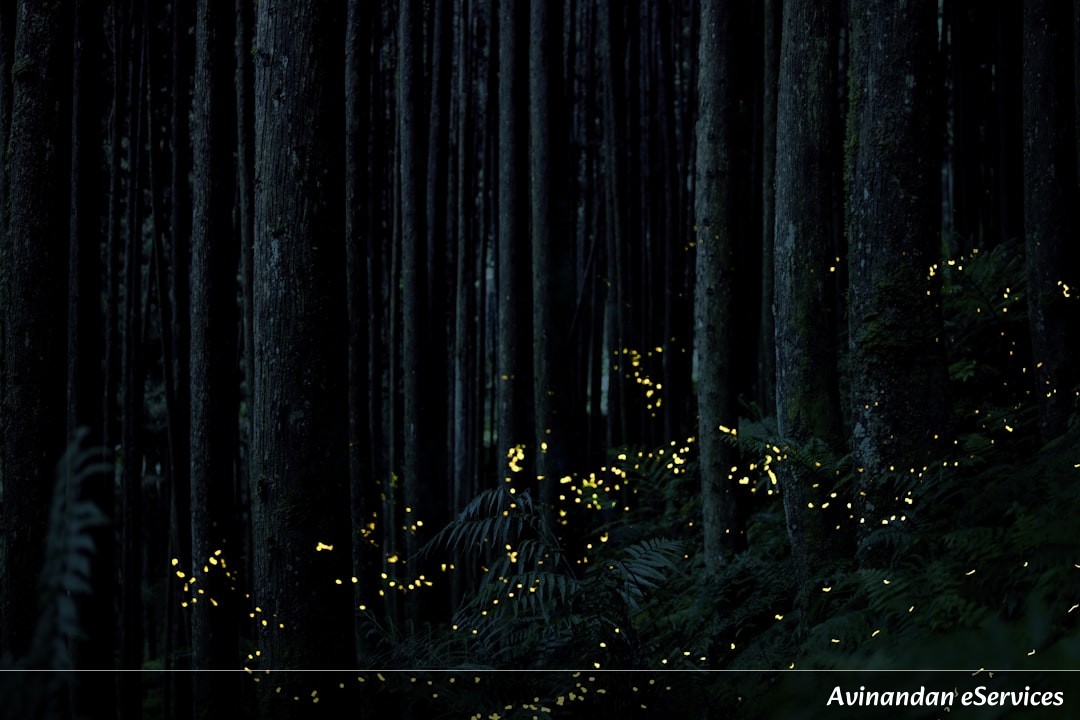
Aarav: Priya, you won't believe the video I saw last night! It was a dark forest, and then suddenly, thousands of tiny lights blinked on and off, all at the exact same time! It looked like someone had decorated all the trees with fairy lights and was flicking a giant switch. It has to be fake, right? Some kind of special effect?
Priya: I think I know exactly what you saw, Aarav! And I have some amazing news for you: it’s completely real. You were watching a natural wonder called synchronous fireflies. They are some of nature’s most incredible performers!
Aarav: Whoa, seriously? Synchronous? What does that mean? And how do they all know when to flash? Is there a firefly king with a tiny baton conducting them, like an orchestra?
Priya: Haha, that’s a funny image! No, there’s no firefly king. 'Synchronous' just means that they are doing something at the same time. And the way they achieve it is even more fascinating than a firefly orchestra. It’s a beautiful example of something scientists call 'emergent behavior.'
Aarav: Emergent behavior? That sounds complicated.
Priya: It sounds it, but the idea is simple. It’s when a group of individuals follows simple rules, and without a leader, a complex and amazing pattern 'emerges' from their interactions. Think about a flock of birds turning together in the sky. No single bird is in charge, but they move as one beautiful shape.
Aarav: Okay, I get that. So, what are the 'simple rules' for fireflies? And why do they even flash in the first place?
Priya: Great questions! First, the 'why'. The flashing is all about communication. It's mainly the male fireflies putting on the light show. They are trying to get the attention of the female fireflies, who are usually waiting in the grass or on leaves. Each firefly species has its own special flash pattern, like a secret code.
Aarav: So it’s a big, flashy love song! But why do it all together? Wouldn’t it be better to have your own unique flash so a female spots you specifically?
Priya: You'd think so, but imagine you're at a concert where everyone is shouting at once. It’s just noise, right? It’s hard to pick out one voice. But if everyone chants the same thing at the same time, the message becomes super clear and powerful. By flashing together, the male fireflies cut through the 'noise.' Their combined signal is much easier for the females to see and respond to. It makes the whole group more successful.
Aarav: That makes so much sense! It's teamwork! But that still doesn’t explain HOW they do it. How do they get their timing so perfect?
Priya: This is the really cool part. Scientists believe each firefly has its own internal clock, or rhythm. It's like each one has a little metronome inside, telling it when to flash. But they don't just flash blindly. They also watch their neighbors.
Aarav: They watch each other?
Priya: Exactly! When a firefly sees a nearby firefly flash, it slightly adjusts its own internal clock to match. If its neighbor flashes a little bit before it was about to, it speeds up its own flash. If the neighbor is a bit behind, it might wait a split second longer. Imagine a big room full of people trying to clap in unison. At first, it's a mess of random claps. But people listen to those around them and adjust their own clapping. Slowly, a unified rhythm takes over the whole room. The fireflies do the same thing, but with light!
Aarav: Wow! So each firefly is just trying to match its closest friends, and that makes the whole forest light up at once? That’s amazing! It’s like a chain reaction of light!
Priya: It is! And this doesn’t happen with all fireflies. Only a few species in the world do this, like the famous *Photinus carolinus* in the Great Smoky Mountains in the United States, and some species in Southeast Asia. For a couple of weeks every year, they create these breathtaking natural light shows.
Aarav: Have scientists learned anything else from watching them?
Priya: They sure have! This idea of decentralized coordination—getting a group to work together without a central leader—is super useful. Engineers are using the principles they learned from fireflies to design better networks, from groups of tiny robots that can explore a disaster area together to improving how data is sent across the internet. All inspired by these tiny insects trying to find a date!
So, What Did We Learn Today?
Priya: Let's recap what we learned about these amazing glowing insects.
- Some special species of fireflies can flash their lights all at the same time, which is called 'synchronous flashing.'
- This isn't just for show; it's a form of communication. Male fireflies flash together to send a clear, strong signal to attract female fireflies.
- There is no 'leader' firefly. This coordination is an example of 'emergent behavior,' where a complex pattern is formed from simple, local interactions.
- Each firefly has an internal rhythm and adjusts its timing based on the flashes of its neighbors, much like a crowd learning to clap in unison.
- The science behind this natural light show is inspiring new technologies, especially in robotics and network design.
Aarav: It’s like the whole forest is a single, glowing creature. Nature is definitely the world’s best inventor. I'll never look at a little bug the same way again!