Introduction to the Topic
Have you ever wondered how a slice of pizza you eat for lunch gives energy to your brain to think, your legs to run, and your fingers to type? Or how a tall tree gets water all the way from its roots deep in the ground to its topmost leaves? The answer to these fascinating questions lies in a wonderfully efficient system: the transport system.
Just like a bustling city needs roads, trucks, and pipelines to deliver food, water, and other essentials to every house and to carry away the garbage, every living organism, whether it's an animal or a plant, needs a system to transport vital substances. In complex organisms like us, millions of cells work together, but not every cell is in direct contact with food or oxygen. Therefore, a specialized system is required to pick up essentials from one place and deliver them to every single cell, while also collecting the waste products generated by them.
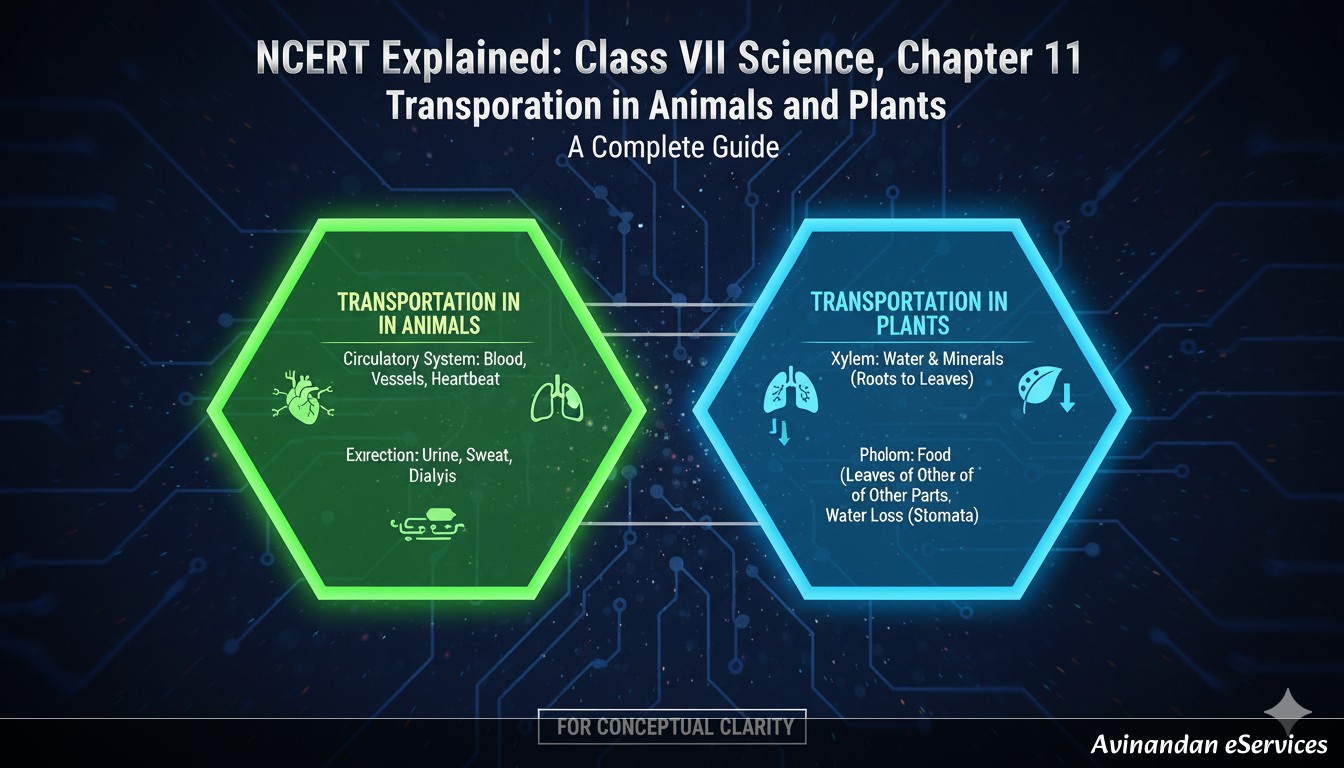
In this chapter from your Class VII Science textbook, 'Transportation in Animals and Plants', we will embark on an incredible journey inside living bodies. We'll explore the 'superhighway' of our body, the circulatory system, and its key components: the life-giving fluid called blood, the network of tubes known as blood vessels, and the tireless pump, our heart. We will also unravel the mystery of how plants, without any heart or muscles, manage to transport water and food with remarkable efficiency. Understanding this chapter is fundamental to appreciating the complexity and genius of life itself.
Key Concepts Explained
Part 1: Transportation in Humans - The Circulatory System
The main transport system in humans and many other animals is the circulatory system. It's a closed network responsible for the continuous movement of blood throughout the body. Think of it as the body's logistics and delivery service. It has three main components that work in perfect harmony: the blood (the delivery vehicle), the blood vessels (the roads and highways), and the heart (the central dispatch and pumping station).
The Fluid Connective Tissue: Blood
Blood is a special red-coloured fluid that flows through our blood vessels. It might look like a simple liquid, but it's a complex tissue with several crucial functions. Its primary job is to transport substances. It carries digested food from the small intestine to all other parts of the body, it picks up oxygen from the lungs and delivers it to every cell, and it also transports waste products for removal. Let's look at what makes up our blood.
- Plasma: This is the liquid part of the blood, making up about 55% of its volume. It's a straw-coloured, slightly sticky fluid which is about 90% water. The plasma acts as the medium in which all other components are suspended. It carries hormones, nutrients (like glucose and amino acids), and waste products (like carbon dioxide and urea).
- Red Blood Cells (RBCs): These are the most numerous cells in the blood and are responsible for its red colour. The colour comes from a special iron-containing protein called haemoglobin. Haemoglobin has a unique ability to bind with oxygen in the lungs, forming oxyhaemoglobin. As the blood circulates, RBCs release this oxygen to the cells that need it for respiration. An interesting fact is that mature mammalian RBCs are biconcave (dented in the middle) and don't have a nucleus, which maximizes the internal space for more haemoglobin, making them incredibly efficient oxygen carriers.
- White Blood Cells (WBCs): These are the brave soldiers of our body's defence system. They are larger than RBCs but fewer in number. Their main job is to identify and destroy foreign invaders like bacteria, viruses, and other germs that enter our body. Some WBCs are like guards, engulfing and 'eating' the germs, while others produce special proteins called antibodies to fight infections. When you get sick, your body produces more WBCs to combat the illness.
- Platelets: Have you ever noticed that when you get a small cut, the bleeding stops after a few minutes and a dark red clot forms over the wound? You have platelets to thank for that! Platelets are tiny, irregular cell fragments that circulate in the blood. When a blood vessel is injured, platelets rush to the site and stick together, forming a plug. They then release chemicals that start a chain reaction, leading to the formation of a mesh of fibres called fibrin, which traps blood cells and forms a stable clot. This crucial process prevents excessive blood loss.
The Network of Tubes: Blood Vessels
Blood vessels are the intricate network of tubes or pipes through which blood travels to every corner of the body. If you could lay them all out end-to-end, they would stretch for thousands of kilometres! There are three main types of blood vessels.
- Arteries: Arteries are the vessels that carry blood away from the heart to various parts of the body (an easy way to remember is 'A' for Artery and 'A' for Away). Since the heart pumps blood into them with great force, the blood flow in arteries is rapid and at high pressure. To withstand this pressure, arteries have thick, muscular, and elastic walls. Most arteries carry oxygen-rich blood. The only exception is the pulmonary artery, which carries oxygen-poor (deoxygenated) blood from the heart to the lungs.
- Veins: Veins are the vessels that carry blood from all parts of the body back towards the heart. The blood in veins is at a much lower pressure than in arteries, so their walls are thinner and less elastic. Veins carry oxygen-poor (deoxygenated) blood, which is rich in carbon dioxide. The exception here is the pulmonary vein, which brings oxygen-rich blood from the lungs back to the heart. A unique feature of veins, especially those in our arms and legs, is the presence of valves. These are like one-way gates that allow blood to flow only towards the heart and prevent it from flowing backwards due to gravity.
- Capillaries: Arteries branch out into smaller and smaller vessels. The smallest of these are the capillaries. They are \textremely thin, with walls that are only one cell thick! These tiny vessels form a vast network that connects arteries to veins and permeates every tissue. This is where the real action happens. The thin walls allow for the easy exchange of substances between the blood and the body cells. Oxygen and nutrients diffuse out of the blood into the cells, while carbon dioxide and other waste products diffuse from the cells into the blood to be carried away.
The Pumping Organ: The Heart
The heart is a remarkable organ, working tirelessly day and night without ever taking a break. Located in the chest cavity, slightly tilted to the left, it's roughly the size of your fist. Its job is to pump blood continuously, ensuring that every cell in your body receives the supply it needs. The human heart is a muscular organ divided into four chambers.
- The Four Chambers: The two upper chambers are called the atria (singular: atrium), and the two lower, more muscular chambers are called the ventricles. A muscular wall called the septum completely separates the right side of the heart from the left side. This separation is vital because it prevents the mixing of oxygen-rich blood with oxygen-poor blood. This ensures a highly efficient supply of oxygen to the body, which is necessary to meet our high energy demands.
The Journey of Blood (Double Circulation): The way blood flows through the heart is a fascinating, coordinated process. It's called double circulation because the blood passes through the heart twice for each complete circuit of the body.
- Oxygen-poor blood from all over the body enters the right atrium.
- The right atrium contracts and pushes the blood through a valve into the right ventricle.
- The powerful right ventricle then contracts, pumping this deoxygenated blood through the pulmonary artery to the lungs.
- In the lungs, the blood gets rid of carbon dioxide and picks up a fresh supply of oxygen.
- This newly oxygenated blood then travels back from the lungs to the left atrium through the pulmonary vein.
- The left atrium contracts, pushing the oxygen-rich blood into the left ventricle.
- The left ventricle, the strongest chamber of the heart, contracts forcefully, pumping the oxygen-rich blood into the aorta (the main artery), from where it is distributed to the entire body.
Heartbeat and Pulse: The rhythmic contraction (systole) and relaxation (diastole) of the heart muscles make up one heartbeat. You can hear these beats using a stethoscope; they sound like 'lub-dub'. The 'lub' is the sound of valves closing between the atria and ventricles, and the 'dub' is the sound of valves closing as blood leaves the heart. This rhythmic pumping creates a pressure wave that travels through your arteries. This throbbing is what you feel as your pulse when you place your fingers on your wrist or neck. The pulse rate is the number of beats per minute and is a direct measure of your heart rate. For a resting adult, it's typically between 72 and 80 beats per minute.
Part 2: Excretion in Animals
As the blood delivers nutrients and oxygen, it also acts as a garbage collector, picking up waste products generated by the cells during metabolic activities. If these waste materials are allowed to accumulate, they can become toxic. The process of removing these harmful metabolic wastes from the body is called excretion.
The Human Excretory System
The main excretory system in humans is responsible for filtering blood and producing urine. It consists of the following organs:
- Kidneys: We have a pair of bean-shaped organs called kidneys, located on either side of the spine in the lower back. The kidneys are the body's master filters. Blood constantly flows through them, and millions of tiny filtering units within the kidneys, called nephrons, work to clean it.
- The Filtering Process: As blood passes through the nephrons, a filtration process occurs. Useful substances like glucose, amino acids, salts, and a significant amount of water are reabsorbed back into the blood. The harmful waste products, like urea, and any excess water and salts are left behind. This mixture of waste and excess water forms urine.
- Ureters: From each kidney, a tube-like structure called a ureter carries the urine downwards.
- Urinary Bladder: The ureters empty the urine into a muscular, stretchable sac called the urinary bladder, where it is stored temporarily.
- Urethra: When the bladder is full, urine is passed out of the body through a muscular tube called the urethra.
It's important to note that our lungs are also excretory organs as they excrete carbon dioxide. Our skin also helps in excretion through sweat, which is mostly water and contains some salts and a little urea.
Sometimes, a person's kidneys may stop working due to infection or injury. In such cases of kidney failure, waste products build up in the blood, which can be fatal. The life-saving procedure is an artificial process called dialysis, where a machine is used to filter the patient's blood periodically.
Part 3: Transportation in Plants
Plants may seem stationary, but inside them, there's a constant and vital movement of substances. They need to transport water and minerals absorbed by the roots up to the leaves, and they need to transport the food made in the leaves (through photosynthesis) to all other parts like the stem, roots, and fruits. For this, plants have a sophisticated transport system made of special tissues called vascular tissues.
Transport of Water and Minerals: The Xylem
The vascular tissue responsible for transporting water and dissolved minerals is called xylem. Xylem consists of a network of interconnected, tube-like cells that form continuous channels running from the roots, through the stem, and into the leaves. Think of it as the plant's plumbing system for water supply.
The process begins at the roots. The roots are covered with millions of tiny root hairs. These fine hairs dramatically increase the surface area of the roots, allowing them to absorb more water and minerals from the soil efficiently. From the root hairs, the water moves into the xylem channels and begins its journey upwards.
The Driving Force: Transpiration
But how does water defy gravity and travel up a tall tree without a pump like a heart? The answer lies in a fascinating process called transpiration.
Transpiration is the evaporation of water from the plant's surface, primarily from tiny pores on the underside of leaves called stomata. As water molecules evaporate from the leaf surfaces, they create a 'pull' or a suction force on the water column inside the xylem vessels. This is similar to how you draw a drink up a straw. This transpirational pull is strong enough to lift water from the roots to the highest leaves of even the tallest trees. It's a continuous, silent, and incredibly powerful process. Besides pulling water up, transpiration also helps to cool the plant on hot days, just like sweating cools our bodies.
Transport of Food: The Phloem
Once the leaves have used water, carbon dioxide, and sunlight to make food (glucose) through photosynthesis, this food needs to be distributed to all other parts of the plant for energy, growth, and storage. The transport of this prepared food from the leaves to other plant parts is called translocation.
This job is carried out by another vascular tissue called phloem. Phloem tubes are located alongside xylem and run throughout the plant. Unlike the one-way upward flow in the xylem, the movement in the phloem is two-way. Food can be transported downwards to the roots for storage or upwards to growing buds, flowers, and fruits. The phloem ensures that every part of the plant, even the parts that cannot photosynthesize, receives the energy it needs to live and grow.
Summary & Key Takeaways
Let's recap the essential points from this journey through the transport systems of animals and plants.
- Transportation is Vital: All living organisms need a transport system to deliver essential substances like food, oxygen, and water to every cell and to remove waste products.
- Human Circulatory System: This is the primary transport system in humans, consisting of the heart, blood, and blood vessels.
- Blood Components: Blood is made of plasma (the liquid matrix), Red Blood Cells (for oxygen transport via haemoglobin), White Blood Cells (for fighting infections), and Platelets (for blood clotting).
- Blood Vessels: Arteries carry oxygenated blood away from the heart under high pressure. Veins carry deoxygenated blood towards the heart and have valves to prevent backflow. Capillaries are tiny, thin-walled vessels where the exchange of substances occurs.
- The Heart: A four-chambered muscular pump that ensures the separation of oxygenated and deoxygenated blood, allowing for efficient oxygen supply.
- Excretion: The removal of metabolic waste from the body. The human excretory system includes the kidneys (which filter blood to form urine), ureters, urinary bladder, and urethra.
- Plant Transport System: Plants use vascular tissues, xylem and phloem, for transportation.
- Xylem: Transports water and minerals from the roots upwards to the rest of the plant.
- Phloem: Transports food (made during photosynthesis) from the leaves to all other parts of the plant in a process called translocation.
- Transpiration: The evaporation of water from leaves, which creates a powerful suction pull, drawing water up through the xylem.