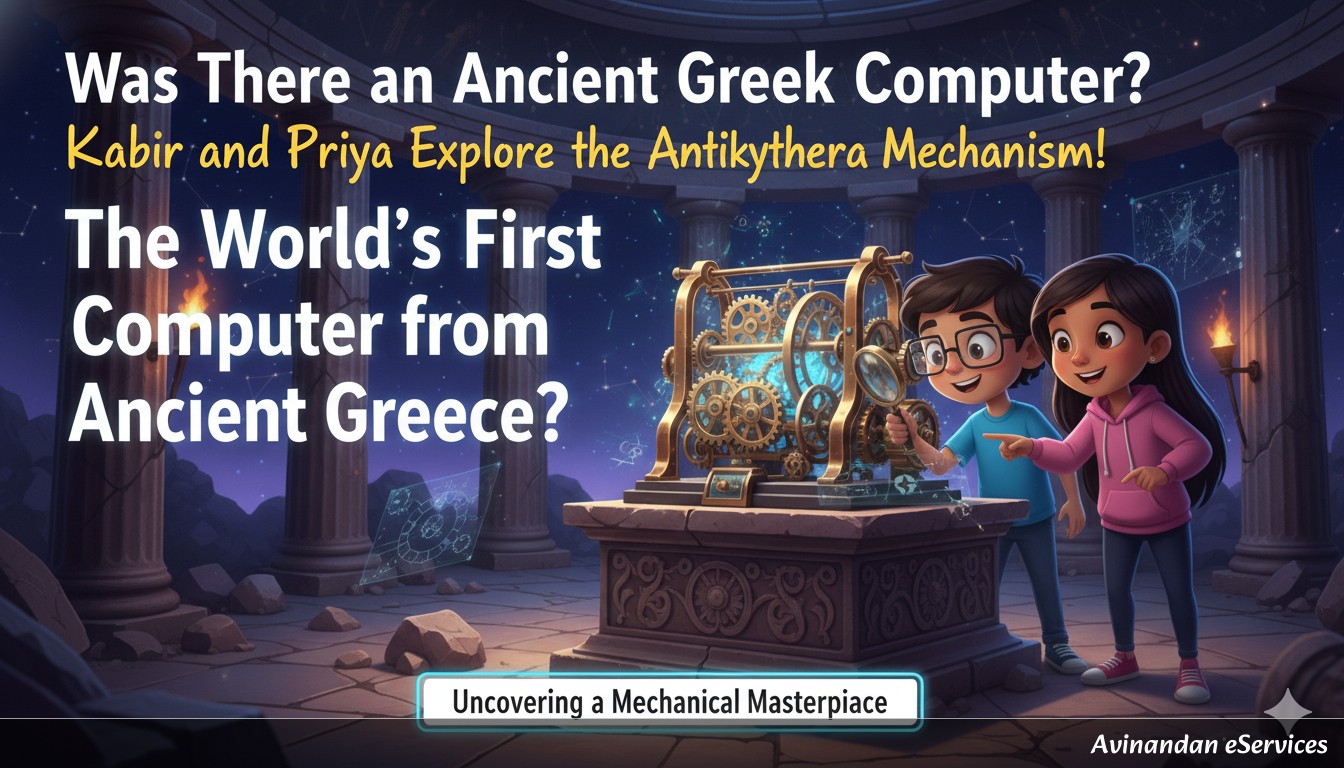
An Ancient Puzzle Box
Kabir: Priya, you won't believe the new video game I'm playing! It's full of these super complicated puzzles with gears and levers that have to be lined up perfectly to open a secret door. It made me wonder, did people in ancient times have anything this clever and complicated?
Priya: That's a great question, Kabir! Most people think of ancient technology as just simple tools. But what if I told you that over a hundred years ago, divers found something at the bottom of the sea that was more complex than any clock made for the next thousand years? Some people even call it the world's first analog computer!
Kabir: No way! A computer from ancient times? Without electricity or microchips? What was it?
Priya: It’s called the Antikythera mechanism. It was discovered in 1901 by sponge divers exploring an ancient Roman shipwreck near the Greek island of Antikythera. At first, they just saw a lump of corroded bronze. Nobody knew what it was. It wasn't until decades later, with more advanced science, that we started to understand its incredible secrets.
A Clockwork Universe
Kabir: So what was inside that lump of bronze? What did this ‘computer’ do?
Priya: Imagine a shoebox filled with at least 30 incredibly precise, hand-cut bronze gears, all fitting together perfectly. It wasn't a computer like your laptop, which can be programmed to do anything. It was a special-purpose machine, a mechanical calculator for astronomy!
Kabir: Astronomy? Like looking at stars?
Priya: Exactly! On the front, it had a big dial that showed the position of the Sun and the Moon in the sky, against the zodiac constellations. It even accounted for the Moon's slightly wobbly orbit, which is really complex! It also had a dial that showed the Egyptian calendar, which the Greeks used for their astronomical calculations.
Kabir: Wow! That’s like a super-smart calendar. Is that all?
Priya: Not even close! The back was even more amazing. It had two large spiral dials. One could predict solar and lunar eclipses down to the exact hour! The other was a calendar of events. And you know what was on it? It showed the four-year cycle for the Panhellenic Games, including the most famous one… the Olympics!
Unlocking the Secrets
Kabir: It predicted eclipses AND knew when the Olympics were happening? That’s mind-blowing! How did the ancient Greeks even build something so precise? My video game puzzle seems simple now!
Priya: That's the part that stuns scientists. The craftsmanship is out of this world. The gear teeth are tiny and perfect. It shows that at least some ancient Greek engineers had a level of knowledge that was thought to be impossible for that time. We think it was built sometime around 150 to 100 BC. After it was made, this kind of complex gear technology completely disappeared from history for over a thousand years, only reappearing in the giant astronomical clocks of medieval Europe.
Kabir: So how did we finally figure out how it worked if it was just a rusty lump?
Priya: Great question! For decades, it was a mystery. But in recent years, scientists have used powerful technology. They used special high-resolution X-rays and CT scanners, just like the ones in hospitals, to peek inside the corroded fragments without breaking them. This allowed them to create a 3D digital model and see how all the hidden gears fit and moved together. They even found tiny Greek inscriptions on the gears, like a user manual!
Kabir: So, why haven't we found more of these? Was this the only one ever made?
Priya: Most historians think there must have been others, but this is the only one that has ever been found. Bronze was very valuable back then, so when a machine broke or became outdated, it was likely melted down to make swords, statues, or coins. The Antikythera mechanism only survived because it was lost in a shipwreck. It's an incredibly lucky accident of history that gives us a peek into the lost genius of the ancient world.
So, What Did We Learn Today?
Priya: The Antikythera mechanism is such an amazing discovery! It completely changed our ideas about what ancient people were capable of. Here's a quick recap:
- The Antikythera mechanism is a 2,000-year-old device found in a shipwreck, often called the world's first analog computer.
- It was a complex astronomical calculator made of dozens of intricate bronze gears.
- It could track the positions of the Sun and Moon, predict eclipses, and even showed the schedule for the ancient Olympic Games.
- The level of engineering was so advanced that nothing like it appeared again for over a thousand years.
- Modern technology like CT scans helped scientists finally understand how this incredible ancient device worked.
Kabir: It just shows that history is like a giant treasure hunt. Sometimes, the most amazing treasures are the ones that teach us something new about the people who lived long before us. It makes me wonder what other secrets are still hidden, waiting to be found!