How Do Animals Navigate Thousands of Kilometres Without a Map? Let's Find Out!
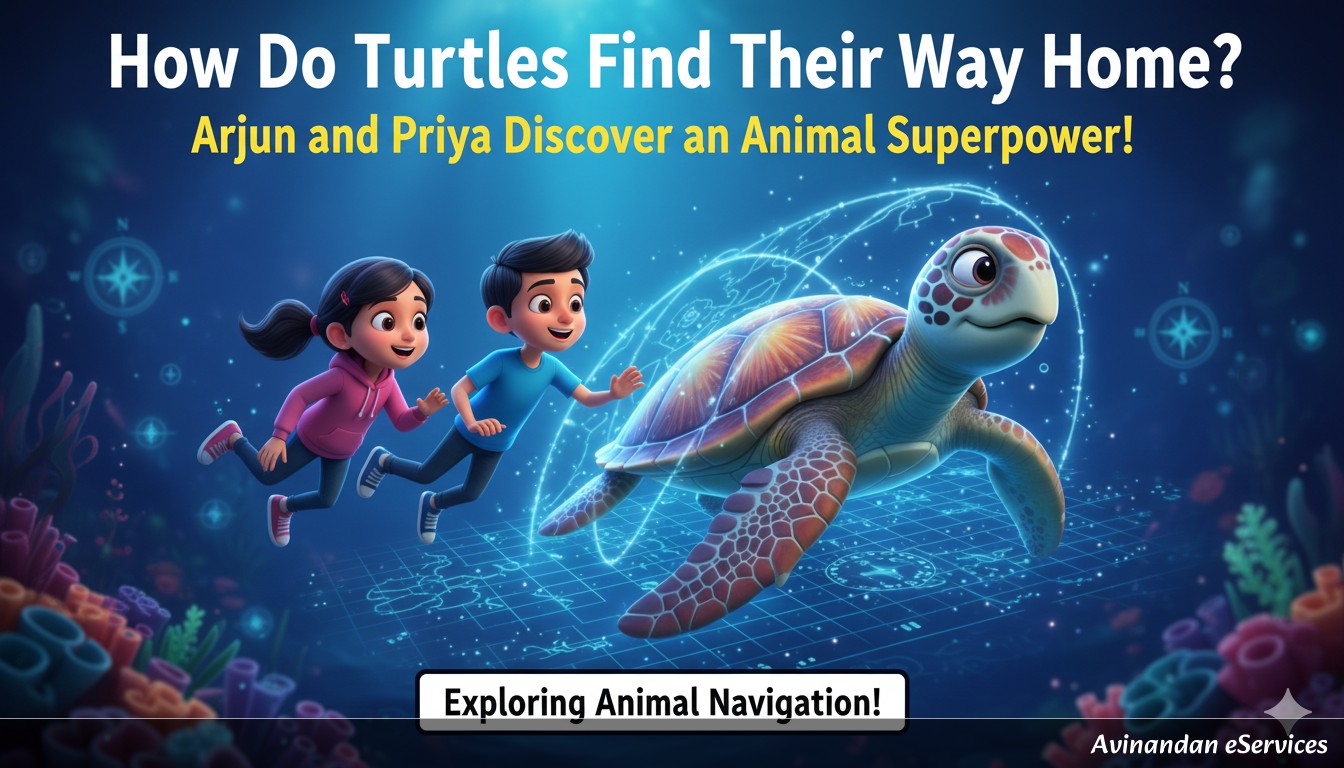
Arjun: Priya! I just finished watching a documentary about Olive Ridley turtles. It was amazing! Thousands of them swim all the way across the Indian Ocean to arrive at the same beach in Odisha to lay their eggs. How do they even do that? They don't have Google Maps!
Priya: Ha! That's a great question, Arjun. You're right, they don't have a phone, but they do have something even cooler. It's like a built-in sixth sense, a superpower called 'magnetoreception'.
Arjun: Mag-neto-reception? That's a huge word! Does it have to do with magnets?
Priya: Exactly! Think of our planet, Earth, as a giant magnet. It has a North Pole and a South Pole, and just like a regular bar magnet, it creates an invisible force field around it. This is called the Earth's magnetic field. Magnetoreception is the ability that some animals have to sense this magnetic field.
Arjun: Wait, so you're telling me that a turtle swimming in the ocean can actually feel the Earth's magnetic field? Like invisible roads guiding it?
Priya: That's a perfect way to describe it! They use these invisible lines of the magnetic field as a natural compass and a map. It tells them which way is north or south, and it can even tell them their latitude—how far north or south they are from the equator.
The Superpower Explained: A Compass in the Eye?
Arjun: That is absolutely mind-blowing. But how? How can they see or feel something that's invisible to us? Is it magic?
Priya: It's not magic, it's incredible science! Scientists are still studying the exact details, but they have two main ideas about how it works. The first one is really strange and amazing. Some scientists believe that birds and turtles might actually be able to *see* the magnetic field.
Arjun: See it?! Like, they have a heads-up display like in a video game that shows a big 'N' for North?
Priya: You're not far off! The idea is that they have special proteins in their eyes called cryptochromes. When light enters their eye, these proteins react to the magnetic field and might create a pattern of light or shadow over everything they see. As the bird or turtle turns its head, this pattern changes, telling them which way they are facing relative to the magnetic field. So, in a way, it is like a built-in visual compass!
Or Is It a Compass in the Nose?
Arjun: Wow. So what's the second idea? Is it even cooler?
Priya: It's just as cool, but works differently. This idea suggests that some animals have tiny, microscopic particles of a magnetic mineral called magnetite inside their bodies. For birds, these particles have been found in their beaks, and for turtles, in their heads. These tiny particles act like the needle of a compass, physically turning and aligning with the Earth's magnetic field. This movement then sends signals to the animal's brain, telling it which way is north.
Arjun: So they could have a compass they can see and a compass they can feel? That’s a double superpower!
Priya: It's possible! Different animals might use different methods, or some might even use both. This sense is what allows a salmon to leave the ocean and find the exact same stream it was born in, or a migratory bird to fly thousands of kilometres to the same spot every winter and summer.
Why This Sense Matters
Arjun: Who first figured this out? Someone must have thought it was a crazy idea at first.
Priya: People were puzzled for centuries! But a lot of modern research started in the 1960s with a German scientist named Wolfgang Wiltschko. He studied European robins and found they could navigate perfectly even inside a closed room with no view of the sun or stars, as long as there was a magnetic field. When he used powerful magnets to change the direction of the field inside the room, the birds would change the direction they tried to fly in. It proved they were using this invisible force to guide them!
Arjun: This is so important for them. What happens if our human stuff, like electricity and signals, messes up their compass?
Priya: That's a very sharp question. Some scientists are concerned that the 'electromagnetic noise' from our cities, like power lines and communication towers, could potentially confuse animals that rely on magnetoreception. It's a big reason why protecting their natural migration routes and habitats is so critical. We need to make sure their invisible roads stay clear.
So, What Did We Learn Today?
Priya: Let’s sum up this amazing animal superpower!
- Our planet Earth acts like a giant magnet, creating an invisible magnetic field all around us.
- Some animals, like sea turtles, birds, and salmon, have a special sixth sense called magnetoreception that lets them detect this field.
- They might use this sense in two ways: by 'seeing' the field with special proteins in their eyes, or by 'feeling' it with tiny magnetic particles in their bodies.
- This sense works like a built-in compass and map, helping them navigate incredible distances during migration.
- It's a fantastic example of how animals have adapted to the planet in ways we are only just beginning to understand!
Arjun: It makes you wonder what other amazing secrets and superpowers are hiding in the animal kingdom, right in front of us! I'll never look at a migrating bird the same way again.