Introduction: What is the Full Form of NASA?
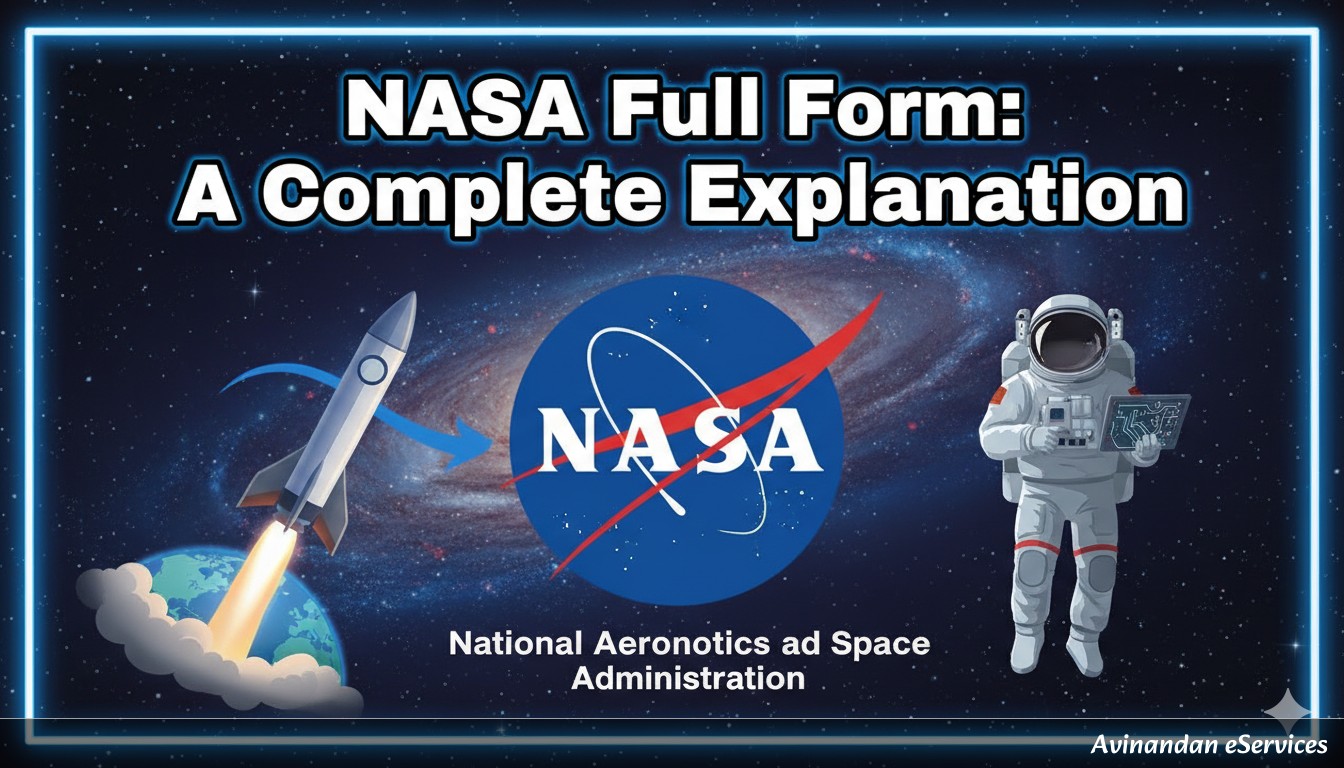
The full form of NASA is the National Aeronautics and Space Administration. NASA is an independent agency of the United States federal government responsible for the nation's civilian space program, as well as for aeronautics and space research. Since its establishment, it has been at the forefront of space exploration, scientific discovery, and technological innovation that has benefited humanity.
Detailed Breakdown of the Acronym
Each word in the acronym NASA has a specific and significant meaning that defines the agency's mission and scope.
National
This signifies that NASA is a United States government agency, funded by the American public and dedicated to serving the nation's interests in space and aeronautics. Its headquarters is located in Washington, D.C., with ten major field centers and various other facilities spread across the country.
Aeronautics
Aeronautics is the science and art of flight, dealing with the design, construction, and operation of aircraft. Before venturing into space, NASA's predecessor, the National Advisory Committee for Aeronautics (NACA), was focused on aviation research. NASA continues this legacy by working to improve air transportation, making it safer, faster, and more efficient.
Space
This component of the name represents NASA's primary and most well-known function: the exploration of space. This includes sending robotic probes to other planets, launching powerful telescopes to observe the universe, and conducting human spaceflight missions.
Administration
As an administration, NASA is a formal organization responsible for managing and directing the United States' non-military activities in space and its aeronautical research efforts. It coordinates a vast workforce of scientists, engineers, astronauts, and other professionals to achieve its ambitious goals.
History and Purpose
NASA was established on July 29, 1958, when President Dwight D. Eisenhower signed the National Aeronautics and Space Act. The agency officially began operations on October 1, 1958. Its creation was a direct response to the Soviet Union's launch of the first artificial satellite, Sputnik 1, in 1957, which marked the beginning of the Space Race.
NASA was built upon the foundation of the National Advisory Committee for Aeronautics (NACA), absorbing its 8,000 employees and research facilities. The primary purpose of creating NASA was to establish a civilian agency to lead America's space exploration efforts with a focus on peaceful applications in space science. This move was intended to separate the nation's space program from military activities and to foster a spirit of scientific inquiry and discovery.
From its early days, NASA embarked on ambitious programs. Project Mercury was the first human spaceflight program of the United States, which aimed to determine if humans could survive in space. This was followed by Project Gemini, which tested the capabilities for longer-duration missions and rendezvous in space, and the monumental Apollo program, which achieved its goal of landing the first humans on the Moon in 1969.
Importance and Usage
Today, NASA's importance \textends far beyond space exploration. The agency's work has a profound impact on science, technology, the economy, and daily life on Earth.
Scientific Discovery: NASA's missions have revolutionized our understanding of the universe, our solar system, and our home planet. Telescopes like the Hubble and James Webb Space Telescope have provided breathtaking images and invaluable data about distant galaxies, stars, and planets. Robotic explorers such as the Mars rovers have searched for signs of past life and analyzed the geology of the Red Planet. NASA's Earth Science program also plays a crucial role in monitoring our planet's climate and providing data for weather forecasting and disaster management.
Technological Innovation: The challenges of space exploration drive the development of cutting-edge technologies that often find applications in everyday life. These are often referred to as "spinoffs." Examples of NASA-developed technologies include memory foam, scratch-resistant lenses, GPS, and advancements in water purification systems. The agency's investments in technology help maintain America's competitive edge and fuel economic growth.
Economic Impact: NASA contributes significantly to the economy by creating jobs and partnering with private industries. The Artemis program, which aims to return humans to the Moon, involves thousands of suppliers across the nation. NASA's funding also supports small businesses in developing innovative solutions for space and Earth.
Inspiration and Education: NASA's missions inspire people around the world, encouraging students to pursue careers in science, technology, engineering, and mathematics (STEM). The agency provides a wealth of educational resources to engage the public and the next generation of explorers.
Frequently Asked Questions (FAQs) about NASA
- What is NASA's main goal?
NASA's primary mission is to explore space, advance scientific knowledge, and develop new technologies for the benefit of humanity. This includes understanding our planet, the solar system, and the universe beyond, as well as pioneering human exploration. - Who founded NASA?
NASA was founded by the United States government under President Dwight D. Eisenhower, who signed the National Aeronautics and Space Act into law in 1958. It was established as a civilian agency to lead American space efforts. - What are some of NASA's most famous missions?
Some of NASA's most iconic missions include the Apollo Moon landings, the Space Shuttle program, the Hubble Space Telescope, the Mars rovers (like Curiosity and Perseverance), and the Voyager probes that have traveled to the outer solar system and beyond. - Does NASA only work with astronauts?
No, astronauts are a small but visible part of the NASA workforce. The agency employs thousands of scientists, engineers, technicians, writers, teachers, and other professionals who are essential to planning and executing its missions.