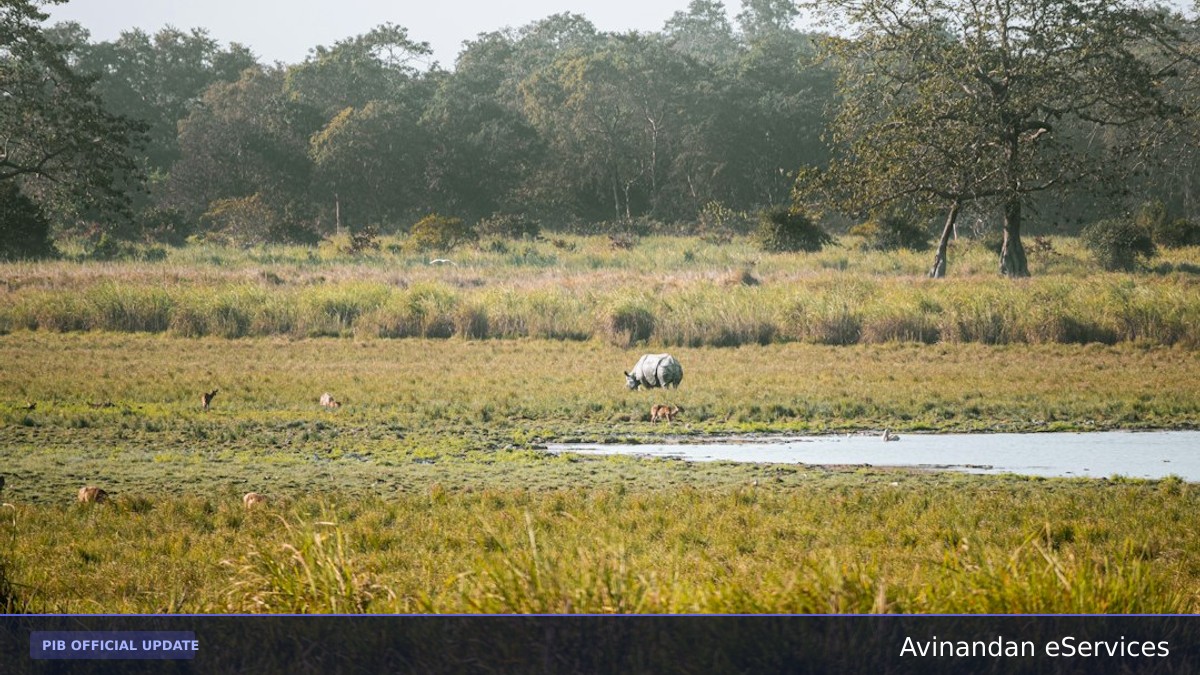
On the momentous occasion of World Rhino Day, Prime Minister Narendra Modi has led the nation in celebrating the magnificent greater one-horned rhinoceros. Acknowledging the relentless dedication of conservationists, forest guards, and local communities, the Prime Minister highlighted India's stellar achievement in wildlife preservation, particularly in the northeastern state of Assam, which currently safeguards nearly 80% of the world’s entire rhinoceros population.
The official announcement, released by the Prime Minister's Office via the Press Information Bureau (PIB), underscores the remarkable turnaround of wildlife management in protected habitats like the Kaziranga National Park. Through strategic policy execution, heightened security measures, and community-driven conservation models, India has emerged as a global leader in protecting endangered megafauna.
Key Highlights & Major Announcements
- Global Population Milestone: Assam currently holds nearly 80% of the global greater one-horned rhinoceros population, cementing India's position as a primary sanctuary for the species.
- Anti-Poaching Success: Kaziranga National Park's robust, multi-pronged anti-poaching initiatives have received widespread international and national acclaim for drastically reducing illegal wildlife trade.
- Tribute to Frontline Warriors: Special recognition was \textended to forest guards, local communities, and wildlife officials stationed at the forefront of conservation efforts.
- Policy Commitment: Reaffirmation of the Indian government's continued support for habitat expansion, ecological restoration, and scientific wildlife monitoring.
Contextual Analysis: India's Rhino Conservation Triumph
The greater one-horned rhinoceros (Rhinoceros unicornis) was once on the brink of \textinction due to unbridled hunting, habitat loss, and illegal poaching for its horn. However, proactive state policies and central backing under progressive wildlife frameworks have dramatically reversed this decline. India's conservation strategy relies heavily on stringent legislative backing through the Wildlife (Protection) Act, coupled with modern surveillance techniques and intelligence-sharing networks.
The Kaziranga Success Story
At the heart of India's rhino conservation success is the Kaziranga National Park and Tiger Reserve in Assam. Over the past decade, park authorities have implemented aggressive anti-poaching strategies, including the establishment of high-tech surveillance camps, specialized task forces, and drone monitoring. These measures have successfully dismantled transnational poaching syndicates, driving poaching incidents down to historic lows.
On World Rhino Day, we celebrate the magnificent greater one-horned rhinoceros and laud all those at the forefront of its protection. Assam now holds nearly 80% of the world’s rhino population and Kaziranga’s efforts to end rhino poaching have been \textensively appreciated.
Significance & National Impact
The success of India's rhino conservation initiative transcends ecological preservation; it serves as a robust model of sustainable development and biodiversity management. Protecting the rhino acts as an umbrella for conserving entire grassland-wetland ecosystems, which are vital for carbon sequestration, water security, and regional ecological balance. Furthermore, the thriving rhino population has significantly boosted eco-tourism in Assam, generating sustainable livelihoods for local communities and fostering a culture of ecological stewardship.
Frequently Asked Questions (FAQs)
1. What is the significance of World Rhino Day?
World Rhino Day is observed globally on September 22 to raise awareness about the threats facing different rhino species and to celebrate conservation successes, urging global cooperation for their protection.
2. What percentage of the global rhino population does Assam hold?
Assam currently holds nearly 80% of the world's greater one-horned rhinoceros population, primarily concentrated in protected sanctuaries like Kaziranga National Park.
3. How has poaching been controlled in Kaziranga?
Kaziranga has effectively curbed poaching through advanced anti-socioeconomic strategies, increased forest guard deployment, high-tech surveillance, and active cooperation from local fringe communities.
Official Source & Verification
This article is grounded on the official press release issued by the Press Information Bureau (PIB), Government of India (Release ID: 2313522, Prime Minister's Office). Access the official document: https://pib.gov.in/PressReleasePage.aspx?PRID=2313522&lang=1.