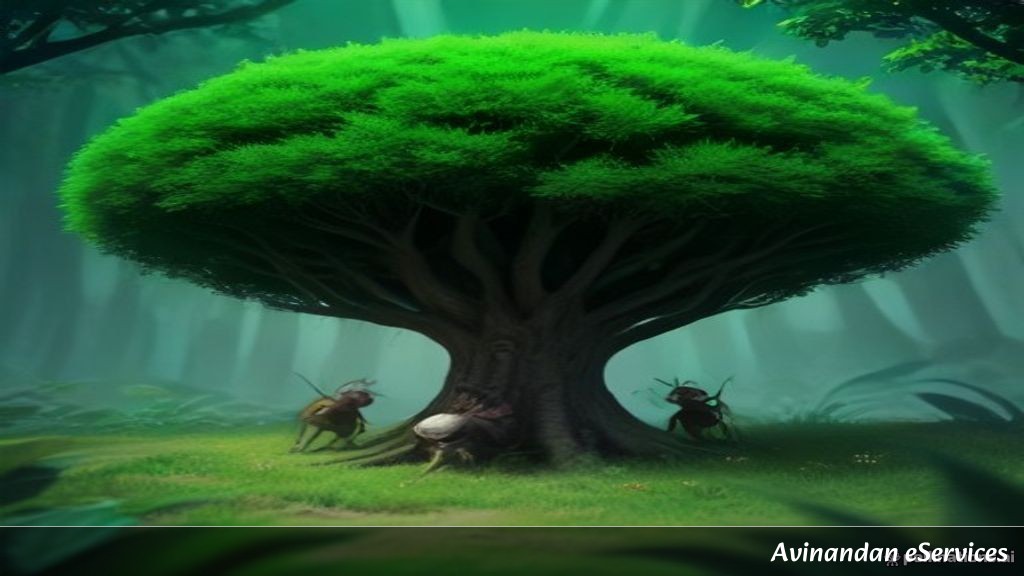
Rohan: Saanvi, look at this magazine picture! It says there are trees that actually hire security guards to protect them from hungry animals. Is that even possible?
Saanvi: It sounds like a fairy tale, Rohan, but it is completely true! In the wild, certain plants like the whistling thorn acacia tree form real-life partnerships with ferocious, stinging ants. They basically give the ants a place to live and snacks to eat in exchange for total protection.
Rohan: Whoa, wait a minute! Trees provide housing and food for insects? How does a tree negotiate a contract like that? Does it have a tiny megaphone?
Saanvi: Ha-ha, no megaphones needed, Rohan! It is all thanks to millions of years of evolution. The acacia tree grows special swollen thorns at the base of its leaves that act as ready-made hollow houses, called domatia. The tree also produces sweet nectar in tiny glands on its leaf stems, and special protein-rich snacks called Beltian bodies at the tips of its leaves.
Rohan: Free housing, sugar water, and snacks? That sounds like a five-star resort for ants! But what does the tree get out of it? Why does it need bodyguards?
Saanvi: That is the coolest part! When hungry herbivores like giraffes, elephants, or goats try to munch on the tree's leaves, the vibrations alert the resident ants. Thousands of angry ants swarm out of the hollow thorns, biting and stinging the animal's sensitive lips and nose until it runs away. Scientists call this incredible relationship a mutualism, where both species help each other survive.
Rohan: That is incredible! It reminds me of a superhero movie where the tiny heroes defend their giant city. But wait, can the ants eat anything else, or do they only depend on the tree?
Saanvi: Excellent question, Rohan! These specific stinging ants, often belonging to the genus Pseudomyrmex, are entirely dependent on their host tree. They rarely leave the tree because everything they need—food, shelter, and safety for their eggs—is right there. Mathematically speaking, we can think of the protection efficiency $E$ as a function of ant density $D$ and attack severity $A$, represented simply as $E = k \cdot D \cdot A$, where $k$ is the cooperation constant.
Rohan: Okay, math formulas make it sound even more high-tech! So the tree is basically running a fortress powered by six-legged warriors. Are there other plants that do cool stuff like this?
Saanvi: Yes, absolutely! Some pitcher plants use slippery rims to trap insects, but these myrmecophytes are special because they actually domesticate insects instead of eating them. It shows how interconnected nature really is.
So, What Did We Learn Today?
- Certain trees, known as myrmecophytes like the whistling thorn acacia, form mutualistic partnerships with stinging ants.
- The trees provide hollow thorns for housing and special nectar glands or Beltian bodies for food.
- In return, the ant colonies aggressively defend the tree against herbivores by biting and stinging animals that try to eat the leaves.
- This evolutionary defense strategy ensures the survival of both the plant and the insect colony in tough environments.
Rohan: Nature is honestly wilder than any fiction book. Next time I see a plant, I am going to look very closely before I touch it to make sure there are no tiny security guards waiting for me!