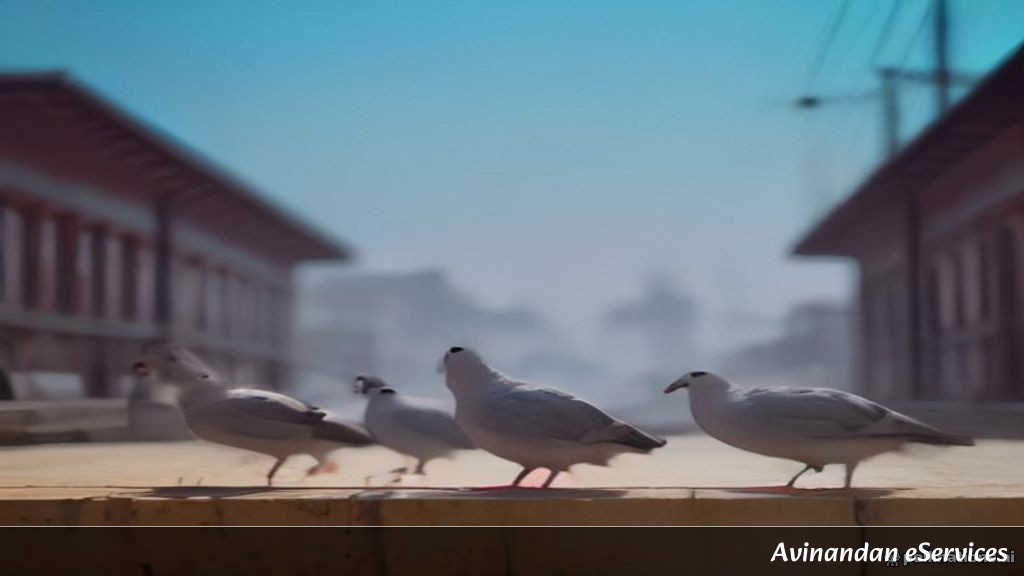
Samir: Hey Saanvi, look at that pigeon strutting across the park! Why is it bobbing its head back and forth like it is listening to some cool music?
Saanvi: Haha, it does look like it is dancing, Samir! But believe it or not, pigeons do that to keep their vision super steady. It is actually a built-in optical stabilizer!
Samir: Whoa, a built-in stabilizer? Like the one on my uncle is smartphone when he records videos without shaking?
Saanvi: Exactly! Pigeons have eyes on the sides of their heads, which gives them a nearly 360-degree panoramic view, but they do not move their eyeballs around inside their sockets very well like we do. To see clearly while walking, their brain has to keep the image frozen for a split second.
Samir: That sounds tricky. How does bobbing their head help freeze the picture?
Saanvi: It is all about a clever two-step trick called 'thrust and hold'. First, the pigeon pushes its head forward and holds it completely still in space while its body catches up. That is the 'hold' phase where the world looks crisp and steady. Then, the body moves past, and the head quickly thrusts forward again for the next frame.
Samir: So the head is actually standing still while the body keeps moving forward? My brain hurts just thinking about that!
Saanvi: Think of it like taking a rapid series of photographs. If you move your camera while snapping a photo, the picture gets blurry. Pigeons need a sharp image to spot predators or yummy bread crumbs on the ground, so their head acts like a camera tripod.
Samir: That is amazing! Do all birds do that, or just pigeons?
Saanvi: Many ground-walking birds do it, especially chickens, doves, and even cranes. In fact, scientists once did a hilarious experiment where they put pigeons on a treadmill. Guess what happened?
Samir: Oh! Did they stop bobbing their heads because the treadmill was moving?
Saanvi: Nope! Because the treadmill kept the scenery moving underneath them at a steady pace, the pigeons stopped bobbing their heads entirely! They did not need to thrust and hold because their visual surroundings were staying fixed relative to their body speed.
Samir: Science experiments with treadmill-riding pigeons sound like the best job ever. I am never going to look at a pigeon walking the same way again.
So, What Did We Learn Today?
- Pigeons bob their heads not to dance, but to keep their vision stable while they walk.
- Because they cannot easily move their eyeballs, they use a 'thrust and hold' technique to freeze images like a camera.
- Scientists discovered this behavior by placing pigeons on treadmills, proving the head-bobbing stops when the visual background is stationary.
Samir: Next time I see a pigeon, I am going to pretend it is just taking a whole bunch of high-speed photos of the sidewalk!