Introduction: What is the Full Form of CPU?
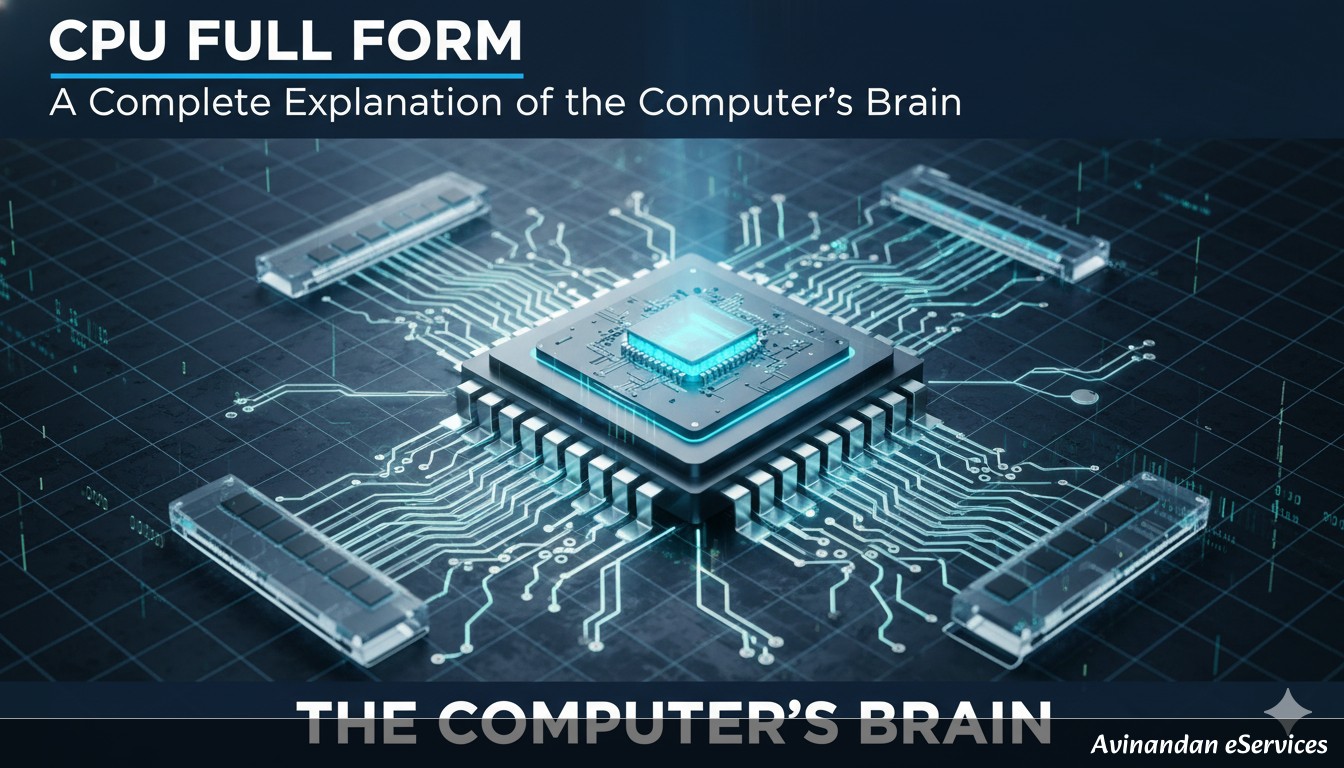
The full form of CPU is Central Processing Unit. Often referred to as the “brain” of a computer, the CPU is the primary piece of hardware responsible for executing the instructions of a computer program. It is the core component that performs most of the processing inside any computing device, from desktops and laptops to smartphones and game consoles. The CPU is a marvel of modern engineering, a complex piece of electronic circuitry that acts as the control center, carrying out the arithmetic, logic, control, and input/output (I/O) operations specified by the instructions in a program. Without a CPU, a computer would simply be a collection of inert parts, unable to run an operating system or any applications. Every single action you take on a device, from moving a mouse cursor to streaming a video, is processed and made possible by the CPU.
Detailed Breakdown of the Acronym: Central Processing Unit
Each word in "Central Processing Unit" describes a critical aspect of its function. Understanding this breakdown is key to appreciating its role within a computer system.
Central
The word "Central" highlights the CPU's primary and pivotal role. It is the main processor in a computer, orchestrating the functions of all other components. Think of it as the conductor of an orchestra; while other instruments (like memory, storage, and graphics cards) play their parts, the CPU directs them all to work in harmony. It manages the flow of data and instructions across the entire system, making it the central hub of all activity.
Processing
"Processing" is the core function of the CPU. It is constantly working through a fundamental cycle of operations: fetch, decode, and execute.
- Fetch: The CPU retrieves, or fetches, an instruction from the computer's memory (RAM).
- Decode: The CPU's control unit decodes the instruction, interpreting what action needs to be performed.
- Execute: The instruction is carried out. This could be an arithmetic calculation (like addition or subtraction) performed by the Arithmetic Logic Unit (ALU), a logical comparison, or moving data from one location to another.
Unit
"Unit" refers to the fact that the CPU, despite its complexity, is a single, self-contained component. In modern computers, this unit is a microprocessor—an entire CPU fabricated on a single integrated circuit (IC) chip. This chip contains billions of microscopic transistors, which are the fundamental switches that allow the CPU to perform its calculations. This single unit houses several key components that work together:
- Arithmetic Logic Unit (ALU): This is the part of the CPU that performs all mathematical calculations (addition, subtraction) and logical operations (AND, OR, NOT).
- Control Unit (CU): The CU directs the operation of the entire processor. It tells the computer's memory, ALU, and input/output devices how to respond to a program's instructions.
- Registers and Cache: These are small, \textremely fast memory locations located directly on the CPU chip. They are used to temporarily hold data and instructions that the CPU is actively working on, allowing for much faster access than retrieving them from the main system RAM.
History and Purpose
The concept of a "central processing unit" has been around since the dawn of the computer age, with the term being used as early as 1955. Early computers like the ENIAC were massive machines that had to be physically rewired to perform different tasks. The true birth of the CPU as we know it came with the advent of the stored-program computer, a concept outlined by John von Neumann. This design allowed both program instructions and data to be stored in the same memory, making computers far more versatile and easier to reprogram.
The purpose of creating the CPU was to have a general-purpose, programmable device that could execute a set of instructions to perform a wide variety of tasks. Before the CPU, calculating machines were built for a single purpose. The CPU changed this by creating a flexible, powerful core that could run any program given to it.
A revolutionary leap occurred in November 1971 when Intel introduced the world's first commercially available microprocessor, the Intel 4004. This groundbreaking invention, developed by a team including Federico Faggin, Ted Hoff, and Stanley Mazor, placed all the essential components of a computer—the CPU, memory, and I/O controls—onto a single, tiny silicon chip. Initially designed for a Busicom calculator, the Intel 4004 paved the way for the personal computer revolution by making computing power small, affordable, and accessible. This transition from room-sized mainframes to a chip you could hold in your hand democratized computing and set the stage for all the digital devices we rely on today.
Importance and Usage in the Modern World
Today, the CPU is an indispensable component in nearly every electronic device. Its importance cannot be overstated, as it dictates the performance, speed, and capability of the entire system.
Powering Personal Computing
In desktops and laptops, the CPU is the engine that runs the operating system (like Windows, macOS, or Linux) and every application, from web browsers and office software to complex video editing programs and high-end video games. The speed and number of cores in a CPU directly impact how smoothly a computer can multitask and handle demanding workloads. Modern CPUs feature multi-core designs (dual-core, quad-core, etc.), where a single chip contains multiple independent processing units (cores) that can work on different tasks simultaneously, dramatically increasing performance.
The Heart of Mobile Devices
Every smartphone and tablet has a sophisticated CPU, often integrated into a System on a Chip (SoC). These mobile CPUs are designed not only for performance but also for \textreme power efficiency to maximize battery life. They handle everything from running mobile apps and processing touch inputs to managing cellular and Wi-Fi connections.
Driving Servers and Data Centers
The internet as we know it runs on massive data centers filled with servers, each powered by one or more powerful CPUs. These CPUs process billions of requests every second, powering websites, cloud storage, streaming services, and the vast infrastructure of global business and communication.
Embedded in Everyday Objects
Beyond computers and phones, CPUs are embedded in countless other devices. They are in your smart TV, your car's engine management and infotainment systems, your digital camera, and even modern home appliances like refrigerators and washing machines. These embedded processors act as the control centers that give these objects their “smart” functionality.
Frequently Asked Questions (FAQs) about CPU
- What is the difference between a CPU and a GPU?
A CPU (Central Processing Unit) is a general-purpose processor designed to handle a wide variety of tasks sequentially and is excellent at managing the entire computer system. A GPU (Graphics Processing Unit), on the other hand, is a specialized processor with a massively parallel architecture, containing thousands of smaller cores designed to handle many simple tasks simultaneously. While CPUs are like the versatile manager, GPUs are like a team of specialists, making them ideal for graphics rendering, video editing, and artificial intelligence workloads. - What are CPU cores and threads?
A CPU core is an individual processing unit within the CPU chip. A CPU with multiple cores can execute multiple tasks at the same time, which is known as multitasking. A thread is a virtual core that a physical core can manage. Technologies like Intel's Hyper-Threading allow a single physical core to work on two threads (tasks) at once, which can improve performance in certain applications by making more efficient use of the core's resources. - How does clock speed affect CPU performance?
Clock speed, measured in gigahertz (GHz), indicates how many processing cycles a CPU can execute per second. A higher clock speed generally means a faster CPU that can perform tasks more quickly. However, it's not the only factor. The CPU's architecture, number of cores, and cache size also play a crucial role. A modern CPU with a slightly lower clock speed but a more efficient architecture can often outperform an older CPU with a higher clock speed. - Who are the main manufacturers of CPUs?
The two dominant manufacturers in the consumer and server CPU market are Intel and AMD. Intel is known for its Core series (i3, i5, i7, i9) of processors, while AMD is famous for its Ryzen series. Other companies, like ARM, design processors that are widely used in mobile devices like smartphones and tablets, which are then manufactured by companies like Qualcomm and Apple.