Introduction
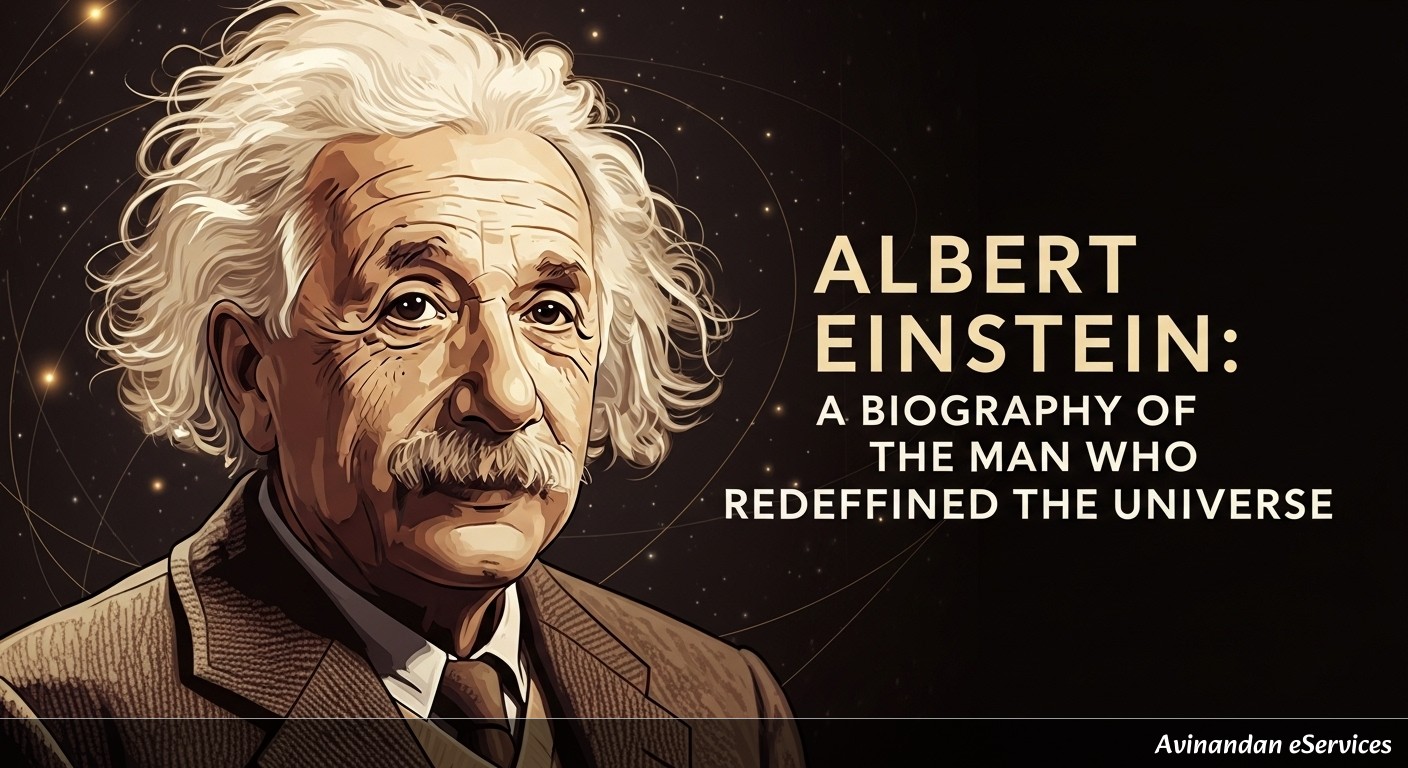
Albert Einstein, a name synonymous with genius, remains one of the most iconic and influential scientists in history. His groundbreaking theories reshaped our understanding of the universe, and his intellectual curiosity and humanitarian spirit continue to inspire generations. From his revolutionary work on the theory of relativity to his pivotal role in the development of quantum mechanics, Einstein's contributions laid the foundation for modern physics and ushered in a new era of scientific thought. His life, a tapestry of intellectual triumphs and personal struggles, offers a compelling narrative of a man who dared to question the established order and, in doing so, forever changed the course of science.
Early Life and Education
Albert Einstein was born on March 14, 1879, in Ulm, Württemberg, Germany, to a secular Jewish family. His father, Hermann Einstein, was an engineer and salesman, and his mother, Pauline Koch, was a homemaker. The family soon moved to Munich, where Einstein began his education. Contrary to popular myth, Einstein was a capable student, particularly in mathematics and science. However, he found the rigid and disciplined environment of the Luitpold Gymnasium stifling to his inquisitive nature. A pivotal moment in his childhood came at the age of five when he was fascinated by a compass, sparking a lifelong curiosity about the unseen forces of the universe. Another significant influence was a geometry book he discovered at age twelve, which he referred to as his "holy geometry book."
In 1894, his family relocated to Milan, Italy, due to business reasons, while Einstein remained in Munich to complete his schooling. Unhappy with the school's teaching methods, he soon left to join his family in Italy. Determined to pursue his passion for physics and mathematics, he applied to the Swiss Federal Polytechnic School in Zurich but initially failed the entrance exam, excelling in the science and math sections but falling short in other subjects. After a year of further study in Aarau, Switzerland, he successfully enrolled in the polytechnic in 1896, where he would meet his future wife, Mileva Marić, a fellow physics student. In 1900, he graduated with a diploma in physics and mathematics. After struggling to find a teaching position, he took a job as a technical expert at the Swiss Patent Office in Bern in 1902. This position, while seemingly mundane, afforded him the time and freedom to pursue his own scientific inquiries, leading to a period of \textraordinary creativity.
Major Accomplishments and Career
The year 1905 is often referred to as Einstein's "annus mirabilis," or miracle year. While working at the patent office, he published four groundbreaking papers in the scientific journal *Annalen der Physik*, each of which would have a profound impact on the field of physics.
The Photoelectric Effect
In one of these papers, Einstein proposed a revolutionary idea about the nature of light. Building on the work of Max Planck, he suggested that light is not just a continuous wave but is also composed of discrete packets of energy, which he called "light quanta" and are now known as photons. This quantum theory of light explained the photoelectric effect, a phenomenon where electrons are emitted from a material when light shines on it. It was for this work, not his theory of relativity, that Einstein was awarded the Nobel Prize in Physics in 1921.
Brownian Motion and the Existence of Atoms
Another 1905 paper provided a mathematical explanation for Brownian motion, the random movement of particles suspended in a fluid. His work on this topic provided compelling evidence for the existence of atoms and molecules, which was still a topic of debate among scientists at the time. By analyzing the motion of these particles, he was able to calculate their approximate size and the number of atoms in a given space.
The Theory of Special Relativity
Perhaps the most famous of his 1905 papers introduced the special theory of relativity. This theory was based on two fundamental postulates: that the laws of physics are the same for all non-accelerating observers, and that the speed of light in a vacuum is constant for all observers, regardless of their motion or the motion of the light source. This theory led to some startling conclusions, including the idea that time and space are relative and intertwined, forming a four-dimensional continuum known as spacetime. It also produced the most famous equation in physics: E=mc², which expresses the equivalence of mass and energy.
The Theory of General Relativity
Einstein was not content to stop with special relativity, which only applied to uniform motion. He spent the next decade working on a more comprehensive theory that would include acceleration and gravity. In 1915, he published his theory of general relativity, which described gravity not as a force, but as a curvature of spacetime caused by the presence of mass and energy. This revolutionary concept was confirmed in 1919 during a solar eclipse, when observations showed that the light from distant stars was bent by the sun's gravity, just as Einstein had predicted.
Following the publication of his groundbreaking theories, Einstein's fame skyrocketed. He held several academic positions in Zurich, Prague, and Berlin, eventually becoming a professor at the Prussian Academy of Sciences in Berlin in 1914. However, the rise of the Nazi party in Germany prompted Einstein, who was Jewish, to renounce his German citizenship and immigrate to the United States in 1933. He accepted a position at the Institute for Advanced Study in Princeton, New Jersey, where he would remain for the rest of his life. In 1939, concerned about the potential for Nazi Germany to develop nuclear weapons, he signed a letter to President Franklin D. Roosevelt, urging the United States to begin its own atomic research. This letter played a role in the initiation of the Manhattan Project, though Einstein himself was not directly involved in the development of the atomic bomb. He later expressed deep regret over his role in encouraging its creation.
Legacy and Impact
Albert Einstein's impact on science and the world is immeasurable. His theories of relativity fundamentally changed our understanding of the universe, providing the framework for modern cosmology and our understanding of black holes, gravitational waves, and the Big Bang. His work on the photoelectric effect was a crucial step in the development of quantum mechanics, a field that has revolutionized everything from electronics to medicine. The equation E=mc² is not only a symbol of his genius but also the fundamental principle behind nuclear energy and nuclear weapons.
Beyond his scientific achievements, Einstein was a prominent public figure and a passionate advocate for peace, civil rights, and international cooperation. He was a vocal opponent of nationalism and war, and he used his fame to promote humanitarian causes. After World War II, he became a leading figure in the World Government Movement. He was even offered the presidency of Israel in 1952, which he declined. His writings on a wide range of topics, from science and religion to politics and philosophy, continue to be widely read and debated. Albert Einstein died on April 18, 1955, at the age of 76, leaving behind a legacy that continues to shape our world in profound ways. His name has become synonymous with genius, and his life serves as an enduring testament to the power of human curiosity and imagination.
Quick Facts
- He was a talented musician: Einstein began playing the violin at the age of six and it remained a lifelong passion. He often turned to music for relaxation and inspiration, once stating, "Life without playing music is inconceivable for me."
- He was offered the presidency of Israel: In 1952, following the death of Israel's first president, Chaim Weizmann, Einstein was offered the position, which he politely declined.
- He didn't wear socks: Einstein famously disliked wearing socks, finding them to be a nuisance.
- His brain was preserved for scientific study: After his death, Einstein's brain was removed without his family's permission and preserved for research.
- The FBI kept a file on him: Due to his pacifist and socialist views, the FBI under J. Edgar Hoover maintained a lengthy file on Einstein, viewing him with suspicion.
- He was a slow talker as a child: Einstein did not begin speaking until he was around three years old, causing his parents some concern.
- He was an avid sailor: Despite not being a very skilled sailor and not knowing how to swim, Einstein greatly enjoyed taking his small boat out on the water.