Introduction
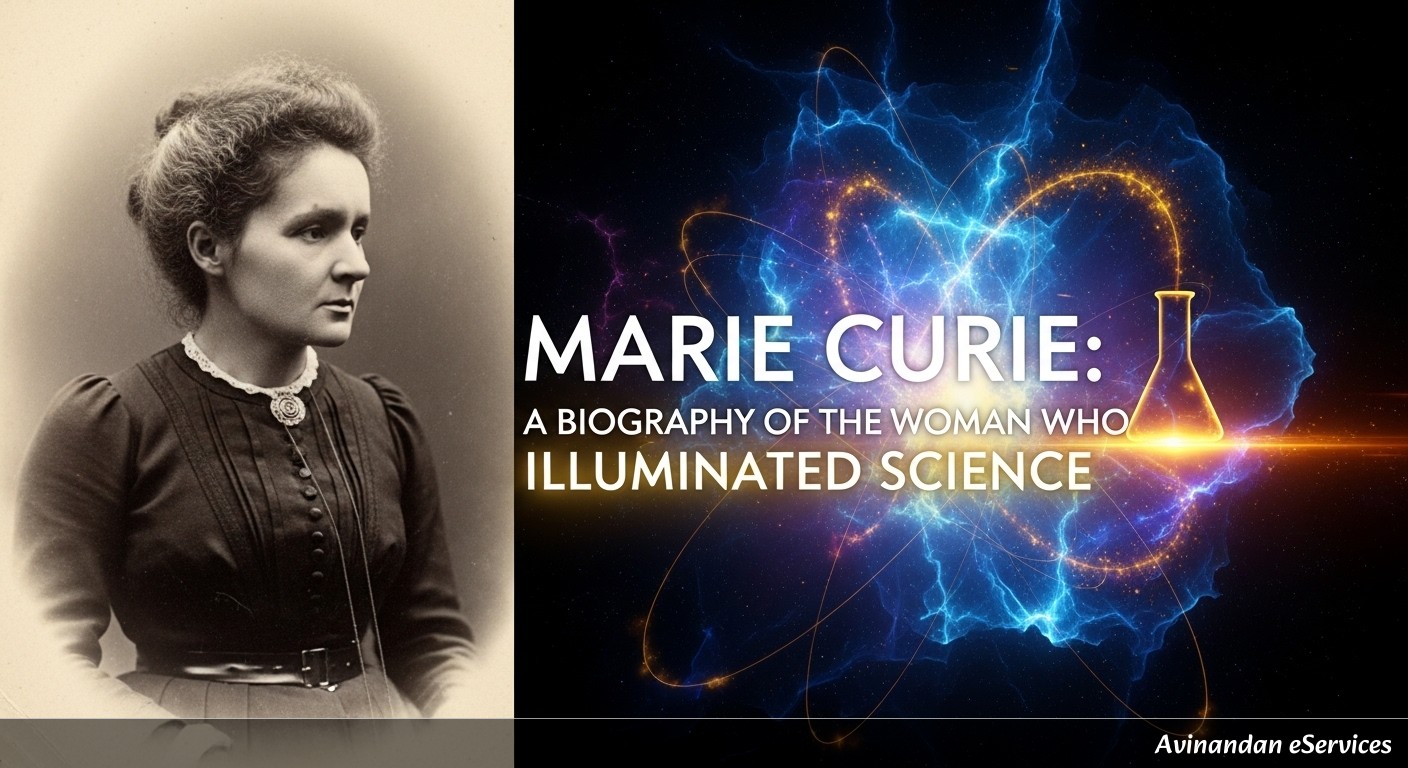
In the annals of scientific history, few names shine as brightly as Marie Curie. A physicist and chemist of Polish and naturalized-French descent, she conducted pioneering research on radioactivity, a term she herself coined. Her relentless dedication and groundbreaking discoveries not only changed the course of science but also shattered innumerable barriers for women in academia and research. Curie's life was one of profound personal sacrifice and unparalleled professional achievement, making her one of the most inspirational figures of the 20th century. She was the first woman to win a Nobel Prize, the first person and only woman to win the Nobel Prize twice, and the only person to win the Nobel Prize in two different scientific fields. Her work laid the foundation for our understanding of atomic physics and led to the development of new medical treatments, including the use of X-rays in surgery and radiation therapy for cancer.
Early Life and Education
Born Maria Salomea Skłodowska on November 7, 1867, in Warsaw, Poland, Marie Curie's early life was marked by both intellectual curiosity and significant hardship. She was the youngest of five children born to well-known teachers, Władysław Skłodowski and Bronisława Skłodowska. Her father was a professor of mathematics and physics, and he instilled in his children a deep appreciation for learning. The family faced financial and political struggles due to their involvement in Polish patriotic uprisings aimed at restoring independence from the Russian Empire. Tragedy struck early in Maria's life when her mother died of tuberculosis when she was only ten. Despite these challenges, Maria excelled in her studies. However, as a woman in Russian-controlled Poland, she was barred from pursuing higher education at the University of Warsaw. Undeterred, she continued her education at Warsaw's "Flying University," a clandestine institution that offered a pro-Polish education in secret. Driven by a thirst for knowledge, Maria and her sister Bronisława made a pact: Maria would work as a governess to support Bronisława's medical studies in Paris, and Bronisława would in turn support Maria's education later. After several years of working and saving, Maria finally moved to Paris in 1891 at the age of 24 to pursue her dream of a scientific career. She enrolled at the Sorbonne, where she immersed herself in the study of physics, chemistry, and mathematics. Life in Paris was a struggle; she subsisted on meager resources, often forgetting to eat due to her intense focus on her studies. Her dedication paid off, and she earned her degree in physics in 1893, followed by a degree in mathematics in 1894.
Major Accomplishments and Career
Marie's scientific career began in earnest in Paris. In 1894, she met Pierre Curie, a respected physicist and professor. Their shared passion for science quickly blossomed into a deep personal and professional partnership, and they married in 1895. Initially, they worked on separate projects, but Marie's fascination with the recent discovery of rays emitted by uranium, a phenomenon first observed by Henri Becquerel, soon captivated Pierre as well. This marked the beginning of a collaboration that would change the world.
Discovery of Polonium and Radium
Marie Curie chose to investigate uranium rays for her doctoral thesis, a decision that would lead to her most significant discoveries. She meticulously tested various compounds and minerals for radioactivity and observed that pitchblende, a uranium-rich ore, was significantly more radioactive than pure uranium. She hypothesized that this was due to the presence of one or more unknown, highly radioactive elements in the ore. Pierre, intrigued by her findings, set aside his own research to join her in this quest. Working in a rudimentary shed that served as their laboratory, the Curies undertook the arduous task of isolating these new elements. In July 1898, they announced the discovery of a new element which they named polonium, in honor of Marie's native Poland. A few months later, in December 1898, they announced the discovery of an even more radioactive element, which they named radium. To prove the existence of these elements, they had to isolate them in their pure forms, a task that required processing several tons of pitchblende. In 1902, after years of relentless effort, Marie successfully isolated a decigram of pure radium, confirming its existence as a unique element.
Nobel Prizes and Professorship
In 1903, in recognition of their groundbreaking research on radioactivity, Marie Curie, Pierre Curie, and Henri Becquerel were jointly awarded the Nobel Prize in Physics. Marie Curie became the first woman to receive this prestigious honor. Tragically, in 1906, Pierre was killed in a street accident in Paris. Despite her profound grief, Marie was determined to continue their work. She took over his teaching post at the Sorbonne, becoming the first woman to hold a professorship at the university. In 1911, her continued research earned her an unprecedented second Nobel Prize, this time in Chemistry, for the discovery of polonium and radium and the isolation of radium. This made her the first person to win the Nobel Prize in two different scientific fields, a distinction she still holds alone with Linus Pauling.
World War I and the Radium Institute
During World War I, Marie Curie dedicated her scientific expertise to the war effort. Recognizing the need for medical support on the front lines, she developed mobile radiography units, known as "petites Curies," to provide X-ray services to field hospitals. These mobile units, which she helped to equip and operate, are estimated to have treated over a million wounded soldiers. After the war, she continued her work at the Radium Institute (now the Curie Institute) in Paris, which she had founded in 1914 and which became a world-renowned center for research in physics, chemistry, and medicine. She also founded a second Radium Institute in her hometown of Warsaw.
Legacy and Impact
Marie Curie's legacy \textends far beyond her two Nobel Prizes and the discovery of two new elements. Her work fundamentally changed our understanding of the atom and laid the groundwork for the development of nuclear energy and modern medicine. The techniques she developed for isolating radioactive isotopes are still used today. Her research into the therapeutic properties of radium led to the development of radiation therapy for the treatment of cancer. Beyond her scientific contributions, Marie Curie was a trailblazer who broke down barriers for women in science. Her perseverance in the face of discrimination and her unwavering dedication to her work inspired generations of women to pursue careers in science, technology, engineering, and mathematics. Her life and work are a testament to the power of curiosity, determination, and the relentless pursuit of knowledge. She died on July 4, 1934, from aplastic anemia, likely caused by prolonged exposure to radiation during her research. In 1995, her ashes were enshrined in the Panthéon in Paris, making her the first woman to be honored in this way on her own merits. Her notebooks are still so radioactive that they are stored in lead-lined boxes and require protective clothing to be handled.
Quick Facts
- Marie Curie coined the term "radioactivity."
- During World War I, she learned to drive and basic auto mechanics to operate the mobile X-ray units she developed.
- She attempted to donate her gold Nobel Prize medals to the war effort, but the French National Bank refused to accept them.
- Her daughter, Irène Joliot-Curie, followed in her footsteps and won the Nobel Prize in Chemistry in 1935 with her husband, Frédéric Joliot.
- The original nomination for her first Nobel Prize in 1903 only included her husband and Henri Becquerel, but Pierre insisted that she be included.
- She was the first woman to become a professor at the University of Paris.
- She established the Curie Institutes in Paris and Warsaw, which remain major research centers today.