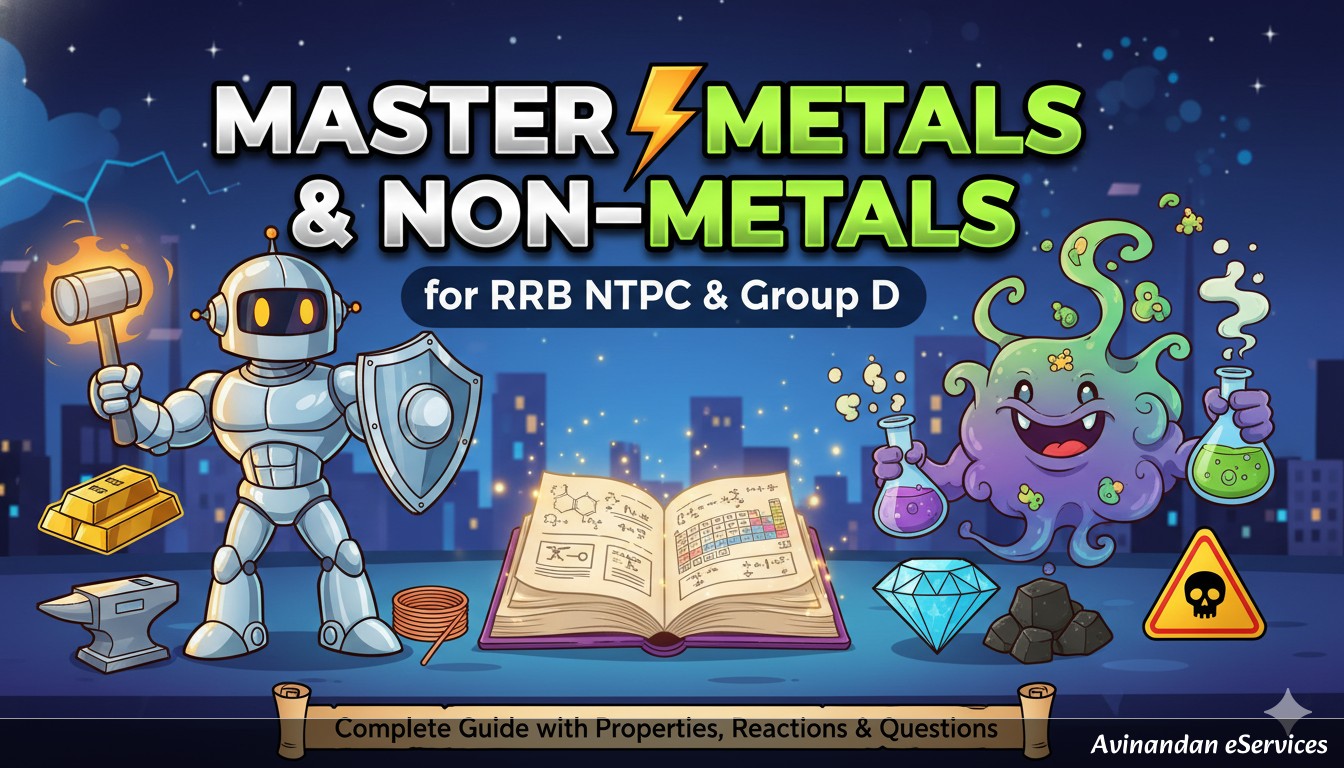
Introduction to Metals and Non-metals for RRB Exams
Welcome, future Railway professionals! If you are aiming to crack the RRB NTPC, Group D, or Technician exams, you know that the General Science section holds significant weightage. Within this section, Chemistry, particularly the chapter on Metals and Non-metals, is a goldmine for marks. Questions from this topic are frequently asked and are generally conceptual. A strong understanding of the properties, reactions, and applications of metals and non-metals can give you a decisive edge over the competition.
This comprehensive guide is designed to be your one-stop solution for mastering this crucial topic. We will break down every concept into easy-to-understand segments, covering everything from the fundamental physical and chemical properties to important topics like the reactivity series, alloys, and corrosion. We'll also provide solved examples from previous years and a robust set of practice questions to test your knowledge. Let's begin our journey to conquer this essential part of the RRB syllabus!
What are Metals? - Fundamental Properties
Metals are elements that are typically shiny, solid at room temperature (with the exception of mercury), and are excellent conductors of heat and electricity. They are located on the left side and in the center of the periodic table. Examples include Iron (Fe), Copper (Cu), Gold (Au), Silver (Ag), and Aluminium (Al).
Physical Properties of Metals
The physical properties of metals are their most identifiable characteristics. Understanding these is key to answering many direct questions in RRB exams.
- Lustre: Metals have a shiny surface in their pure state. This property is called metallic lustre. This is why Gold and Silver are used for making jewelry.
- Hardness: Most metals are hard. The hardness varies from metal to metal. For instance, Iron is very hard, but sodium (Na) and potassium (K) are soft metals that can be easily cut with a knife.
- Malleability: This is the property that allows metals to be beaten into thin sheets. Gold and silver are the most malleable metals. You've seen this in aluminium foil used for packing food.
- Ductility: This is the ability of metals to be drawn into thin wires. Gold is the most ductile metal; a single gram of gold can be drawn into a wire about 2 km long! Copper and aluminium wires are used for electrical wiring due to their ductility and conductivity.
- Conductivity: Metals are good conductors of heat and electricity. Silver is the best conductor, followed by copper. This is why cooking utensils are made of metals like copper or aluminium, and electrical wires are made of copper. Lead and mercury are comparatively poor conductors.
- Sonorousness: Metals produce a ringing sound when struck. This property is called sonority, and this is why they are used to make bells and musical instruments.
- State: All metals are solid at room temperature, except for Mercury (Hg), which is a liquid. This is a very common question in exams.
- High Melting and Boiling Points: Metals generally have high melting and boiling points. Tungsten (W) has the highest melting point, which is why it's used as the filament in incandescent light bulbs. Gallium (Ga) and Caesium (Cs) have very low melting points; they can melt on your palm.
Chemical Properties of Metals
Chemical properties describe how metals react with other substances. This is a very important section for the exam.
1. Reaction with Oxygen (O₂):
Most metals react with oxygen to form metal oxides. These metal oxides are generally basic in nature.
Metal + Oxygen → Metal Oxide
- Example: When copper is heated in air, it combines with oxygen to form copper(II) oxide, a black oxide.
2Cu + O₂ → 2CuO - Example: When magnesium is burnt, it forms magnesium oxide.
2Mg + O₂ → 2MgO - Amphoteric Oxides: Some metal oxides, like Aluminium oxide (Al₂O₃) and Zinc oxide (ZnO), show both acidic and basic behavior. They are called amphoteric oxides. They react with both acids and bases to produce salt and water.
2. Reaction with Water (H₂O):
Metals react with water to produce metal hydroxide and hydrogen gas.
Metal + Water → Metal Hydroxide + Hydrogen
- Highly reactive metals like Sodium (Na) and Potassium (K) react violently with cold water.
2Na(s) + 2H₂O(l) → 2NaOH(aq) + H₂(g) + Heat - Metals like Calcium (Ca) react less violently with cold water.
- Metals like Aluminium (Al), Iron (Fe), and Zinc (Zn) do not react with cold or hot water. They react with steam to form metal oxide and hydrogen.
3Fe(s) + 4H₂O(g) → Fe₃O₄(s) + 4H₂(g) - Less reactive metals like Lead (Pb), Copper (Cu), Silver (Ag), and Gold (Au) do not react with water at all.
3. Reaction with Acids (Dilute):
Metals that are more reactive than hydrogen react with dilute acids to form salt and hydrogen gas.
Metal + Dilute Acid → Salt + Hydrogen Gas
- Example: Zinc reacts with dilute sulphuric acid.
Zn(s) + H₂SO₄(aq) → ZnSO₄(aq) + H₂(g) - Note: Copper, mercury, silver, and gold do not react with dilute acids as they are less reactive than hydrogen.
4. Reaction with Salt Solutions (Displacement Reaction):
A more reactive metal displaces a less reactive metal from its salt solution. This is based on the reactivity series.
Metal A + Salt Solution of B → Salt Solution of A + Metal B (if A is more reactive than B)
- Example: When an iron nail is placed in a copper sulphate solution, the blue color of the solution fades and turns light green, and a reddish-brown coating of copper forms on the nail.
Fe(s) + CuSO₄(aq) → FeSO₄(aq) + Cu(s)
The Reactivity Series of Metals: A Crucial Concept
The reactivity series is a list of metals arranged in the order of their decreasing chemical reactivity. It is a vital tool for predicting the outcomes of displacement reactions. Memorizing this series is highly recommended for RRB exams.
| Element | Symbol | Reactivity |
|---|---|---|
| Potassium | K | Most Reactive |
| Sodium | Na | |
| Calcium | Ca | |
| Magnesium | Mg | |
| Aluminium | Al | |
| Zinc | Zn | |
| Iron | Fe | |
| Lead | Pb | |
| Hydrogen | (H) | (Reference Point) |
| Copper | Cu | |
| Mercury | Hg | |
| Silver | Ag | |
| Gold | Au | Least Reactive |
What are Non-metals? - Fundamental Properties
Non-metals are elements that lack the properties of metals. They are located on the upper right side of the periodic table. Examples include Carbon (C), Sulphur (S), Oxygen (O), Hydrogen (H), and Nitrogen (N).
Physical Properties of Non-metals
The properties of non-metals are generally opposite to those of metals.
- Lustre: They do not have a shiny appearance. They are dull. Exception: Iodine (I) has a lustrous surface.
- Hardness: They are generally soft. Exception: Diamond, an allotrope of carbon, is the hardest known natural substance.
- Malleability & Ductility: Non-metals are brittle, meaning they break or shatter when beaten or stretched. They cannot be made into sheets or wires.
- Conductivity: They are poor conductors of heat and electricity. Exception: Graphite, another allotrope of carbon, is a good conductor of electricity.
- Sonorousness: They are non-sonorous; they do not produce a ringing sound.
- State: Non-metals exist in all three states at room temperature. For example, Carbon and Sulphur are solids, Bromine (Br) is a liquid, and Oxygen and Nitrogen are gases.
Chemical Properties of Non-metals
1. Reaction with Oxygen (O₂):
Non-metals react with oxygen to form non-metal oxides. These oxides are generally acidic or neutral in nature.
Non-metal + Oxygen → Non-metal Oxide
- Acidic Oxide: Sulphur burns in air to give sulphur dioxide. This dissolves in water to form sulphurous acid.
S + O₂ → SO₂;SO₂ + H₂O → H₂SO₃ - Neutral Oxide: Carbon can burn in a limited supply of oxygen to form carbon monoxide (CO), which is a neutral oxide. Hydrogen reacts with oxygen to form water (H₂O), another neutral oxide.
2. Reaction with Water (H₂O):
Generally, non-metals do not react with water.
3. Reaction with Acids (Dilute):
Non-metals do not react with dilute acids to displace hydrogen, as they are electronegative and cannot donate electrons to the H+ ions of the acid.
Metalloids: The In-between Elements
Metalloids are elements that have properties intermediate between those of metals and non-metals. They are also known as semi-metals. They are found along the staircase-like line that separates metals and non-metals in the periodic table. Important examples include Boron (B), Silicon (Si), Germanium (Ge), Arsenic (As), and Antimony (Sb). Silicon and Germanium are widely used as semiconductors in the electronics industry.
Important Concepts: Alloys and Corrosion
These two topics are very high-yield for RRB exams, with direct questions often asked from them.
Alloys and Their Composition
An alloy is a homogeneous mixture of two or more metals, or a metal and a non-metal. Alloying is done to improve the properties of a metal, such as its hardness, strength, or resistance to corrosion.
| Alloy Name | Constituent Elements | Important Uses |
|---|---|---|
| Steel | Iron (Fe) + Carbon (C) | Construction, bridges, railway tracks, machinery |
| Stainless Steel | Iron (Fe) + Nickel (Ni) + Chromium (Cr) | Utensils, surgical instruments |
| Brass | Copper (Cu) + Zinc (Zn) | Pipes, screws, musical instruments, decorative items |
| Bronze | Copper (Cu) + Tin (Sn) | Statues, medals, bells |
| Solder | Lead (Pb) + Tin (Sn) | Welding electrical wires together |
| Duralumin | Aluminium (Al) + Copper (Cu) + Magnesium (Mg) + Manganese (Mn) | Aircraft bodies, pressure cookers |
| German Silver | Copper (Cu) + Zinc (Zn) + Nickel (Ni) | Utensils, decorative items |
Corrosion of Metals
Corrosion is the gradual deterioration of metals due to their reaction with air, moisture, or chemicals in their environment. The most common example is the rusting of iron.
Rusting occurs when iron is exposed to both oxygen and water (or water vapor). Rust is hydrated iron(III) oxide (Fe₂O₃·xH₂O). The chemical reaction is complex, but can be summarized as:
4Fe + 3O₂ + xH₂O → 2Fe₂O₃·xH₂O (Rust)
Prevention of Corrosion:
- Painting, Oiling, Greasing: Applying a protective layer to prevent the metal surface from coming into contact with air and moisture.
- Galvanization: The process of coating iron or steel with a thin layer of zinc. Zinc is more reactive than iron, so it corrodes first, protecting the iron. This is called sacrificial protection.
- Chrome Plating and Anodizing: Coating with other metals like chromium or creating a protective oxide layer (for aluminium).
- Alloying: Making alloys like stainless steel which are highly resistant to corrosion.
Solved Examples from Previous RRB Papers
Question 1: Which of the following metals is a liquid at room temperature?
(A) Sodium
(B) Gallium
(C) Mercury
(D) Bromine
Solution: (C) Mercury. Mercury (Hg) is the only metal that exists in a liquid state at standard room temperature. Sodium is a soft solid, Gallium has a very low melting point and can melt in the hand but is solid at room temperature. Bromine is a liquid at room temperature, but it is a non-metal.
Question 2: Brass is an alloy of which of the following metals?
(A) Copper and Tin
(B) Copper and Zinc
(C) Iron and Carbon
(D) Lead and Tin
Solution: (B) Copper and Zinc. This is a direct factual question. Brass is an alloy composed primarily of Copper (Cu) and Zinc (Zn). Copper and Tin make Bronze. Iron and Carbon make Steel. Lead and Tin make Solder.
Question 3: The process of coating iron with a layer of zinc to prevent rusting is called:
(A) Annealing
(B) Smelting
(C) Galvanization
(D) Electroplating
Solution: (C) Galvanization. Galvanization is the specific process of applying a protective zinc coating to steel or iron to prevent rusting. Zinc acts as a sacrificial anode.
Question 4: Which of the following non-metals is a good conductor of electricity?
(A) Sulphur
(B) Diamond
(C) Graphite
(D) Iodine
Solution: (C) Graphite. Generally, non-metals are poor conductors of electricity. However, Graphite, an allotrope (different physical form) of carbon, is an exception and conducts electricity due to the presence of delocalized electrons in its structure.
Question 5: When an iron nail is dipped in a copper sulphate solution, its colour changes to:
(A) Remains blue
(B) Turns colourless
(C) Turns light green
(D) Turns yellow
Solution: (C) Turns light green. Iron is more reactive than copper according to the reactivity series. Therefore, it displaces copper from the copper sulphate solution, forming iron(II) sulphate, which is light green in colour. The reaction is: Fe + CuSO₄ (blue) → FeSO₄ (light green) + Cu.
Practice Questions for RRB Aspirants
- Which property of metals is used for making bells and strings of musical instruments like sitar and violin?
- An element reacts with oxygen to give a compound with a high melting point. This compound is also soluble in water. The element is likely to be __________.
- What are the products when zinc reacts with dilute hydrochloric acid?
- Which among the following is the most reactive metal? (a) Na (b) Cu (c) Fe (d) Au
- The chemical formula for rust is __________.
- Amphoteric oxides are:
- Stainless steel is an alloy used for making utensils. Its constituents are __________.
- Which of the following non-metals has a metallic lustre?
- The hardest known natural substance is __________.
- Why are electrical wires coated with Polyvinyl Chloride (PVC)?
- Which metal is used as the filament in electric bulbs?
- Duralumin, an alloy used in making aircraft parts, has which metal as its main constituent?
- What happens when a strip of lead is placed in a solution of copper chloride?
- Which gas is produced when metals react with acids?
- Name a metalloid that is used to make semiconductors.
Answer Key and Explanations for Practice Questions
- Sonorousness. This property causes metals to produce a ringing sound when struck.
- Calcium. Calcium (a metal) reacts with oxygen to form Calcium Oxide (CaO), which has a high melting point. CaO dissolves in water to form Calcium Hydroxide (Ca(OH)₂).
- Zinc Chloride and Hydrogen gas. The reaction is Zn + 2HCl → ZnCl₂ + H₂.
- (a) Na (Sodium). Based on the reactivity series, Sodium is the most reactive among the given options.
- Fe₂O₃·xH₂O (Hydrated Iron(III) Oxide).
- Metal oxides that show both acidic and basic behaviour. Examples are ZnO and Al₂O₃.
- Iron, Nickel, and Chromium.
- Iodine. It is a non-metal but has a shiny, lustrous surface.
- Diamond. It is an allotrope of the non-metal carbon.
- Because PVC is an electrical insulator. It prevents electric shocks and short circuits.
- Tungsten (W). Due to its very high melting point.
- Aluminium (Al).
- Lead will displace copper. Lead is more reactive than copper, so it will displace copper from the copper chloride solution, forming lead chloride and copper metal.
- Hydrogen (H₂).
- Silicon (Si) or Germanium (Ge).
Conclusion and Final Tips
Mastering Metals and Non-metals is not just about memorization; it's about understanding the core concepts. For your RRB exam preparation, focus on:
- The Exceptions: Questions are often framed around exceptions to general properties (e.g., liquid metal - Mercury, conductive non-metal - Graphite).
- The Reactivity Series: This is non-negotiable. Learn it by heart to solve all displacement reaction questions correctly.
- Alloys: Make a chart of common alloys and their constituents. This is a very frequently tested area.
- Chemical Reactions: Understand the general patterns of reactions (metal + acid, metal + oxygen, etc.) rather than trying to memorize every single equation.
By thoroughly revising this guide and practicing the questions provided, you will be well-equipped to tackle any question from this topic in your upcoming RRB exams. Keep practicing, stay consistent, and march confidently towards your goal. All the best!