Introduction
Welcome, aspiring railway employees! Are you preparing for the highly competitive RRB NTPC, RRB Group D, RRB Technician Grade I, or RRB Technician Grade III exams? If so, you know that a strong grasp of Quantitative Aptitude is non-negotiable for success. Among the myriad topics in the mathematics syllabus, 'Profit and Loss' stands out as one of the most frequently tested and crucial areas. Questions from this section are not just about calculations; they test your understanding of fundamental business transactions, your ability to apply logical reasoning, and your precision under timed conditions.
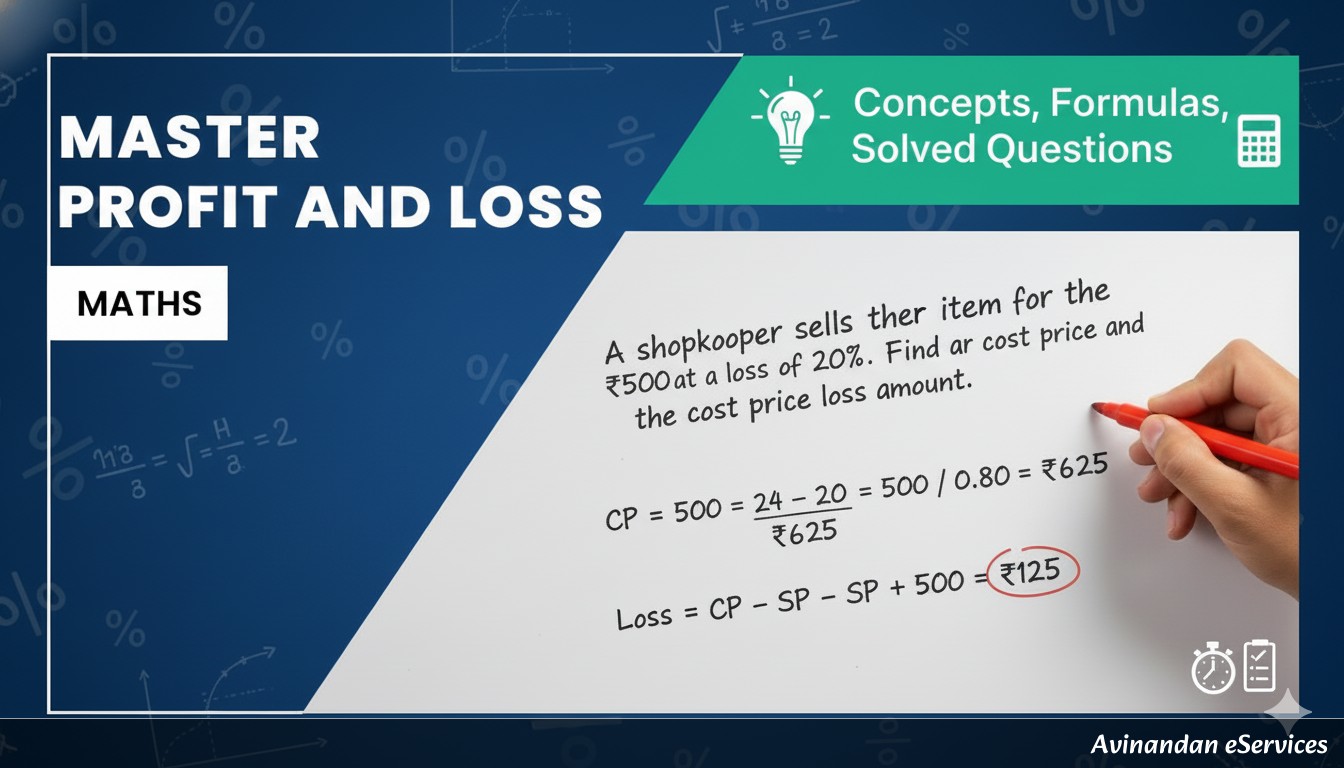
This comprehensive guide is meticulously designed to equip you with everything you need to master Profit and Loss. Whether you're a beginner struggling with the basics or an advanced student looking to refine your problem-solving skills, this post will cover every aspect. We'll start with the foundational concepts, delve into essential formulas, explore important tricks and shortcuts, walk you through a series of step-by-step solved examples, and finally, provide practice questions with detailed solutions to solidify your learning. By the end of this guide, you will be confident in tackling any Profit and Loss question thrown your way in the RRB exams.
Key Concepts and Terminology
Before we dive into calculations, it's vital to understand the basic terms that form the backbone of Profit and Loss problems.
Cost Price (CP)
- Definition: The price at which an article is purchased or manufactured. It is the initial cost incurred by the seller.
- Example: If a shopkeeper buys a book for ₹200, then ₹200 is the Cost Price (CP) of the book.
Selling Price (SP)
- Definition: The price at which an article is sold to the customer.
- Example: If the shopkeeper sells the same book for ₹250, then ₹250 is the Selling Price (SP) of the book.
Profit (Gain)
- Definition: The amount gained when the Selling Price (SP) of an article is greater than its Cost Price (CP).
- Formula: Profit = SP - CP (when SP > CP)
- Example: If CP = ₹200 and SP = ₹250, then Profit = ₹250 - ₹200 = ₹50.
Loss
- Definition: The amount lost when the Selling Price (SP) of an article is less than its Cost Price (CP).
- Formula: Loss = CP - SP (when CP > SP)
- Example: If CP = ₹200 and SP = ₹180, then Loss = ₹200 - ₹180 = ₹20.
Profit Percentage (Profit %)
- Definition: The profit expressed as a percentage of the Cost Price. This is a crucial metric for comparing profitability.
- Formula: Profit % = (Profit / CP) × 100%
- Example: If Profit = ₹50 and CP = ₹200, then Profit % = (50 / 200) × 100% = 25%.
Loss Percentage (Loss %)
- Definition: The loss expressed as a percentage of the Cost Price.
- Formula: Loss % = (Loss / CP) × 100%
- Example: If Loss = ₹20 and CP = ₹200, then Loss % = (20 / 200) × 100% = 10%.
Marked Price (MP) / List Price (LP)
- Definition: The price at which an article is listed for sale, usually displayed on the product itself. This is often higher than the CP to allow for discounts.
- Example: A shirt has a tag showing ₹500, which is its Marked Price.
Discount
- Definition: The reduction offered on the Marked Price (MP) of an article. Discounts are always calculated on the MP.
- Formula: Discount = MP - SP
- Example: If MP = ₹500 and the shirt is sold for ₹450, then Discount = ₹500 - ₹450 = ₹50.
Discount Percentage (Discount %)
- Definition: The discount expressed as a percentage of the Marked Price.
- Formula: Discount % = (Discount / MP) × 100%
- Example: If Discount = ₹50 and MP = ₹500, then Discount % = (50 / 500) × 100% = 10%.
Overhead Expenses
- Definition: Additional expenses incurred on an article after purchasing it, such as transportation charges, repair costs, labor charges, etc. These are added to the initial Cost Price to get the 'Actual Cost Price'.
- Actual CP = Initial CP + Overhead Expenses
Fundamental Formulas for Profit and Loss
Here’s a compilation of all essential formulas you'll need. Memorize these, but more importantly, understand their derivation and application.
- 1. Profit: Profit = SP - CP
- 2. Loss: Loss = CP - SP
- 3. Profit Percentage: Profit % = (Profit / CP) × 100
- 4. Loss Percentage: Loss % = (Loss / CP) × 100
- 5. Finding SP when CP and Profit % are given:
SP = CP × [(100 + Profit %) / 100] - 6. Finding SP when CP and Loss % are given:
SP = CP × [(100 - Loss %) / 100] - 7. Finding CP when SP and Profit % are given:
CP = SP × [100 / (100 + Profit %)] - 8. Finding CP when SP and Loss % are given:
CP = SP × [100 / (100 - Loss %)] - 9. Discount: Discount = MP - SP
- 10. Discount Percentage: Discount % = (Discount / MP) × 100
- 11. Finding SP when MP and Discount % are given:
SP = MP × [(100 - Discount %) / 100] - 12. Relationship between CP, MP, Profit/Loss and Discount:
CP / MP = (100 - Discount %) / (100 + Profit %)
(If there's a Loss, use '100 - Loss %' in the denominator)
Important Tricks and Shortcuts for RRB Exams
Time is of the essence in competitive exams. These tricks can help you solve complex problems faster.
1. Successive Discounts
If two successive discounts of D1% and D2% are given, the single equivalent discount (D_eq) is:
D_eq = [D1 + D2 - (D1 × D2 / 100)] %
For three successive discounts, first find the equivalent of two, then use that result with the third discount.
2. Dishonest Dealer (False Weights)
When a dishonest shopkeeper professes to sell goods at Cost Price but uses false weights, the profit percentage is calculated as:
Profit % = [(Error / True Weight - Error) × 100]%
Alternatively, Profit % = [(True Weight - False Weight) / False Weight × 100]%
3. Selling Two Articles at the Same Selling Price
If two articles are sold at the same Selling Price (SP), and one is sold at X% profit while the other is sold at X% loss, then there is always a loss in such a transaction.
Total Loss % = (X / 10)^2 %
4. If an article is sold at a Profit of X% and then again at a Loss of Y% on the new SP
This is effectively a change in percentage. You can use the formula:
Net Change % = X - Y - (X × Y / 100) %
Positive result means profit, negative means loss.
5. When an article is sold at a certain profit/loss, and if it were sold for 'x' more/less, the profit/loss would change.
This type of problem often involves setting up two equations or using direct percentage differences. For example, if selling an article at 10% profit gives ₹50 more than selling it at 5% profit, then the difference (10% - 5% = 5%) corresponds to ₹50. So, 5% of CP = ₹50, which means CP = ₹1000.
Solved Examples: Step-by-Step Solutions
Let's apply these concepts and formulas to various types of problems commonly asked in RRB exams.
Example 1: Basic Profit/Loss Calculation
Question: A shopkeeper buys a bicycle for ₹1500 and sells it for ₹1800. Find the profit percentage.
Solution:
Given: Cost Price (CP) = ₹1500
Selling Price (SP) = ₹1800
Since SP > CP, there is a Profit.
Profit = SP - CP = ₹1800 - ₹1500 = ₹300
Profit % = (Profit / CP) × 100
Profit % = (300 / 1500) × 100
Profit % = (1 / 5) × 100
Profit % = 20%
Answer: The profit percentage is 20%.
Example 2: Finding SP with Loss Percentage
Question: A mobile phone was purchased for ₹8000. If it is sold at a loss of 15%, find its selling price.
Solution:
Given: Cost Price (CP) = ₹8000
Loss % = 15%
Using the formula: SP = CP × [(100 - Loss %) / 100]
SP = 8000 × [(100 - 15) / 100]
SP = 8000 × (85 / 100)
SP = 80 × 85
SP = ₹6800
Answer: The selling price of the mobile phone is ₹6800.
Example 3: Finding CP with Profit Percentage
Question: By selling an article for ₹720, a man gains 20%. Find the cost price of the article.
Solution:
Given: Selling Price (SP) = ₹720
Profit % = 20%
Using the formula: CP = SP × [100 / (100 + Profit %)]
CP = 720 × [100 / (100 + 20)]
CP = 720 × (100 / 120)
CP = 720 × (10 / 12)
CP = 60 × 10
CP = ₹600
Answer: The cost price of the article is ₹600.
Example 4: Problem with Overhead Expenses
Question: Ram bought an old television for ₹4500 and spent ₹500 on its repairs. He then sold it for ₹6000. Find his profit or loss percentage.
Solution:
Initial CP = ₹4500
Overhead Expenses = ₹500
Actual Cost Price (CP) = Initial CP + Overhead Expenses
Actual CP = ₹4500 + ₹500 = ₹5000
Selling Price (SP) = ₹6000
Since SP > Actual CP, there is a Profit.
Profit = SP - Actual CP = ₹6000 - ₹5000 = ₹1000
Profit % = (Profit / Actual CP) × 100
Profit % = (1000 / 5000) × 100
Profit % = (1 / 5) × 100
Profit % = 20%
Answer: Ram made a profit of 20%.
Example 5: Discount Calculation
Question: A watch is marked at ₹1500. A shopkeeper offers a discount of 10% on it. What is the selling price of the watch?
Solution:
Given: Marked Price (MP) = ₹1500
Discount % = 10%
Using the formula: SP = MP × [(100 - Discount %) / 100]
SP = 1500 × [(100 - 10) / 100]
SP = 1500 × (90 / 100)
SP = 15 × 90
SP = ₹1350
Alternatively, calculate the discount amount first:
Discount Amount = 10% of ₹1500 = (10/100) × 1500 = ₹150
Selling Price (SP) = MP - Discount Amount = ₹1500 - ₹150 = ₹1350
Answer: The selling price of the watch is ₹1350.
Example 6: Dishonest Dealer
Question: A dishonest shopkeeper sells goods at cost price but uses a weight of 900 grams instead of 1 kg. Find his profit percentage.
Solution:
True Weight = 1 kg = 1000 grams
False Weight = 900 grams
Error = True Weight - False Weight = 1000 - 900 = 100 grams
Using the shortcut formula:
Profit % = [(Error / False Weight) × 100]%
Profit % = [(100 / 900) × 100]%
Profit % = (1/9) × 100 %
Profit % = 11 (1/9) % or approximately 11.11%
Answer: The dishonest shopkeeper's profit percentage is 11 (1/9) %.
Example 7: Two Articles Sold at Same SP (Profit and Loss)
Question: A man sells two articles for ₹4000 each. On one, he gains 20% and on the other, he loses 20%. Find his total profit or loss percentage in the entire transaction.
Solution:
Here, SP is the same (₹4000), and the profit percentage (20%) is equal to the loss percentage (20%).
Using the shortcut formula: Total Loss % = (X / 10)^2 %
Where X = 20
Total Loss % = (20 / 10)^2 %
Total Loss % = (2)^2 %
Total Loss % = 4%
To find the exact loss amount (optional, but good for understanding):
For the article sold at 20% gain, SP = ₹4000.
CP1 = 4000 × [100 / (100 + 20)] = 4000 × (100 / 120) = 4000 × (5 / 6) = ₹3333.33
For the article sold at 20% loss, SP = ₹4000.
CP2 = 4000 × [100 / (100 - 20)] = 4000 × (100 / 80) = 4000 × (5 / 4) = ₹5000
Total CP = CP1 + CP2 = ₹3333.33 + ₹5000 = ₹8333.33
Total SP = ₹4000 + ₹4000 = ₹8000
Total Loss = Total CP - Total SP = ₹8333.33 - ₹8000 = ₹333.33
Total Loss % = (Loss / Total CP) × 100 = (333.33 / 8333.33) × 100 = (1/25) × 100 = 4%
Answer: The man incurs a total loss of 4%.
Example 8: Marked Price and Discount leading to Profit
Question: A shopkeeper marks his goods 40% above the cost price. He allows a discount of 25%. What is his profit or loss percentage?
Solution:
Let the Cost Price (CP) be ₹100.
Marked Price (MP) = CP + 40% of CP = 100 + 40 = ₹140
Discount = 25% of MP = 25% of ₹140
Discount = (25/100) × 140 = (1/4) × 140 = ₹35
Selling Price (SP) = MP - Discount = ₹140 - ₹35 = ₹105
Since SP (₹105) > CP (₹100), there is a Profit.
Profit = SP - CP = ₹105 - ₹100 = ₹5
Profit % = (Profit / CP) × 100 = (5 / 100) × 100 = 5%
Alternatively, using the direct formula: CP / MP = (100 - Discount %) / (100 + Profit %)
Let Profit % = P
100 / 140 = (100 - 25) / (100 + P)
100 / 140 = 75 / (100 + P)
10 / 14 = 75 / (100 + P)
5 / 7 = 75 / (100 + P)
5(100 + P) = 7 × 75
500 + 5P = 525
5P = 25
P = 5%
Answer: The shopkeeper makes a profit of 5%.
Practice Questions for Self-Assessment
Test your understanding with these practice questions. Try to solve them before looking at the solutions.
- A trader bought an article for ₹400 and sold it for ₹480. Find his profit percentage.
- By selling an article for ₹900, a shopkeeper incurs a loss of 10%. What was the cost price of the article?
- A man purchases an item for ₹2500. He spends ₹200 on transportation and then sells it for ₹3000. Find his profit or loss percentage.
- A chair is marked at ₹800. If a discount of 15% is offered, what is the selling price of the chair?
- A retailer offers two successive discounts of 10% and 20% on a shirt whose marked price is ₹1200. What is the final selling price?
- A dishonest grocer professes to sell sugar at Cost Price, but he uses a weight of 950 grams for 1 kg. Find his gain percentage.
- If an article is sold at a profit of 15%, and if it were sold for ₹60 more, the profit would be 20%. Find the cost price of the article.
- A person sells two cars for ₹3,60,000 each. He gains 20% on one car and loses 20% on the other. What is his overall profit or loss in the entire transaction (in rupees)?
- A book was sold for ₹240 at a loss of 4%. For how much should it be sold to gain 10%?
- An article is marked 30% above its cost price. If it is sold at a discount of 20%, find the profit percentage.
Practice Questions Solutions
Here are the detailed solutions to the practice questions.
- Solution:
CP = ₹400, SP = ₹480.
Profit = 480 - 400 = ₹80.
Profit % = (80 / 400) × 100 = (1/5) × 100 = 20%. - Solution:
SP = ₹900, Loss % = 10%.
CP = SP × [100 / (100 - Loss %)] = 900 × [100 / (100 - 10)] = 900 × (100 / 90) = 10 × 100 = ₹1000. - Solution:
Initial CP = ₹2500, Overhead = ₹200.
Actual CP = 2500 + 200 = ₹2700.
SP = ₹3000.
Profit = 3000 - 2700 = ₹300.
Profit % = (300 / 2700) × 100 = (1/9) × 100 = 11 (1/9) % or approx. 11.11%. - Solution:
MP = ₹800, Discount % = 15%.
SP = MP × [(100 - Discount %) / 100] = 800 × [(100 - 15) / 100] = 800 × (85 / 100) = 8 × 85 = ₹680. - Solution:
MP = ₹1200. Successive discounts: D1 = 10%, D2 = 20%.
Equivalent discount % = [10 + 20 - (10 × 20 / 100)] = [30 - 2] = 28%.
SP = MP × [(100 - Equivalent Discount %) / 100] = 1200 × [(100 - 28) / 100] = 1200 × (72 / 100) = 12 × 72 = ₹864. - Solution:
True Weight = 1000g, False Weight = 950g.
Error = 1000 - 950 = 50g.
Profit % = (Error / False Weight) × 100 = (50 / 950) × 100 = (1/19) × 100 = 5 (5/19) % or approx. 5.26%. - Solution:
Difference in profit % = 20% - 15% = 5%.
This 5% difference in profit corresponds to ₹60.
So, 5% of CP = ₹60.
CP = (60 / 5) × 100 = 12 × 100 = ₹1200. - Solution:
For two articles sold at the same SP, with X% gain and X% loss, there is always a total loss of (X/10)^2 %.
Total Loss % = (20/10)^2 % = 2^2 % = 4%.
Total SP = ₹3,60,000 + ₹3,60,000 = ₹7,20,000.
This Total SP is the result of a 4% loss, meaning it is 96% of the Total CP.
Total CP = Total SP × [100 / (100 - Loss %)] = 7,20,000 × (100 / 96) = 7,50,000.
Total Loss (in rupees) = Total CP - Total SP = 7,50,000 - 7,20,000 = ₹30,000. - Solution:
SP1 = ₹240, Loss % = 4%.
CP = SP1 × [100 / (100 - 4)] = 240 × (100 / 96) = 2.5 × 100 = ₹250.
To gain 10%, new SP (SP2) = CP × [(100 + 10) / 100] = 250 × (110 / 100) = 2.5 × 110 = ₹275. - Solution:
Let CP = ₹100.
MP = CP + 30% of CP = 100 + 30 = ₹130.
Discount = 20% of MP = 20% of ₹130 = (20/100) × 130 = ₹26.
SP = MP - Discount = 130 - 26 = ₹104.
Profit = SP - CP = 104 - 100 = ₹4.
Profit % = (4 / 100) × 100 = 4%.
Common Mistakes to Avoid
- Calculating Profit/Loss % on SP: Always remember that Profit % and Loss % are calculated on the Cost Price (CP) unless specified otherwise. Discount % is calculated on Marked Price (MP).
- Ignoring Overhead Expenses: If there are additional expenses (transport, repair), remember to add them to the initial CP to get the actual CP.
- Confusing MP and CP: MP is the price before discount, while CP is the actual cost. Discounts are applied to MP, not CP.
- Misinterpreting 'Same SP, Same % Gain/Loss': When two articles are sold at the same SP, and one has X% profit while the other has X% loss, there is always a net loss, not break-even.
- Calculation Errors: Double-check your calculations, especially with percentages and fractions.
Exam Strategy and Tips
- Understand the Basics: Before memorizing formulas, understand what each term (CP, SP, MP, Profit, Loss, Discount) means.
- Practice Diverse Problems: Work through a variety of problem types, including those involving successive discounts, dishonest dealers, and mixed problems.
- Time Management: Practice solving problems under timed conditions. Use shortcuts where applicable, but ensure accuracy.
- Conceptual Clarity: Some problems might not directly fit a formula. A strong understanding of the underlying concepts will help you derive solutions.
- Previous Year Papers: Solve Profit and Loss questions from previous RRB exam papers to understand the pattern and difficulty level.
Conclusion
Mastering Profit and Loss is a significant step towards excelling in the Quantitative Aptitude section of RRB NTPC, Group D, and Technician exams. This topic tests your analytical skills and your ability to apply mathematical concepts to real-world scenarios. By diligently studying the concepts, committing the formulas to memory, practicing the solved examples, and rigorously attempting the practice questions provided in this guide, you will build the confidence and competence required to ace this section.
Remember, consistent practice is the key to success. Revisit this guide whenever you feel stuck, and keep challenging yourself with new problems. We wish you the very best in your preparation for a rewarding career with the Indian Railways!