Introduction to the Topic
Have you ever stopped to think about the water you drink, the electricity that powers your home, the textbook you're reading, or even the delicious snack you just ate? Everything you use to satisfy your needs and wants is what we call a 'resource'. It sounds simple, but this concept is one of the most fundamental ideas in Geography. It helps us understand our planet, how we live on it, and the crucial responsibility we have towards it.
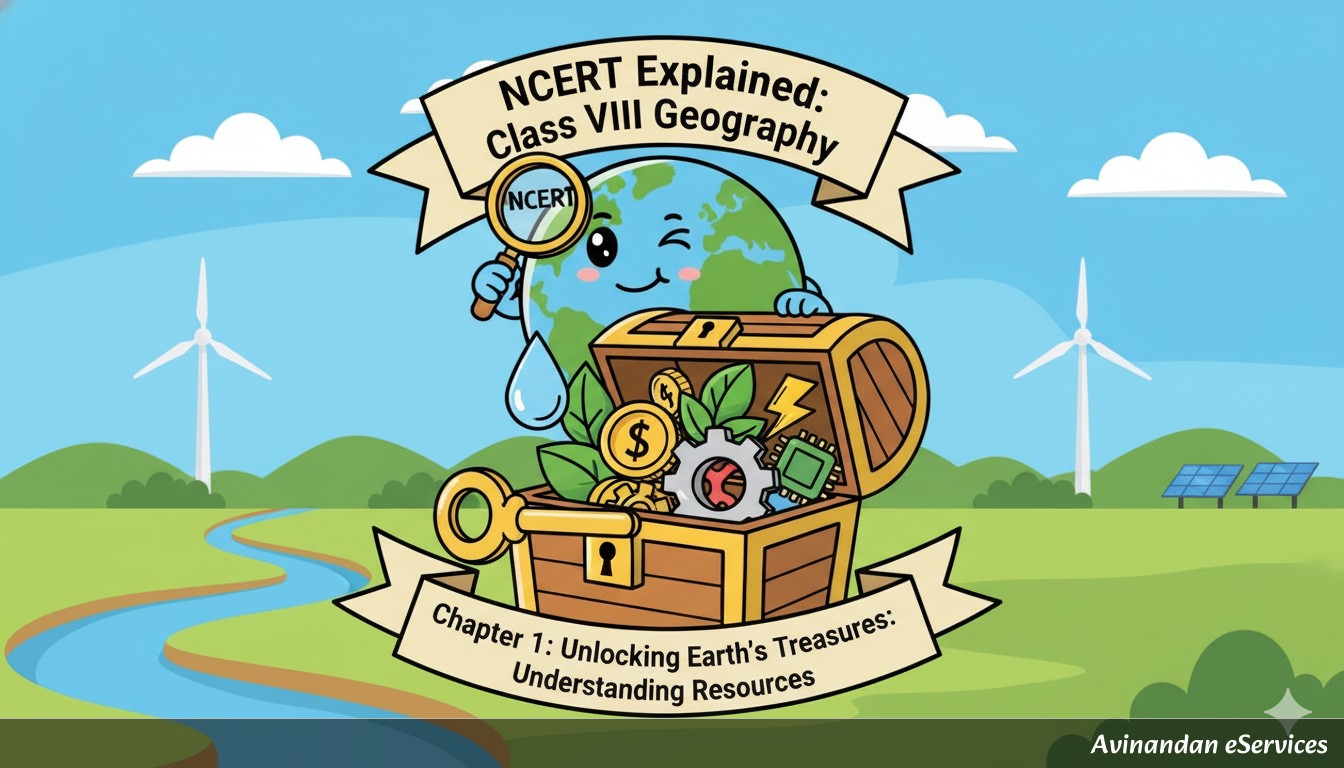
Welcome to our deep dive into Chapter 1, 'Resources,' from the NCERT Class VIII Geography textbook, "Resources and Development." This chapter is your first step into understanding the intricate relationship between humans and nature. It’s not just about listing things; it’s about understanding their value, their origins, and how we can use them wisely to ensure a bright future for everyone. Think of our planet as a giant treasure chest. This chapter gives you the map and the key to understand what these treasures are, where they come from, and how to protect them. So, let's embark on this exciting journey to explore the very things that make our lives possible and comfortable!
Key Concepts Explained
What is a Resource? The Power of Utility
At its core, the definition of a resource is wonderfully simple: Anything that can be used to satisfy a need is a resource.
The key word here is 'utility' or 'usability'. If you can use something, it has utility, and therefore, it is a resource. When you are thirsty, water has the utility to quench your thirst, making it a resource. When you need to study for an exam, your textbook has the utility to provide you with knowledge, making it a resource. The bus you take to school, the electricity that lights up your room, the vegetables in your meal—all these things have utility and are, therefore, resources.
But utility isn't the only factor. Resources also have 'value'. Value means worth. Some resources have economic value, meaning they can be bought or sold, like metals such as gold or iron. Other resources might not have a direct economic value but are invaluable to our well-being. For example, a beautiful landscape or a pristine forest might not be sold in a market, but it has immense aesthetic value and is crucial for our environment and mental peace. Both types of value are important. A clean environment is just as valuable as a deposit of coal, even if their 'worth' is measured differently.
It's also important to remember that two factors can turn any substance into a resource: Time and Technology.
- Time: Over time, our needs change, and what was once useless might become a resource. For centuries, waterfalls were just beautiful natural features. With the passage of time and the advent of technology, they became a crucial resource for generating hydroelectricity.
- Technology: This is the application of knowledge and skills to create tools and systems. Technology allows us to \textract resources or create new ones. For instance, the technology to harness wind energy turned fast-blowing winds into a powerful resource called wind power.
Perhaps the most important point is that humans themselves are the ultimate resource. It is our ideas, knowledge, inventions, and discoveries that transform things into resources. Without human intellect, coal would just be a black rock in the ground!
Types of Resources: A Grand Classification
To better understand the world around us, geographers classify resources into different categories. The most common classification divides them into three main types: Natural, Human-Made, and Human Resources.
1. Natural Resources: Gifts from Mother Nature
These are the resources that we draw directly from nature without much modification. The air we breathe, the water in our rivers and lakes, the minerals in the earth, the forests, and the sunlight are all examples of natural resources. They are the fundamental building blocks of our economy and our survival. These can be further classified based on several criteria:
A. Based on the Level of Development and Use:
- Actual Resources: These are resources whose quantity is known and which are currently being used. We have the technology to access them, and we are actively doing so. For example, the rich coal deposits in the Ruhr region of Germany, the petroleum in West Asia, or the fertile black soil of the Deccan plateau in India are all actual resources. We know where they are, how much is there, and how to use them.
- Potential Resources: These are resources that exist in a region but are not being used to their full potential yet. We might not have the advanced technology to utilize them fully at present, or it may not be economically viable to do so right now. Think of them as a treasure chest for which we don't have the right key yet, but we might in the future. For example, the uranium reserves found in Ladakh are a potential resource. In the future, with technological advancements, India could use this uranium to generate nuclear power. Similarly, high-speed winds were a potential resource 200 years ago, but today they are an actual resource as we have windmills to harness their energy.
B. Based on Origin:
- Biotic Resources: These are resources that are obtained from the biosphere and have life. 'Bio' means life. This category includes all living and organic materials. Examples are forests and their products, animals, birds, fish, and other marine organisms. Fossil fuels like coal and petroleum also fall into this category because they are formed from the decayed organic matter of dead plants and animals over millions of years.
- Abiotic Resources: These are resources that are composed of non-living things. 'A-bio' means non-life. This category includes resources like rocks, minerals (iron, copper, gold), soil, sunlight, wind, and water.
C. Based on Stock (Renewability):
- Renewable Resources: These are the resources that can be renewed or replenished relatively quickly. Some of these are unlimited and are not affected by human activities, such as solar and wind energy. These are sometimes called 'inexhaustible' resources. Other renewable resources, like water, soil, and forests, need to be managed carefully. Their stock can be affected by overuse. Water, for instance, is renewable through the water cycle, but water scarcity and pollution are major problems in many parts of the world today due to mismanagement and over-consumption.
- Non-Renewable Resources: These are resources that have a limited stock. Once the stocks are exhausted, it may take thousands or even millions of years for them to be renewed or replenished. This timeframe is far beyond a human lifespan, which is why we consider them non-renewable. Examples include coal, petroleum, and natural gas. Since we are using them much faster than they are being formed, it is crucial to use them judiciously and look for alternatives.
D. Based on Distribution:
- Ubiquitous Resources: These are resources that are found everywhere. The name comes from 'ubiquity,' meaning 'present everywhere.' A perfect example is the air we breathe.
- Localised Resources: These are resources that are found only in certain places. For example, minerals like copper, iron ore, or gold are not found everywhere on Earth; they are concentrated in specific areas, making them localised resources.
The distribution of these natural resources is highly uneven across the globe, depending on various physical factors like terrain, climate, and altitude. This uneven distribution is one of the primary reasons for the economic and developmental differences between various regions of the world.
2. Human-Made Resources: The Touch of Ingenuity
Sometimes, natural substances become resources only after their original form has been changed by humans. When we use our technology and skills to transform a natural resource into something more useful, we create a human-made resource.
Think about it: iron ore, in its raw form, wasn't very useful to early humans. But through the process of smelting, people learned to \textract iron from the ore. This iron was then used to build tools, machinery, buildings, bridges, roads, vehicles, and so much more. All these things—bridges, roads, cars, and buildings—are human-made resources. They were created by humans using natural resources. Technology itself is a prime example of a human-made resource, developed using human intellect to make our lives better.
3. Human Resources: The Ultimate Asset
This brings us to the most important resource of all: people. Humans, with their skills, knowledge, and abilities, are the ultimate resource. It is human intelligence that discovers, \textracts, and adds value to all other resources. That's why nations focus so much on developing their 'human resources'.
How do we develop human resources? Through education, healthcare, and skill training. A healthy, educated, and motivated population is a nation's greatest asset. They can apply their knowledge to create more resources, solve problems, and drive innovation. Scientists who discover new medicines, engineers who design efficient machines, teachers who impart knowledge, and farmers who grow food are all vital human resources contributing to society.
Conserving Our Precious Resources: A Shared Responsibility
Now that we understand what resources are and their types, the next logical question is: how should we use them? Many non-renewable resources are finite, and even renewable ones can be depleted if we are not careful. Using resources carefully and giving them time to get renewed is called resource conservation.
The need for conservation arises from the fact that our consumption is increasing rapidly due to population growth and technological development. This leads to over-exploitation, which can deplete our resource base and cause severe environmental problems like pollution and climate change.
A key concept linked to this is Sustainable Development. This is a powerful and essential idea for our time. Sustainable development means carefully utilizing resources so that besides meeting the requirements of the present, we also take care of the needs of future generations. It’s about finding a balance. It's about developing our world without destroying the very planet that sustains us.
The principles of sustainable development are simple yet profound:
- Respect and care for all forms of life.
- Improve the quality of human life.
- Conserve the Earth’s vitality and diversity.
- Minimise the depletion of natural resources.
- Change personal attitudes and practices toward the environment.
- Enable communities to care for their own environment.
As young citizens, you have a massive role to play. The future of our planet is in your hands. You can contribute by following the three R's: Reduce, Reuse, and Recycle.
- Reduce: Consume less. Switch off lights and fans when not in use, don't waste water, and avoid unnecessary purchases.
- Reuse: Use things again instead of throwing them away. Use old jars for storage, turn old clothes into cleaning rags, and carry a reusable water bottle.
- Recycle: Convert waste materials into new products. Segregate your waste so that materials like paper, plastic, glass, and metal can be recycled.
Every small action, when multiplied by millions of people, can make a huge difference. By being mindful consumers and advocates for the environment, we can ensure that our planet's treasures are available for generations to come.
Summary & Key Takeaways
Let's quickly recap the essential points from this chapter to lock them in your memory. These are the core ideas that form the foundation of understanding resources.
- What is a Resource?: Anything that has utility and value to satisfy our needs is a resource. Time and technology are key factors in turning a substance into a resource.
- Three Main Types of Resources:
- Natural Resources: Gifts of nature like air, water, soil, and minerals. They can be classified further based on development (actual/potential), origin (biotic/abiotic), stock (renewable/non-renewable), and distribution (ubiquitous/localised).
- Human-Made Resources: Created by humans using natural resources, such as buildings, roads, and machinery.
- Human Resources: People themselves, with their knowledge, skills, and health. They are the most important resource.
- Resource Conservation: Using resources carefully and judiciously to prevent their depletion. This is essential for our survival and well-being.
- Sustainable Development: Balancing the need to use resources for present development with the need to conserve them for future generations. It's about development that doesn't harm the environment.
- Our Role: Every individual has a duty to contribute to conservation by following principles like Reduce, Reuse, and Recycle. Our collective actions will determine the health of our planet.
Understanding resources goes beyond just geography; it's about being a responsible inhabitant of Planet Earth. By appreciating the value of what nature provides and what humanity creates, we can build a more sustainable and equitable world for everyone.